
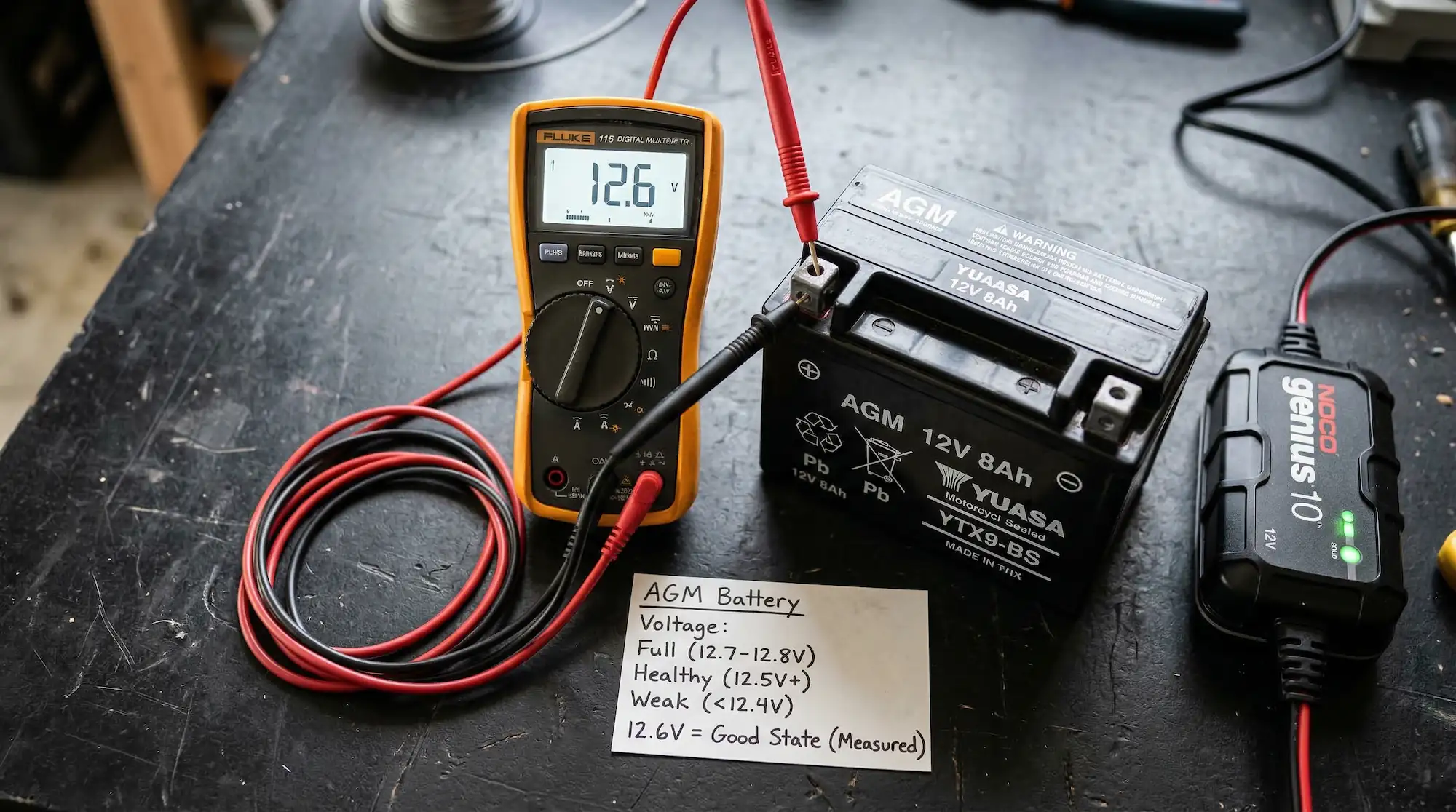
A “12-volt” motorcycle battery does not actually read 12.0V when it is healthy — if yours does, it is nearly dead. The name “12V motorcycle battery” refers to the nominal system voltage, not the actual reading you should see on a multimeter. Understanding what voltage your battery should show at rest, during cranking, and while the engine is running tells you everything about your battery’s health and your bike’s charging system. The difference between 12.6V and 12.0V is the difference between a bike that fires right up and one that leaves you stranded.
This guide covers every scenario for every battery type — lead-acid, AGM, gel, and lithium (LiFePO4) — so you can diagnose problems with a $30 multimeter in under a minute.
Table of Contents
- Why Motorcycle Battery Voltage Matters
- Motorcycle Battery Voltage Chart — All Battery Types
- How to Test Your Motorcycle Battery — 4 Scenarios
- Quick Diagnostic Guide
- Common Causes of Low Battery Voltage
- Battery Maintenance Tips
- Frequently Asked Questions
Why Motorcycle Battery Voltage Matters
Voltage is the single most useful diagnostic number for your motorcycle’s electrical health. A quick reading tells you the battery’s state of charge, whether the charging system is working correctly, and whether something is draining power when the bike is parked. Every 12V motorcycle battery — whether it is a budget flooded lead-acid or a premium lithium unit — can be evaluated with the same basic voltage tests.
- Voltage indicates state of charge: A fully charged 12V battery reads well above 12.0V. A reading of exactly 12.0V means the battery is roughly 25% charged — barely enough to crank a cold engine.
- Too-low voltage causes hard starting, dim lights, stalling at idle, and fuel injection faults on modern EFI bikes.
- Too-high voltage while running (above 15.0V) indicates a failed voltage regulator that can destroy electronics and boil the battery’s electrolyte.
- Testing takes 30 seconds with a basic digital multimeter — it is the cheapest and fastest diagnostic available to any rider.
Motorcycle Battery Voltage Chart — All Battery Types
This is the complete motorcycle battery voltage chart covering every common battery chemistry. Bookmark this table — it is the reference to return to every time you test.
| State of Charge | Lead-Acid (Flooded) | AGM (Sealed) | Gel | Lithium (LiFePO4) |
|---|---|---|---|---|
| 100% (fully charged) | 12.6V | 12.8–13.0V | 12.8–13.0V | 13.2–13.6V |
| 75% | 12.4V | 12.6V | 12.6V | ~13.0V |
| 50% | 12.2V | 12.3V | 12.3V | ~13.0V* |
| 25% | 12.0V | 12.0V | 12.0V | ~12.8V |
| Discharged / dead | 11.8V or below | 11.8V or below | 11.8V or below | 12.0V or below** |
*Note on lithium voltage curve: LiFePO4 batteries have an extremely flat discharge curve — they hold approximately 13.0V through most of their usable capacity range, then drop rapidly near complete depletion. This makes them harder to read accurately with a voltmeter alone compared to lead-acid batteries, where voltage drops more linearly and predictably with state of charge.
**Important note on lithium batteries reading 0V–5V: If your LiFePO4 battery reads 0V, 2V, or any very low voltage, it is most likely not dead — the internal Battery Management System (BMS) has entered Sleep Mode or Under-Voltage Lockout (UVLO) to protect the cells from permanent damage. Most motorcycle LiFePO4 batteries have a BMS that automatically disconnects output when pack voltage drops below approximately 10–11V (2.5V per cell). The terminals will then read near zero, but the cells inside may still be perfectly healthy.
To recover: connect a LiFePO4-compatible charger with a “lithium activation” or “BMS wake-up” function. If your charger does not detect the battery, some riders briefly connect a charged 12V lead-acid battery in parallel for 30–60 seconds only to bring voltage above the BMS threshold, then immediately switch to a proper lithium charger. Do not discard a lithium battery showing 0V without attempting the wake-up procedure first.
Key takeaways from the chart:
- A healthy lead-acid or AGM battery at rest reads 12.6–13.0V.
- A healthy lithium battery at rest reads 13.2–13.6V (after settling 30+ minutes — fresh off a charger it may briefly show ~14.4V).
- Below 12.4V on lead-acid/AGM = needs charging soon.
- Below 12.0V on any type = effectively dead, likely will not crank the engine.
- A battery reading exactly 12.0V is not “fine” — it is at roughly 25% charge and struggling.
⚠️ Important: These are resting voltages — measured with the engine off and all electrical loads disconnected. Wait at least 30 minutes after riding or charging before testing to allow surface charge to dissipate and get an accurate reading.
How to Test Your Motorcycle Battery — 4 Scenarios
Test 1 — Resting Voltage (Engine Off)
What it tells you: The battery’s current state of charge.
- Turn off the engine and all accessories. Wait 30+ minutes after riding or charging.
- Set your multimeter to DC Volts (20V scale or auto-range).
- Touch the red probe to the positive (+) terminal and the black probe to the negative (−) terminal.
- Read the voltage and compare to the chart above.
Interpreting the result:
- 12.6V+ (lead-acid/AGM) or 13.2V+ (lithium): Healthy and fully charged.
- 12.2–12.5V: Partially discharged. Recharge before your next ride.
- Below 12.0V: Deeply discharged. Charge immediately and retest after the charger completes a full cycle.
- Below 11.8V: Likely permanently damaged. Internal sulfation in lead-acid batteries has hardened enough to permanently reduce capacity. If a battery will not hold above 12.4V after a full overnight charge, replace it regardless of age.
Test 2 — Cranking Voltage (While Starting)
What it tells you: The battery’s ability to deliver high current under load — the real test of whether it can reliably start the engine.
- Connect the multimeter to the battery terminals with the engine off.
- Press the starter button and watch the voltage drop during cranking.
Expected floors during cranking:
- Lead-acid/AGM: A healthy battery should ideally not drop below 10.0–10.5V during cranking at normal ambient temperatures. The 9.6V figure you may see cited comes from the SAE J537 laboratory load test standard, measured at 0°F / −18°C under controlled discharge conditions. In real-world cranking at room temperature, a drop to 9.6V is already a sign of a weak battery — treat anything below 10.5V as a warning.
- Lithium (LiFePO4): Due to their extremely low internal resistance (typically 5–15 mΩ versus 30–50 mΩ for a comparable AGM), a healthy LiFePO4 battery should stay above 12.0V during cranking. A drop to 10.0–10.5V on a lithium battery indicates a severely degraded or unbalanced pack, or the BMS entering its protective cutoff. This is not a normal healthy threshold for lithium — it is already a failure indicator.
⚠️ Safe method for no-start cranking test: To observe voltage drop during cranking without the engine firing, the safest universal method is to remove the spark plugs entirely before cranking. This prevents both spark and ignition regardless of bike type, allows the starter to crank freely, and causes no risk to electronics. On bikes where plug access is difficult, unplugging the ignition coil connectors achieves the same result. Avoid manipulating the main relay or ignition fuse on modern motorcycles with IMU, cornering ABS, or complex ECU management systems — cutting the main relay on a live circuit can generate voltage spikes that damage sensitive electronic modules.
Test 3 — Charging Voltage (Engine Running)
What it tells you: Whether the stator and regulator/rectifier are functioning correctly. The motorcycle battery voltage when running tells you about the charging system, not the battery itself.
- Start the bike and let it idle for one minute.
- Measure voltage at the battery terminals.
- Rev to 3,000–5,000 RPM and hold steady.
Expected reading: 13.5V–14.8V for both lead-acid and lithium systems.
Many modern motorcycles designed for AGM batteries — including current BMW, Triumph, and Japanese sportbike models — run charging systems intentionally regulated to 14.6V–14.8V. This higher voltage is required to fully charge AGM batteries and overcome acid stratification. A reading of 14.7V on a modern AGM-equipped bike is normal and healthy. Harley-Davidson Milwaukee-Eight models run a factory specification of 13.9–14.9V at 2,000 RPM — readings near the top of this range are within spec for those bikes.
Interpreting the result:
- Below 13.0V at RPM: Charging system is not working correctly. Likely a failing stator or regulator/rectifier. Our complete guide on what a motorcycle stator does covers how to diagnose stator and reg/rec failure step by step.
- 13.5–14.8V: Charging system is healthy. This is exactly what motorcycle battery voltage when running should look like.
- Above 15.0V: Overcharging from a failed regulator/rectifier. Stop riding and fix immediately — sustained overcharging destroys the battery and can damage the ECU, instrument cluster, and LED lighting systems.
Test 4 — Parasitic Drain Test (Advanced)
What it tells you: Whether something is drawing power from the battery when the bike is parked and switched off.
- Turn the bike off completely. Wait a few minutes for all systems to fully shut down.
- Disconnect the negative battery cable.
- Set your multimeter to DC Amps and plug the red probe into the 10A (high-amperage) port — not the mA port. If there is an unexpected high current draw or you accidentally bump the ignition, the mA port will instantly blow the multimeter’s internal fuse (typically rated 200–400mA). Always start on the highest amperage scale.
- Connect the multimeter in series between the disconnected negative cable and the negative battery terminal so that current flows through the meter.
- Read the initial result on the 10A scale. If it reads below 1A (it should on any parked motorcycle), switch the red probe to the mA port and change the dial to the mA range for a precise reading.
Interpreting the result:
- Under 5 mA: Normal. Some bikes with clocks, alarms, or ECU memory may read up to 10 mA.
- Over 30 mA: Something is actively draining the battery. Pull fuses one at a time to isolate the offending circuit.
⚠️ Critical safety warning: Never start the engine, turn the ignition to ON, or activate headlights while the multimeter is connected in series for current measurement. The starter motor alone draws 50–200+ amps — this will instantly and permanently destroy the multimeter. Keep the key away from the ignition for the entire duration of this test.
What Your Voltage Reading Means — Quick Diagnostic Guide
| Your Reading | What It Means | What to Do |
|---|---|---|
| Resting: 12.6V+ / 13.2V+ (lithium) | Battery is healthy and fully charged | No action needed |
| Resting: 12.2–12.5V | Battery is partially discharged | Charge with a smart charger, retest after 12 hours |
| Resting: below 12.0V | Battery is deeply discharged | Charge slowly, retest. If it will not hold 12.6V+, replace it |
| Lithium reading 0V–5V | BMS has entered sleep/protect mode | Use a LiFePO4 charger with BMS wake-up function — battery is likely NOT dead |
| Cranking: drops below 10.5V (lead-acid) or 12.0V (lithium) | Battery cannot deliver adequate cranking current | Battery is weak or failing — replace |
| Running: below 13.0V at RPM | Charging system is not working | Test stator and reg/rec — see our motorcycle stator guide |
| Running: 13.5–14.8V | Charging system is healthy | No action needed |
| Running: above 15.0V | Overcharging — failed regulator | Stop riding immediately. Replace regulator/rectifier |
| Battery drains overnight | Parasitic draw or failing battery | Perform parasitic drain test. If under 5 mA, the battery itself is failing |
Common Causes of Low Battery Voltage
Old battery: Lead-acid and AGM batteries typically last 3–5 years. Lithium LiFePO4 batteries last 5–8 years. Internal sulfation in lead-acid or gradual cell degradation in lithium units reduces capacity over time — a battery that tested fine last season may not hold charge this year.
Parasitic drain: Aftermarket alarms, GPS trackers, USB chargers, dashcams, heated gear controllers, or faulty wiring can slowly discharge the battery when the bike is parked. A 30 mA draw will kill a typical motorcycle battery in a few weeks of sitting. A 50 mA draw — common with poorly wired accessories — can drain it in under two weeks. This is one of the most commonly overlooked causes of repeated battery failures that are actually wiring problems.
Bad charging system: A failing stator or regulator/rectifier means the battery is not being replenished while you ride. It drains across multiple rides until the bike will no longer start. This is a very common misdiagnosis — riders replace the battery, it works for a week, then dies again because the charging system is the actual fault. If your battery keeps dying after replacement, always test the running voltage at 3,000–5,000 RPM before purchasing another battery. Our motorcycle stator guide covers the complete diagnostic process for stator and regulator/rectifier failure.
Short rides: The charging system needs sustained RPM to fully replenish what the starter drew. Many short 5–10 minute trips — especially in cold weather — gradually deplete the battery because each cold start draws more current than a short ride at low RPM puts back.
Cold weather: Chemical reactions slow significantly at low temperatures. A marginal battery in summer will fail in winter. Lead-acid batteries lose roughly 20% of their cranking capacity at 32°F / 0°C, and more below that. Cold engines simultaneously require more cranking power due to thicker oil — meaning you need more battery capacity at exactly the moment the battery can deliver less. Lithium LiFePO4 batteries are especially sensitive: most motorcycle lithium batteries must not be charged below 32°F / 0°C without a built-in heating element, and their available output drops noticeably in freezing conditions.
💡 Cold-weather tip for lithium batteries: Before cranking in cold conditions (below ~45°F / 7°C), turn on your headlight and leave it on for 30–60 seconds. The current draw generates internal resistance heating inside the lithium cells, physically warming them and increasing available cranking power. If the first crank attempt is sluggish, pause 30 seconds between attempts — each attempt warms the cells further, and the second or third attempt will perform measurably better. This warm-up procedure is recommended by lithium battery manufacturers and is standard practice in EV thermal management systems.
Corroded terminals: Buildup on battery posts creates electrical resistance, reducing effective voltage reaching the bike’s electrical system. The battery may be perfectly healthy, but the connection is not. Note that while flooded lead-acid batteries generate corrosion from outgassing sulfuric acid fumes, sealed AGM and lithium batteries do not produce acid gas — but galvanic corrosion between dissimilar metals (lead terminals, steel bolts, copper connectors) still occurs over time and creates identical resistance problems. Inspect all terminals regardless of battery chemistry.
Battery Maintenance Tips to Keep Voltage Healthy
- Use a smart charger/tender during storage: Battery Tender, CTEK, and NOCO smart chargers maintain optimal charge without overcharging. For lithium batteries, use a charger with a dedicated LiFePO4 mode — standard lead-acid chargers can overcharge lithium cells.
- Check terminals monthly: Clean corrosion with a baking soda and water solution, dry completely, then apply dielectric grease or a thin coat of petroleum jelly to prevent future buildup.
- For flooded lead-acid only: Check electrolyte level and top up with distilled water if the plates are exposed. AGM, gel, and lithium batteries are sealed and maintenance-free internally.
- Ride for at least 20–30 minutes per session: This gives the charging system enough sustained RPM to replenish what the starter drew and fully top off the battery.
- Replace proactively at 3–5 years (lead-acid/AGM), or when resting voltage consistently reads below 12.4V after a full charge cycle regardless of age.
- Consider upgrading to lithium (LiFePO4) at replacement: Real-world motorcycle lithium battery kits (including BMS housing, terminals, and vibration-resistant casing) typically weigh 50–65% less than a comparable lead-acid unit. They last longer, hold a higher resting voltage, and require no maintenance — but require a lithium-compatible charger and cost more upfront ($80–$150 vs $30–$70 for lead-acid/AGM).
A reading that keeps dropping is usually the charging system rather than the battery, which is explained in what a motorcycle stator is. Batteries also die over winter more than anywhere else, so winterizing the machine is the cheapest fix available, and the yearly cost of all of it is in how much a motorcycle costs to own.
Frequently Asked Questions
What voltage should a motorcycle battery read when fully charged?
A fully charged lead-acid or AGM battery should read 12.6–13.0V at rest. A fully charged lithium (LiFePO4) battery should read 13.2–13.6V after settling for at least 30 minutes. Fresh off the charger, a lithium battery may briefly show approximately 14.4V before the surface charge dissipates and it settles to its true resting voltage.
What voltage is too low for a motorcycle battery?
Below 12.4V on lead-acid or AGM indicates a partial discharge that needs attention before your next ride. Below 12.0V means the battery is effectively depleted and may not crank the engine reliably. Below 11.8V, the battery has likely suffered permanent internal damage from sulfation and needs replacement. For lithium batteries reading 0V–5V: this almost always means the BMS has entered sleep mode to protect the cells — the battery is likely not dead. Attempt a BMS wake-up with a LiFePO4-compatible charger before discarding it.
What should motorcycle battery voltage be when running?
With the engine running at 3,000–5,000 RPM, voltage at the battery terminals should read 13.5–14.8V. This confirms the stator and regulator/rectifier are functioning correctly. Below 13.0V indicates a charging system problem that needs diagnosis. Above 15.0V means the regulator is failing and overcharging — stop riding and fix it immediately to prevent battery and electronics damage.
Can I test my motorcycle battery with a car battery tester?
A standard digital multimeter works for any 12V battery regardless of vehicle type. Some dedicated car battery testers with load-test functions also work on motorcycle batteries, but confirm the tester supports the CCA range of motorcycle batteries (typically 50–300 CCA, significantly lower than the 400–800 CCA range of car batteries). A tester calibrated only for car batteries may give inaccurate load-test results on smaller motorcycle units.
How often should I check my motorcycle battery voltage?
Monthly during the riding season. Every 2–4 weeks during winter storage, even with a smart tender connected — verify the tender is actively maintaining charge, not just showing a green light with a faulty connection. Immediately any time you notice slow cranking, dim headlights, or any electrical oddities during riding.
A healthy motorcycle battery reads 12.6V or above at rest — not 12.0V. Testing takes 30 seconds and tells you whether the problem is the battery, the charging system, or a parasitic drain. Bookmark the voltage chart above, check your battery monthly, and keep it on a smart charger during storage. A battery at 12.4V today will be at 12.0V next week and dead the week after if you do not act. If you are running lithium and it reads 0V, do not panic and do not throw it away — try the BMS wake-up procedure first. When in doubt, test. It is the cheapest diagnostic you will ever do.