
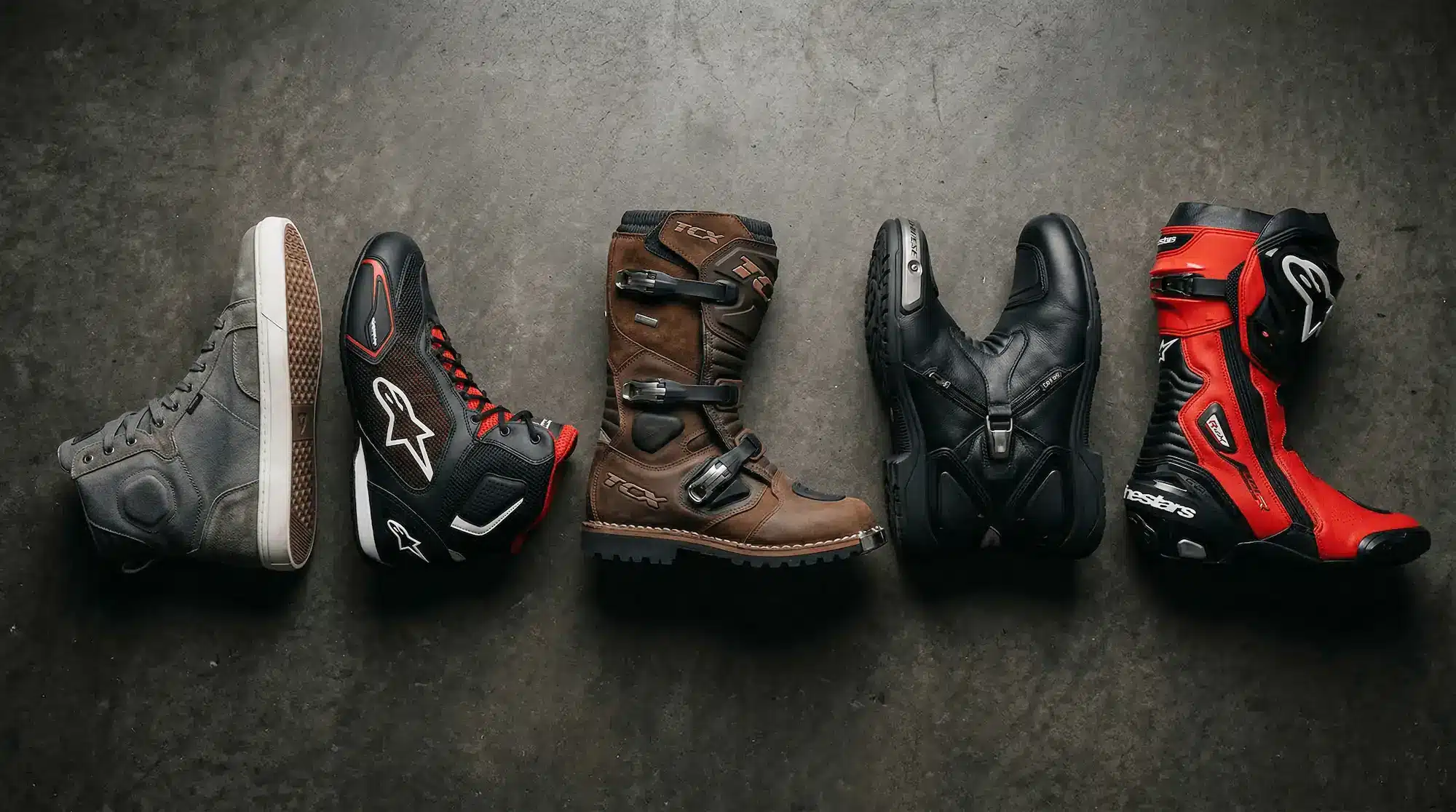
Here is a familiar scenario: you are gearing up for a quick ride to the office or a local coffee shop. You look at your heavy, stiff riding footwear, then glance at your comfortable daily sneakers. You convince yourself that because you are just staying on local streets and taking it easy, the sneakers will be fine. It is one of the most dangerous gambles you can make on two wheels.
When you are searching for the best motorcycle riding boots, you are not looking for a fashion statement. You are looking for a highly engineered piece of safety equipment designed to prevent your foot from being crushed under a 500-pound machine. Regular shoes offer zero structural integrity in a slide or crush scenario. Asphalt friction will burn through casual canvas or thin fashion leather in fractions of a second.
This guide is researched & compared based on verified manufacturer specifications, official CE safety certifications, and analysis of consistent patterns across hundreds of real rider reviews. We have broken down the market into five distinct riding styles, selecting the top option for commuters, canyon carvers, touring veterans, and track day enthusiasts. Before investing in gear, if you are still working out your full new-rider budget, our complete motorcycle license cost breakdown covers every fee from permit to endorsement.
Table of Contents
- Why Regular Shoes Are a Risk
- CE Certification for Motorcycle Boots Explained
- Best Motorcycle Riding Boots by Riding Style (2026)
- How Motorcycle Boots Should Fit
- Motorcycle Shoes vs. Boots
- Frequently Asked Questions
Why Regular Shoes Are a Risk — And What Makes a Real Riding Boot
A dedicated motorcycle boot is engineered specifically to combat the three primary forces your feet face when things go wrong.
- Crush-Resistant Soles: If you drop your bike at a stoplight, or trap your foot under the exhaust in a low-side, a normal sneaker sole will fold completely in half. A certified riding boot features a reinforced shank — made of tempered steel, fiberglass, or high-density TPU — running through the sole. This shank maintains the boot’s rigid structural shape under the crushing weight of the motorcycle, protecting the fragile metatarsal bones in your foot.
- Articulated Ankle Protection: Lower extremity injuries — feet, ankles, and legs — are among the most frequently reported injuries in non-fatal motorcycle crashes, according to NHTSA data. A standard shoe leaves your malleolus (the bony protrusions on the sides of your ankle) completely exposed to pavement impacts. Dedicated motorcycle boots with ankle protection feature localized CE Level 2 armor discs built into the lining to absorb and dissipate blunt force trauma before it reaches the bone.
- Extreme Abrasion Resistance: Sliding across asphalt at 45 mph generates catastrophic heat and friction. The thin leather on a fashion boot or the synthetic mesh on a running shoe will disintegrate almost instantly. Motorcycle boots utilize thick full-grain cowhide, advanced microfiber, or Kevlar-reinforced Cordura to provide crucial seconds of slide time without failing.
CE Certification for Motorcycle Boots — What the Numbers Mean
Never trust a manufacturer’s vague claims about “heavy-duty protection.” Look for the European safety standard label: EN 13634:2017. When you find CE certified motorcycle boots, you will see a pictogram of a motorcyclist followed by four distinct numbers. Each number will be either a “1” (basic pass) or a “2” (superior protection).
Here is what the four digits evaluate:
- Abrasion Resistance: How long the boot’s material can slide across abrasive pavement before wearing through.
- Impact Cut Resistance: The boot’s ability to deflect sharp objects like jagged metal or a shattered footpeg.
- Transverse Rigidity: How much force it takes to crush the sole sideways. Level 2 here is critical for preventing your foot from being flattened under the bike’s weight.
- Ankle Impact Protection: The shock-absorbing capability of the armor over your ankle bones.
For example, a tag reading 2221 means Level 2 in abrasion, cut, and rigidity, but Level 1 in ankle impact protection. Every pick in this guide carries at least Level 2 in its primary protective zones. Do not buy a boot without this certification — if it lacks the EN 13634 tag, it is a costume, not gear.
🛈 Note on CE terminology: You may see boots described using two different CE frameworks. “Level 1/2” refers to performance scores under EN 13634 (the boot-specific technical standard). “Category I/II/III” refers to the EU PPE Regulation 2016/425, which classifies products by risk level (Category II covers most motorcycle gear). These are separate systems — a boot can be “Category II PPE” and simultaneously achieve “EN 13634 Level 2” in all four zones. They are not interchangeable labels.
Best Motorcycle Riding Boots by Riding Style (2026)
The best boot is entirely dictated by your riding environment. A daily commuter who walks through a corporate office needs a radically different boot than a rider tackling a three-day backcountry adventure. These picks were selected based on verified CE testing data, official manufacturer spec sheets, and consistent patterns in RevZilla and Amazon rider reviews.
Best Budget / Casual Boot — Alpinestars Faster-3 Rideknit (~$130–$160)
For the urban commuter, the biggest hurdle to wearing proper gear is the inconvenience of clomping around in stiff, heavy boots all day. The Alpinestars Faster-3 Rideknit solves this. Despite looking exactly like a premium athletic sneaker, it carries CE EN 13634 Level 2 certification. The exterior uses Rideknit technology — a seamlessly knitted mesh that flows large amounts of air while remaining highly abrasion-resistant. It features dual-density TPU ankle discs hidden beneath the upper, an asymmetric toe design to resist premature wear from the shift lever, and an internal heel counter for structural stability.
There is virtually zero break-in period. The honest drawback: the knitted mesh offers zero water resistance. In a downpour, your feet will be soaked within minutes. This is strictly a warm-weather, dry-climate boot.
Check current price on RevZilla
Best Hot-Weather Street Boot — TCX Street Ace Air (~$160–$200)
Riding in summer heat can turn a thick leather boot into an unbearable swamp. The TCX Street Ace Air is engineered specifically to combat intense heat while maintaining a casual streetwear aesthetic. TCX focuses exclusively on footwear, and their expertise is visible in this boot.
The Street Ace Air uses perforated leather with heavy-duty breathable mesh panels and localized hot-melt coating for structural reinforcement. It carries CE EN 13634 Level 2 certification, featuring polyurethane malleolus reinforcements, a stiffened toe box, and a reinforced heel. The Groundtrax rubber outsole grips oily intersection pavement reliably.
Like the Faster-3, its greatest strength — massive airflow — is also its weakness. It is not waterproof, making it unsuitable for riders who frequently ride in rain or cold. For a summer canyon run or hot city commute, it strikes an excellent balance between cooling and legitimate street protection.
Check current price on RevZilla
Best ADV / Touring Boot — Alpinestars Corozal Adventure Drystar (~$280–$320)
When the pavement ends and the fire roads begin, your footwear needs a significant upgrade in torsional rigidity. The Alpinestars Corozal Adventure Drystar is the ideal hybrid for riders who split their time between highway touring and off-road trails.
The standout feature is the biomechanical lateral “blade” system: a flexible polymer brace linking the lower foot to the upper calf, allowing front-to-back movement for walking and shifting while completely locking out the side-to-side twisting forces that cause severe ankle sprains off-road. A heavy-duty shin plate deflects rocks and branches, and the Vibram outsole provides exceptional grip when pushing the bike through mud.
These are genuine waterproof motorcycle boots using Alpinestars’ Drystar membrane, which performs comparably to high-end Gore-Tex in heavy rain based on extensive rider feedback. The trade-off is bulk and cost — this is a serious mid-calf boot that is overkill for a 10-minute city commute.
Check current price on RevZilla
Best Premium Street / Touring Boot — Sidi Aria Gore-Tex (~$340–$400)
If you log high mileage on a sport-tourer or standard bike and demand premium weather-proof Italian craftsmanship, the Sidi Aria Gore-Tex is the pinnacle of the category. Sidi has been manufacturing technical footwear for over 60 years, and the Aria reflects that experience.
Constructed from a blend of abrasion-resistant Cordura, Technomicro microfiber, and Teflon-treated mesh, this boot requires minimal break-in time. The genuine Gore-Tex membrane keeps feet dry in a torrential highway downpour while allowing sweat vapor to escape more efficiently than cheaper proprietary membranes. Aesthetically, under riding jeans it reads as a high-end civil dress boot. It carries CE EN 13634 certification with internal heel, toe, and ankle armor — verify the specific level rating against current Sidi spec sheets for your market, as certification details can vary by region and production run.
One important fitment note: Sidi boots are built on a narrow-to-medium Italian last. If you have wide-fit feet, size up or explore alternative brands before purchasing. Sidi publish a full length-based chart, and why the EU and US columns never line up exactly is explained in the motorcycle boot size chart.
Check current price on RevZilla
Best Racing / Track Boot — Alpinestars Supertech R (~$600–$700)
For aggressive canyon riders and dedicated track day enthusiasts, the protection standard changes entirely. At high speed, you are not concerned with walking comfort — you are focused on surviving a high-side. The Alpinestars Supertech R is the same boot worn by MotoGP competitors.
The Supertech R uses a two-piece construction. The outer shell is an aerodynamic microfiber chassis with replaceable TPU and aluminum toe, heel, and shin sliders. The key safety element is the separate inner biomechanical ankle brace — a localized exoskeleton that provides maximum rigidity to prevent the foot from twisting, hyperextending, or being crushed under a sliding motorcycle.
It achieves CE EN 13634 Level 2 across all four measurable zones. The honest trade-offs: it squeaks when you walk, the inner bootie and outer shell take time to put on correctly, and it is genuinely uncomfortable for casual walking. This is specialized ballistic armor, not a walking shoe.
Check current price on RevZilla
| Boot Model | Approx. Price | CE EN 13634 Rating | Waterproof | Best For |
|---|---|---|---|---|
| Alpinestars Faster-3 Rideknit | ~$145 | Level 2 | No | Commuter / casual street |
| TCX Street Ace Air | ~$180 | Level 2 | No | Street / summer heat |
| Alpinestars Corozal Adventure Drystar | ~$300 | Level 2 | Yes (Drystar) | ADV / mixed touring |
| Sidi Aria Gore-Tex | ~$370 | CE EN 13634 (verify level per market) | Yes (Gore-Tex) | Premium street / touring |
| Alpinestars Supertech R | ~$650 | Level 2 (all four zones) | No | Track / aggressive sport |
How Motorcycle Boots Should Fit
Dropping hundreds of dollars on a high-tech boot is wasted if the fit is wrong. A poorly fitted boot will slide off your foot during a crash impact or allow internal armor to shift away from the bones it is supposed to protect.
When trying on motorcycle riding boots, wear the exact type of thick riding socks you plan to use on the bike. Here is what to check:
- The Heel Lock: Your heel should feel “locked” or nested into the back of the boot. When you walk, your heel must not lift or slip vertically. If it does, the boot is too large and will fail to support your ankle joint in a crash.
- Toe Box Space: You should have just enough room to wiggle your toes freely. Your toes must not be jammed against the front of the crush-resistant toe box — the rigid material will cause severe pain when you are angled forward on the footpegs.
- Firm, Secure Instep: The boot should feel firm across the top of your foot without cutting off circulation or causing a dull ache after ten minutes of wear.
Motorcycle boots use European sizing (Euro 42, 43, 44, etc.) as the industry standard. Do not assume your sneaker size translates directly. Heavy full-grain leather boots require a break-in period of roughly 10–20 hours of riding before they soften and mold to your foot. Synthetic microfiber and Rideknit models require almost zero break-in.
What About Motorcycle Shoes vs. Boots?
The physical height of riding footwear dictates your total coverage area and protection profile.
- Motorcycle Riding Shoes (Sneaker Height): End right at or slightly above the ankle bone. They offer CE-certified ankle discs and crush-resistant soles, but provide zero shin protection and minimal torsional stiffness. Ideal for low-speed urban commuting where walking comfort drives gear choices.
- Short Boots (Mid-Ankle): Extend a few inches above the ankle, offering a more secure closure system that is unlikely to fly off in a crash. The most popular middle-ground for street riders.
- Tall Boots (Mid-Calf): Maximum coverage with heavy-duty shin plates, strong torsional support, and high-level waterproofing. The standard for touring, ADV, and track riding where high-speed impacts and weather exposure are guaranteed.
Boots are the one piece of kit whose sizing is least standardised, which is why the motorcycle boot size chart is worth reading before ordering. For the rest of the kit, the jacket size chart and the glove size chart cover the same ground, and the one item several states actually legislate is the helmet: helmet laws by state.
Frequently Asked Questions
Do you really need motorcycle-specific boots?
Yes. Regular sneakers or fashion boots lack three critical safety features: a crush-resistant sole shank (which prevents the weight of a motorcycle from flattening your foot), articulated ankle armor (lower extremity injuries are among the most frequently reported in non-fatal motorcycle crashes per NHTSA data), and technical abrasion resistance. The CE EN 13634 certification guarantees a boot has passed rigorous laboratory tests for all three. Riding boots are arguably the most underestimated piece of safety gear you can own.
What does CE certified mean for motorcycle boots?
CE EN 13634:2017 is a European standard that evaluates motorcycle footwear in four zones: abrasion resistance, impact cut resistance, transverse (sideways) rigidity, and malleolus (ankle) impact protection. Each zone scores as Level 1 (basic pass) or Level 2 (superior protection). Level 2 in rigidity and ankle impact is the most critical for real-world crush protection. Note that “CE Category II” refers to a separate EU product risk classification system (PPE Regulation 2016/425) — it is not the same as the EN 13634 Level 1/2 performance score. Both may appear on a boot’s documentation and refer to different things.
Can I wear motorcycle boots all day on foot?
It depends entirely on the design. Casual commuter models like the Alpinestars Faster-3 Rideknit are specifically engineered for walking comfort with flexible forefoot zones, making them viable for all-day office wear. Touring boots like the Sidi Aria are walkable for short distances but feel bulky after a few hours. Pure racing boots like the Supertech R are rigidly uncomfortable for any casual walking — they are specialized performance equipment.
Are waterproof motorcycle boots worth it?
If you ride in climates with frequent rain or regularly tour for multiple days with unpredictable weather, yes — absolutely. Riding with soaking wet, cold feet directly degrades focus and reaction times. If you are strictly a fair-weather urban commuter in a dry climate, a highly ventilated mesh boot will serve you better. A premium waterproof membrane like Gore-Tex or Drystar typically adds $100–$150 to the retail price of an equivalent non-waterproof model.
How long do motorcycle boots last?
With regular riding use and proper maintenance — cleaning off road grime and applying leather conditioner to natural hides — a quality pair of motorcycle boots will last between 3 and 7 years. Replace them when the rubber outsole wears flat and loses peg grip, when internal ankle armor degrades or shifts, or when the waterproof membrane consistently fails after re-treatment.
⚠️ Post-crash rule: Never reuse boots after a significant impact, even if the exterior shell appears completely undamaged. The internal impact-absorbing structures — particularly the ankle armor and sole shank — can be permanently deformed by a single crash event with no visible exterior sign of damage.
There is no single perfect boot for every rider — only the correct boot for how you actually ride. If you spend more time walking around your destination than blasting down the highway, a CE-rated casual boot like the Alpinestars Faster-3 gives you vital protection without ruining your day. If you are crossing state lines in variable weather, the Sidi Aria or Corozal Adventure will protect your feet from the elements. For the racetrack, you accept no compromises and lace up the Supertech R. Whatever style you choose, the CE EN 13634 certification is the non-negotiable minimum. If you are still working through the process of getting licensed before your first ride, our state-by-state guide on how to get a motorcycle permit covers every US state requirement in full detail.