
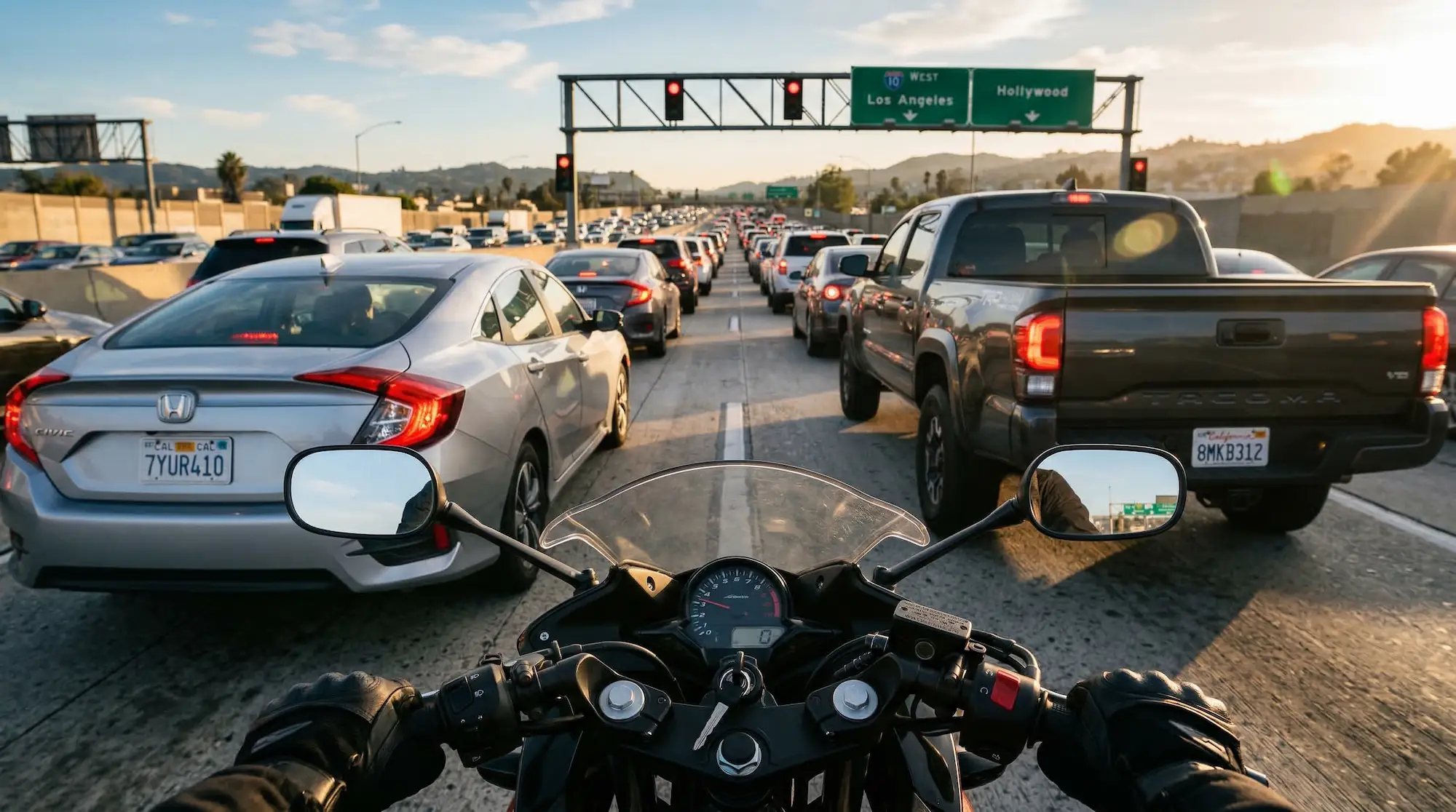
You are stuck in gridlock traffic on the highway, baking in the summer sun, and you find yourself wondering: can I just ride between these stopped cars? The answer depends entirely on the state you are riding in. Currently, California is the only state that permits full motorcycle lane splitting. Five other states have adopted a more restricted version of the practice known as lane filtering. In the remaining 44 states, navigating between cars is either explicitly illegal or falls into a legal gray area that can easily result in a hefty traffic citation.
Understanding motorcycle lane splitting laws by state is critical before you cross state lines. What is completely legal in Los Angeles will get you pulled over in Las Vegas. Below, we break down the definitive list of where it is legal, the speed limits and traffic conditions required in each state, and what the safety data actually says about riding between lanes.
⚠️ Legal Disclaimer: The information in this article is for educational purposes only and does not constitute legal advice. Laws change — always verify current regulations with your state’s DMV or a licensed traffic attorney before riding. The information below reflects laws as of early 2026.
Table of Contents
- Lane Splitting vs. Lane Filtering — What’s the Difference?
- Lane Splitting Laws by State — 2026 Status
- California — The Only State with Full Lane Splitting
- The Filtering States — What’s Allowed and Where
- Is Lane Splitting Safer? What the Research Shows
- How to Lane Filter Safely
- States Considering Lane Splitting Legislation
- Frequently Asked Questions
Lane Splitting vs. Lane Filtering — What’s the Difference?
Before diving into the state laws, it is crucial to understand the terminology. Legislators and law enforcement treat these concepts very differently, and the recent trend in motorcycle filtering laws USA-wide has heavily favored the more restricted “filtering” over full “splitting.”
- Lane Splitting: A motorcycle riding between marked lanes of actively moving traffic, typically on a highway or freeway. The rider is moving faster than the surrounding flow of traffic.
- Lane Filtering: A much more restricted practice. Filtering allows a rider to move between lanes of stopped or very slow-moving traffic, usually to navigate to the front of a line at a red light or intersection. The rider advances to the head of the queue while cars are stationary or nearly so.
- Lane Sharing: Two motorcycles riding side-by-side within the same lane. Legal in practically all 50 states and distinct from both splitting and filtering.
Lane Splitting Laws by State — 2026 Status
| State | Legal Practice | Max Rider Speed | Traffic Condition | Reference Law | Year |
|---|---|---|---|---|---|
| California | Lane splitting (full) | No more than 10 mph over surrounding traffic; avoid if traffic > 30 mph (CHP guidelines) | Moving traffic | AB 51 | 2016 |
| Utah | Lane filtering | ≤ 15 mph | Stopped traffic | HB 149 | 2019 |
| Montana | Lane filtering | ≤ 20 mph | Stopped or very slow traffic | 61-8-392 | 2021 |
| Arizona | Lane filtering | ≤ 15 mph | Stopped traffic (at intersections) | SB 1273 | 2022 |
| Colorado | Lane filtering | ≤ 15 mph | Stopped traffic | SB 24-079 | Aug 2024 |
| Minnesota | Lane filtering + limited splitting | ≤ 15 mph (filtering); specific conditions for splitting | Stopped and slow traffic | HF 5247 | 2025 (verify current status) |
In the remaining 44 states, lane splitting and filtering are either explicitly prohibited or not addressed by specific statute. In gray-area states where no law explicitly uses the words “lane splitting,” riders can still receive citations under general lane discipline laws, improper passing, or reckless driving statutes.
Before riding, make sure you have the correct licensing documentation for every state you pass through. Our guide on how much a motorcycle license costs covers the full breakdown of fees and requirements by state, so you are never caught riding without the right credentials.
California — The Only State with Full Lane Splitting
California is the pioneer and remains the absolute outlier in the US. Historically, the practice was largely tolerated by the California Highway Patrol (CHP) because no law explicitly forbade it. That changed in 2016 when Assembly Bill (AB) 51 formally defined and legalized motorcycle lane splitting, officially granting the CHP authority to develop educational guidelines.
While California allows riders to split moving traffic, the CHP highly recommends keeping your speed differential to no more than 10 mph above the surrounding traffic, and advises against splitting altogether when traffic is moving faster than 30 mph. These are guidelines, not statutory limits — but exceeding them significantly increases both crash risk and your exposure to a reckless driving charge if an incident occurs.
The Filtering States — What’s Allowed and Where
Recent legislative momentum has shifted entirely toward the safer, slower practice of lane filtering rather than full splitting.
Utah (HB 149, 2019): The first state to follow California. Filtering is strictly limited to roads with a speed limit of 45 mph or less, and traffic must be completely stopped. Violating the conditions of the law can result in traffic citations and potential consequences for your motorcycle endorsement. Always check current penalty schedules directly with the Utah DMV.
Montana (61-8-392, 2021): Montana allows a slightly higher filtering speed of up to 20 mph and permits riders to filter through both stopped and very slow-moving traffic — a broader definition than most other filtering states.
Arizona (SB 1273, 2022): Arizona allows filtering up to 15 mph, but strictly on roads with speed limits of 45 mph or less, and only when vehicles are completely stopped at intersections.
Colorado (SB 24-079, Aug 2024): As of August 2024, Colorado riders may filter through stopped traffic at speeds no greater than 15 mph under the conditions established by SB 24-079.
Minnesota (HF 5247, 2025): Minnesota enacted legislation that allows both filtering at 15 mph and a limited form of splitting in slow traffic, making it the most permissive state outside California. The law also includes provisions protecting riders from drivers who intentionally obstruct legal filtering or splitting maneuvers. As this is the most recently enacted law in this list, verify current status and specific conditions at the Minnesota DMV before riding.
Across all filtering states, universal restrictions apply: you cannot filter on the shoulder, you cannot use the bicycle lane, and you must merge back into traffic safely once vehicles resume normal movement.
Is Lane Splitting Safer? What the Research Shows
When non-riders see a motorcycle pass between stopped cars, they often assume it is reckless. The data tells a different story. The most widely cited academic reference is the 2015 UC Berkeley study, which analyzed nearly 6,000 motorcycle accidents in California between June 2012 and August 2013.
Out of those accidents, 997 involved riders who were lane splitting at the time of impact. The primary finding: riders who were lane splitting had a rear-end collision rate of just 2.6%, compared to 4.6% for riders who were not splitting — nearly half the risk of the most common and potentially deadly type of traffic collision.
The logic is straightforward. When you sit at the back of a line of stopped traffic, you are a stationary target for a distracted driver. By filtering to the front of the queue, you remove yourself from that rear-end strike zone entirely.
The UC Berkeley study also noted that safety benefits only apply when the maneuver is performed reasonably. Risk of injury increased significantly when traffic was moving faster than 50 mph, or when the rider exceeded surrounding traffic speed by more than 15 mph. When done recklessly, splitting exposes riders to sudden unsignaled lane changes, extended vehicle mirrors, and sharply reduced lateral clearance.
How to Lane Filter Safely (In States Where It’s Legal)
Following these guidelines keeps the practice both safe and legal. Riders who filter recklessly give ammunition to legislators seeking to reverse these laws.
- Stay between the far-left lanes: Drivers in the #1 and #2 lanes change lanes less frequently than those in right lanes dealing with highway on-ramps and exits.
- Watch your speed differential: Never exceed the surrounding traffic speed by more than 10–15 mph.
- Respect the absolute limit: Never attempt to filter when traffic is flowing faster than 15–20 mph.
- Cover your controls: Keep two fingers on your front brake and two on the clutch at all times for immediate reaction capability.
- Always maintain an escape route: Never allow yourself to get boxed in between two large vehicles where you cannot safely put a foot down.
- Be predictable: Pick a consistent line between two lanes and hold it smoothly — do not zigzag between lanes.
- Extra caution near hazards: Highway merges, changing traffic lights, and large box trucks that block lateral visibility all require additional space and reduced speed.
States Considering Lane Splitting Legislation
The legislative landscape is actively shifting. Several states including Texas, Washington, Connecticut, and Virginia have seen recent proposals to legalize some form of lane filtering. While these bills have not yet advanced into law, the national trend points toward wider acceptance of filtering as traffic congestion worsens and safety data becomes harder to dismiss. For the most current tracking of state bills, riders should consult the American Motorcyclist Association (AMA) directly.
If you are navigating the legalities of riding in a new state, getting your licensing documentation in order is the essential first step. Our complete guide on how to get a motorcycle permit in every US state covers every state’s requirements so you are fully legal before you hit the road.
Two of the five filtering states have moved since this table was written, and both are worth reading in full: Colorado’s authorization is written to repeal itself in September 2027, and it permits passing in the same lane rather than between lanes — see is lane splitting legal in Colorado. Utah, the state that went first, has the narrowest conditions of the group: is lane splitting legal in Utah. The distinction the whole subject turns on is unpicked in lane filtering, and for the prohibiting states we have now read the statutes in Washington, Maryland, Missouri and New Jersey.
The five filtering states do not share one rule: each sets its own speed cap, lane conditions and exclusions, and Colorado’s law carries a built-in expiry date. The exact conditions in Utah, Montana, Arizona, Colorado and Minnesota are in our guide to lane filtering laws, and the state-by-state answers for the bigger markets are here: California, Texas, Florida, New York and Illinois.
Frequently Asked Questions
Is lane splitting legal in the US?
Full lane splitting is only legal in California (AB 51, 2016). Five other states — Utah, Montana, Arizona, Colorado, and Minnesota — permit a more restricted practice called lane filtering, which allows riders to move between stopped or very slow-moving vehicles under specific speed limits. In the remaining 44 states, both practices are either explicitly illegal or fall into a legal gray area where general lane discipline statutes can be applied.
What is the difference between lane splitting and lane filtering?
Lane splitting involves riding between lanes of actively moving traffic, with the motorcyclist traveling faster than surrounding vehicles. Lane filtering is the act of moving between vehicles that are completely stopped or moving very slowly — typically at a red light or intersection — allowing the rider to advance to the front of the queue. Filtering is the more restricted version that most states with any permissive laws have chosen to adopt.
Is lane splitting legal in Texas?
No. Texas prohibits lane splitting under its general lane discipline code (Transportation Code §545.060), even though no specific statute uses the exact phrase “lane splitting.” Legislative attempts to legalize filtering in Texas have not passed. A rider caught splitting in Texas can be cited for improper lane changes or reckless driving.
Is lane splitting safer than staying in your lane?
According to the 2015 UC Berkeley study, riders who split lanes experienced a rear-end collision rate of 2.6%, compared to 4.6% for those who did not. Sitting at the back of stopped traffic leaves a rider vulnerable to being rear-ended by a distracted driver. However, the study strongly emphasizes that the safety benefit only applies when the maneuver is performed at a reasonable speed with a low differential relative to surrounding traffic. At higher speed differentials or when traffic is flowing fast, risk increases substantially.
Can I get a ticket for lane filtering in a state where it’s legal?
Yes. In states where filtering is legal, you can still receive a significant citation if you violate the specific conditions of the law — such as exceeding the maximum allowed filtering speed, filtering on roads whose speed limit exceeds the statutory threshold, or filtering on the shoulder. Each state’s penalty structure differs; always verify the specific consequences for your state directly with the DMV or the relevant statute.
The legislative trend is clear: more states are evaluating or approving lane filtering laws, supported by safety research that backs the practice when executed properly. If you ride in one of the six permissive states, knowing the exact parameters of your local law is your first line of defense against both a ticket and a crash. If you live in the 44 states where it remains illegal, maintain a dominant, highly visible lane position to protect your rear from the distracted drivers behind you. For more information on your fundamental rights and requirements as a rider on public roads, our guide on whether you need a motorcycle license covers the legal baseline for every US state. We now cover five more states in statute-level detail: California, whose law defines the maneuver without prohibiting it, plus New York, Illinois and Ohio, which all prohibit it — by very different drafting.