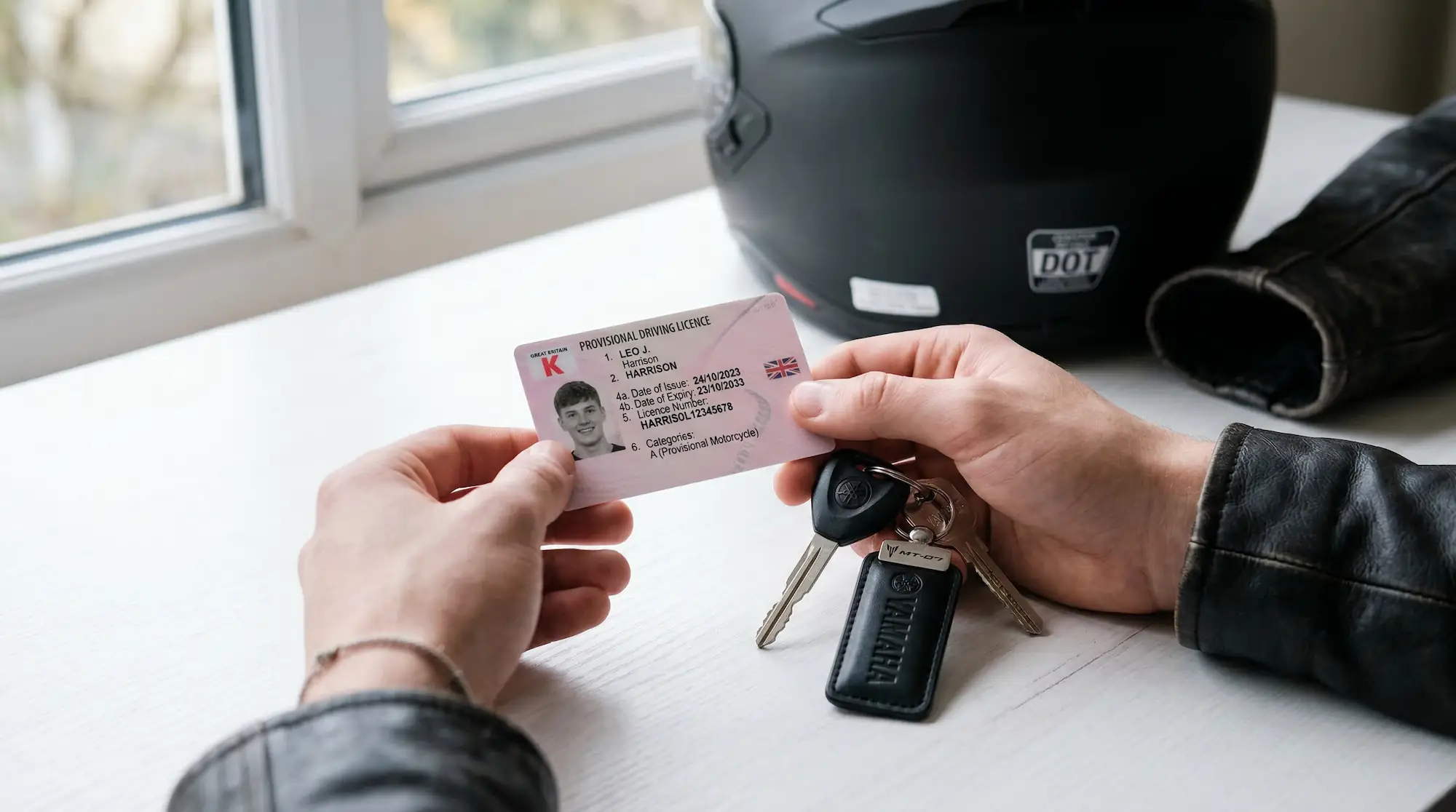
If you are counting down the days to your birthday and wondering, can you get motorcycle license at 16? The short answer is yes. In the majority of US states, you can legally obtain a motorcycle license at 16 years old. However, getting your license as a teenager is significantly different from getting one as an adult.
All young riders must navigate the Graduated Driver Licensing (GDL) system. This means you will face mandatory permit holding periods, specific nighttime curfews, and strict rules against carrying passengers. In some states, you can even apply for a learner’s permit as early as 14 or 15, while a select few states require you to wait until you are 17 or 18 for full riding privileges. Researched against state DMV official requirements, this guide breaks down the minimum age in your state, the specific restrictions that apply to under-18 riders, what parents need to know about liability, and the exact steps to get licensed.
[IMAGE: Young rider in full gear on a small motorcycle in a parking lot — editorial style, safe riding context] alt=”Young rider wearing a full-face helmet and protective gear practicing on a small motorcycle in an empty parking lot”
Motorcycle License at 16 — What Most States Allow
The general rule across the United States is that 16 is the standard minimum age to obtain a provisional or full motorcycle license. However, practically every state requires you to hold a learner’s permit before you can apply for the actual license. Because of this, many states allow teens to apply for their motorcycle permit at 14 or 15, giving them time to practice before their sweet sixteen.
Disclaimer: Requirements below are based on DMV research as of early 2026. Laws change — verify current rules at your state’s official DMV website before starting the process.
Here is a representative look at the minimum motorcycle license age requirement across key states:
| State | Minimum Permit Age | Minimum Full License Age | Notes |
|---|---|---|---|
| Alabama | 14 (moped) / 16 (motorcycle) | 16 | Moped = motor-driven cycle ≤ 50cc. |
| Alaska | 14 | 16 | Must hold permit for a minimum of 6 months. |
| Arizona | 15½ | 16 | Must hold permit for a minimum of 6 months. |
| California | 15½ | 16 | Must hold permit for 6 months + safety course required. |
| Colorado | 15 | 16 | Requires a safety course if under 16. |
| Florida | 15 | 16 | Course mandatory if under 18. |
| Georgia | 15 | 16 | Course mandatory if under 18. |
| Illinois | 15 | 16 years and 90 days | Mandatory course if under 18. |
| Indiana | 15 | 16 years and 90 days | Must complete Ride Safe Indiana course. |
| Iowa | 14 | 16 | Course + road skills test required. |
| Kansas | 14 | 16 (restricted) / 17 (unrestricted) | Operates on a 3-stage GDL system. |
| Michigan | 15 | 16 | — |
| Minnesota | — | 16 | MSF Basic RiderCourse mandatory if under 18. |
| New Mexico | 13 | 15 | The lowest historical minimum in the country (with highly restrictive conditions). |
| New York | 16 | 16 | Requires adult supervision with a motorcycle endorsement. |
| Tennessee | 15 (scooters ≤ 125cc) | 16 (full motorcycle) | At 15: riding is restricted to 4am–8pm within a 7-mile radius of home. |
| Texas | 15 (up to 250cc) | 16 (unrestricted engine) | At 15: restricted to motorcycles 250cc or smaller. |
| Washington | 15½ | 16 | — |
How the Graduated Licensing System Works for Young Riders
For riders under 18, the DMV employs a Graduated Driver Licensing (GDL) system. This means you do not simply take a test and walk out with full, unrestricted privileges. The GDL system is designed to introduce new teen riders to the road in safe, low-risk, highly supervised environments. It typically breaks down into three stages:
- Learner’s Permit / Instruction Permit: This is the first step. A permit is not a license. It allows you to practice riding on public roads, but strictly under specific conditions. You usually cannot carry passengers, you cannot ride at night, and in many states, you must be in the visual presence of an adult who holds a valid motorcycle endorsement.
- Restricted / Provisional License: Once you hit the minimum age (usually 16) and hold your permit for the required time, you upgrade to a restricted license. You can now ride alone, but curfews and passenger bans usually remain in effect.
- Full Unrestricted License: You receive your full endorsement, lifting curfews and passenger bans. This usually happens automatically when you turn 18, or after you have held the provisional license for a set period without any traffic violations.
Crucial Warning: Do not skip or ignore the rules of your permit period. In many states, violating a permit restriction (like riding at night or carrying a friend) will immediately invalidate your motorcycle insurance and can result in the suspension of your riding privileges until you turn 18.
Restrictions That Apply to Under-18 Riders
Even after you pass your road test and get your teen motorcycle license at 16, you are not entirely free. Here are the most common restrictions applied to young riders across the US: The conditions that apply while you are still on the permit — passengers, night riding and how many times it can be renewed — are in motorcycle permit restrictions.
| Restriction | Description |
|---|---|
| Mandatory Permit Period | Nearly all states require you to hold a permit before getting a full license. Typical holding periods range from 30 days to 6 months. |
| No Passengers | Riding with a passenger changes the bike’s physics entirely. Most states forbid under-18 riders from carrying passengers during the permit and provisional license phases. |
| Night Riding Ban | Visibility drops drastically at night. Curfews vary by state, often prohibiting riding after 9:00 PM, 10:00 PM, or 11:00 PM. |
| Engine Limits | Some states limit the power of the bike. Texas, for example, restricts 15-year-old riders to motorcycles displacing 250cc or less. |
| Parental Consent | Mandatory in all 50 states for anyone under the age of 18. |
| Mandatory Safety Course | Required for under-18 applicants in many states (including Illinois, Minnesota, Maryland, and Florida). |
| Mandatory Helmet Use | Every single state requires minors to wear a DOT-approved helmet, even in states where adults can legally choose to ride bareheaded. For help choosing the right lid, see our guide to the Best Motorcycle Helmets. |
The “No Passenger” and “Night Riding Ban” are the two most heavily enforced restrictions. Riding in the dark requires advanced hazard-perception skills that new riders simply have not developed yet. Similarly, carrying a passenger drastically alters the braking distance and cornering clearance of a motorcycle, making it highly dangerous for a 16-year-old who is still mastering clutch control.
What Parents Need to Know
If you are a parent reading this to understand the legalities of your teenager’s request, there are three major factors you need to be aware of before heading to the DMV.
First, your signature is legally required. In all 50 states, a parent or legal guardian must sign the permit and license application, and in many jurisdictions, you must be physically present at the DMV desk to present your own ID.
Second, under the parental liability laws present in most states, civil liability for property damage or physical injury caused by your teenager in a motorcycle accident can extend directly to you. This makes ensuring your teen has the right insurance and the proper training absolutely vital. To understand the financial commitment, see our breakdown of How Much Is a Motorcycle License.
Third, strongly consider mandating that your teen takes the MSF Basic RiderCourse (BRC), even if your state does not legally require it. The BRC provides verified instruction in a highly controlled, closed-course environment using small, lightweight motorcycles provided by the school. It stops bad habits from forming early.
Finally, be involved in the motorcycle purchase. A 16-year-old has no business starting on a 600cc supersport machine. A lightweight, forgiving motorcycle in the 125cc to 300cc range (like a Honda Grom, Kawasaki Z400, or Yamaha R3) is significantly safer, easier to handle, and cheaper to insure. Make sure your teen is also properly equipped — at a minimum, motorcycle riding boots that cover the ankle are essential protection for a new rider still developing bike control.
[IMAGE: Parent signing paperwork at DMV desk — editorial/stock style, no recognizable faces] alt=”A parent standing at a DMV counter signing official paperwork next to their teenager applying for a license”
Step-by-Step: How to Get Your Motorcycle License at 16
Getting licensed is a multi-step process that requires patience. Here is the general roadmap you will follow.
Step 1 — Check Your State’s Minimum Age
Do not rely on third-party aggregate sites alone. Go directly to your official state DMV website to confirm the exact age requirements. Some states allow you to start the classroom portion of your education a few months before your actual birthday.
Step 2 — Get Parental or Guardian Consent
You cannot bypass this. Your legal guardian must sign your application form. Confirm whether your state requires them to sign it in front of a notary or physically in front of a DMV clerk.
Step 3 — Pass the Written Knowledge Test
Download your state’s official Motorcycle Operator Manual and study it. Once you reach the minimum permit age (usually 14, 15, or 15½), you will head to the DMV to take a multiple-choice written exam covering road signs, riding techniques, and state laws.
Step 4 — Hold Your Learner’s Permit
Once you pass the written test, you will receive your learner’s permit. You must hold this permit for the state-mandated minimum time (often 6 months) without receiving any traffic citations. Strictly adhere to all GDL restrictions during this phase.
Step 5 — Complete a Motorcycle Safety Course (or Pass the Road Skills Test)
In many states, completing the MSF Basic RiderCourse (or your state’s equivalent program) is legally mandatory for applicants under 18. Even in states where it is optional, completing the course is highly recommended because the DMV will usually waive the intimidating on-road skills test if you present your graduation certificate. Check the MSF website or your state DMV for current course costs and locations.
Step 6 — Apply for Your License
Once you turn 16, have completed your minimum permit holding period, and have passed your road test (or presented your MSF certificate), return to the DMV. Submit your paperwork, pay the licensing fee, and receive your provisional motorcycle license.
For a deeper dive into the permit phase, read our complete state-by-state guide on How to Get a Motorcycle Permit.
States With Higher Minimum Ages — What to Do If You Have to Wait
Not all riders are lucky enough to live in a state where a full license is granted at 16. A small handful of states restrict full, unrestricted motorcycle licenses to residents aged 17 or 18.
If you find yourself in a state with a higher minimum age requirement, use the waiting period to your advantage. You can still apply for your learner’s permit at the younger age milestone. Use this time to practice in empty parking lots under the supervision of an adult rider. You should also take the MSF Basic RiderCourse early; the certificate is often valid for a year or more, meaning you will have your paperwork ready the exact day you hit the required age. The restrictions placed on young riders are not arbitrary — statistics consistently show that 16- and 17-year-old riders have higher crash rates than adults. Taking extra time to practice under supervision genuinely saves lives.
The waiting periods for young riders vary more than the minimum ages do. Colorado requires a minor under 18 to hold the permit for twelve months (motorcycle license Colorado); Pennsylvania asks for six months plus 65 hours of supervised riding and a mandatory clinic (motorcycle license Pennsylvania); Arizona asks for six months and offers a parental-certification alternative to the course (motorcycle license Arizona); and in Utah the course waives the waiting period entirely for riders under 19 (motorcycle safety course Utah).
Can You Buy or Own a Motorcycle at 16?
Owning one is possible; buying one on your own is harder than the license. A 16-year-old can legally be the owner named on a motorcycle title in most states, and nothing in licensing law stops a minor from buying a bike. The obstacles are contractual, not legal-age-to-ride:
- Financing needs an adult. Loan contracts signed by a minor are voidable in most states, so no lender will finance a 16-year-old alone. A parent or guardian signs or co-signs.
- Dealers usually want a parent present. For the same reason, most dealerships will not complete a sale to an unaccompanied minor, even for cash. Private sellers vary.
- Insurance is written to an adult. The policy is normally in a parent’s name with the teenager listed as a rider. Rates for under-18 riders are the highest on the market.
- Title and registration. Some states allow a minor’s name on the title outright; others require a parent to co-own or to sign the application. Check the registration rules for your state before the purchase, because the bill of sale needs to match whoever will be on the title.
In practice: the bike can be yours at 16, but the paperwork goes through a parent, which is also true of the parental consent every state demands for the license itself.
Can You Ride a Motorcycle at 16 With Just a Permit?
Yes, in every state where the permit age is 16 or lower, which is most of them, but only under the permit conditions. For an under-18 rider those are stricter than for adults: daylight only, no passengers, a mandatory holding period before the full license, and in a number of states supervision by an endorsed rider or a completed safety course before you may ride alone. The exact conditions are in our guide to motorcycle permit restrictions.
Two limits are worth knowing before you plan on riding to school. Several states cap engine size for the youngest permit holders (Texas keeps 15-year-olds to 250cc or less), and every state requires a helmet from any rider under 18, including the ones that let adults choose.
Frequently Asked Questions
Can you buy a motorcycle at 16?
Legally a 16-year-old can own a motorcycle in most states, but a dealer sale, a loan and an insurance policy all need a parent or guardian to sign. Cash sales from private sellers are the only route that does not.
Can a 16-year-old ride a motorcycle with a permit?
Yes, where the permit age is 16 or lower, which is most states. Under-18 permit holders ride in daylight only, without passengers, and in some states only with a licensed rider present or after a safety course.
Q: Can you get a motorcycle license at 16 in all 50 states?
A: In most states yes — 16 is the most common minimum age for a full motorcycle license in the US. However, some states require 17 or 18 for an unrestricted license. The learner’s permit age is lower in many states — as low as 14 in Kansas and Iowa. Always verify requirements with your state’s official DMV.
Q: What age can you get a motorcycle permit?
A: The minimum permit age varies by state. Most states set it at 15 or 15½, but some states allow permits at 14 (Kansas, Iowa, Alabama for mopeds) and at least one (New Mexico) at 13 under specific conditions. Permits always come with restrictions: supervised riding, no night riding in many states, and no passengers.
Q: Do you need a motorcycle license at 16 or just a permit?
A: In most states, at 16 you can get a full license (or provisional license with restrictions) after completing the permit period and passing the road skills test or MSF Basic RiderCourse. A permit alone does not allow unsupervised riding on public roads.
Q: Can a 15-year-old ride a motorcycle in the US?
A: In some states yes, with restrictions. Texas allows motorcycles up to 250cc at 15. Tennessee allows scooters up to 125cc at 15, but only between 4am–8pm and within 7 miles of home. States like Alaska, Arizona, and California allow permits at 14–15½. Parental consent is required in all cases.
Q: Does a 16-year-old need parental consent for a motorcycle license?
A: Yes, in every state. A parent or legal guardian must sign the application, and in many states must be physically present at the DMV. If the minor causes an accident, civil liability may extend to parents under parental liability laws in most states.
Getting your motorcycle license at 16 is an exciting milestone that is totally achievable in the majority of the US. The Graduated Driver Licensing system, with its mandatory permit periods and nighttime curfews, is designed specifically to help young riders build vital road experience in highly controlled, low-risk conditions before earning total freedom. Bypassing the DMV road test by taking the MSF Basic RiderCourse is the smartest, safest shortcut you can take.
To make sure you fully understand your state’s initial requirements and how to handle the DMV paperwork, check out our comprehensive guide: How to Get a Motorcycle Permit, or read up on fundamental riding laws at Do You Need a Motorcycle License?
SCHEMA — COPY EXACTLY INTO RANKMATH “SCHEMA” FIELD ======================================================