
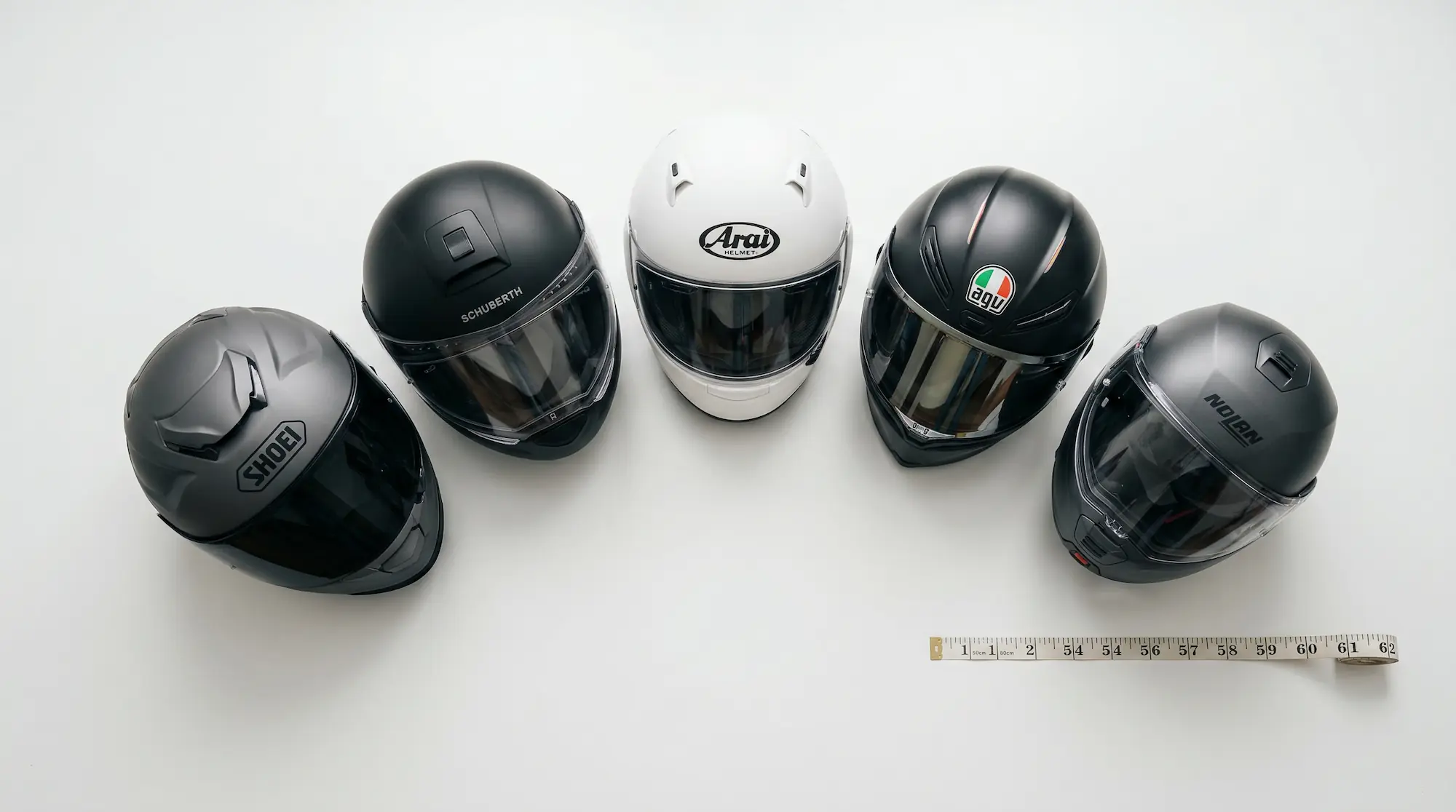
Search for a female-specific riding lid and you are usually hit with a wall of pink graphics, floral decals, and condescending marketing. The reality of the powersports industry is that the vast majority of products labeled as a “women’s motorcycle helmet” use the exact same shell mold and EPS liner as the unisex version, just sprayed with a different paint code. When it comes to finding the best motorcycle helmets for women, paint does not save your life — fit, weight, and safety certifications do.
What actually matters are the real anatomical differences: finding manufacturers that offer genuine extra-small (XS) shell sizes, understanding your specific head shape, and prioritizing a lightweight shell (under 1,500 grams) to reduce cervical fatigue on long rides. A heavy, poorly fitted helmet does not just ruin your ride — it compromises your safety in a crash.
This guide is researched & compared based on verified manufacturer specifications, official safety certifications (DOT, ECE, Snell), and the analysis of hundreds of real-world rider reviews from RevZilla and Amazon. We have not personally tested these helmets; instead, we have aggregated the hard data to cut through the marketing noise. If you are not yet sure whether you legally need a motorcycle license for your specific vehicle, check out our guide on whether you need a motorcycle license first. Below, you will find exactly how to measure your head, how to identify your head shape, and our top 5 picks by riding style.
Table of Contents
- Women’s vs. Unisex — What Actually Matters for Fit
- How to Measure Your Head for a Motorcycle Helmet
- Best Motorcycle Helmets for Women by Riding Style (2026)
- Certifications — What to Require Before You Buy
- What to Look for Beyond the Certification Label
- Frequently Asked Questions
“Women’s” vs. Unisex — What Actually Matters for Fit
Most “women’s” helmets are simply unisex helmets available in smaller sizes with different graphics. Buying a unisex helmet is not a compromise — it is often the smartest choice, provided you know exactly what mechanical features to look for.
There are, however, verified anatomical differences that affect how a helmet sits on a female rider’s head:
- Average Circumference: Women generally have a smaller average head circumference, typically in the 21–22 inch range.
- Cranial Geometry: Female riders often have a slightly more vertical forehead and a flatter crown compared to men.
- Facial Contours: Jawlines and cheekbone structures differ, meaning standard cheek pads may push too hard or leave gaps that compromise the fit seal.
Because of this, premium manufacturers like Shoei, Arai, and AGV adjust the internal geometry of their liners for smaller sizes. The filters that actually matter when shopping are:
- Multiple Shell Sizes: This is the most critical factor. Budget helmets use one outer shell for all sizes and stuff the XS version with thicker foam, creating a heavy “bobblehead” effect. Premium brands use 3–5 distinct outer shell sizes, meaning an XS helmet has a proportionally smaller, lighter shell with better structural geometry.
- Interchangeable Cheek Pads: The ability to swap cheek pads for thicker or thinner options lets you fine-tune the fit to your specific jawline without returning the entire helmet. Available thicknesses and increments vary by manufacturer — always check the specific brand’s accessory catalog before purchasing.
The practical takeaway: find the helmet that best matches your head’s physical dimensions and weight tolerance, completely ignoring whether the marketing department labeled it “for women.”
How to Measure Your Head for a Motorcycle Helmet
Guessing your size based on a hat or a borrowed helmet is a reliable way to end up with a dangerous fit. Getting your exact motorcycle helmet sizing takes two minutes and a soft cloth tape measure.
- Grab a soft, flexible tailor’s measuring tape — not a rigid metal construction tape.
- Wrap the tape around your head approximately one inch above your eyebrows.
- Route the tape just above your ears and around the widest, most prominent part of the back of your skull.
- Have a friend help, or use a mirror to ensure the tape is perfectly level all the way around.
- Take the measurement three times. Write down the largest reading in both centimeters and inches.
- Compare strictly to the specific brand’s sizing chart. A “Medium” in Shoei does not share the same internal dimensions as a “Medium” in HJC or AGV.
| Circumference (Inches) | Circumference (Centimeters) | Typical Helmet Size |
|---|---|---|
| 20–21” | 51–53 cm | Extra Small (XS) |
| 21–22” | 53–55 cm | Small (S) |
| 22–23” | 55–57 cm | Medium (M) |
| 23–24” | 57–59 cm | Large (L) |
⚠️ Critical sizing rule: Never size up expecting the helmet to “break in” to fit. A helmet that is too loose will rotate upon impact and will not protect your brain. If you measure exactly between two sizes, always go with the smaller. Only the interior comfort foam and cheek pads compress and conform to your face during the first 10–15 hours of riding — by approximately 10–15%. The structural EPS liner (the rigid foam directly inside the outer shell) does not compress during normal use and must not — that material is the energy-absorbing layer that crushes permanently in a crash. If the EPS were softening under daily wear, your crash protection would already be compromised.
Head Shape Guide — Long Oval, Intermediate Oval, or Round Oval?
Circumference is only half the equation. Your head shape determines whether a mathematically correct size will feel comfortable or cause pressure headaches.
- Long Oval: Your head is noticeably longer front-to-back than side-to-side. Arai (particularly the Signet-X) and Shoei accommodate this shape well.
- Intermediate Oval: Slight front-to-back elongation. This is the most common head shape in North America, and the vast majority of helmets are built around this mold.
- Round Oval: Your head is almost equally wide side-to-side as it is front-to-back — nearly circular when viewed from above. AGV and HJC fit rounder head shapes well.
The Quick Test: Put the helmet on. Intense pressure on your forehead with loose sides near your ears means the helmet is too round-oval for your head shape. Crushing pressure on your temples with space at the forehead means it is too long-oval. Try helmets on in person whenever possible, especially near size thresholds.
Best Motorcycle Helmets for Women by Riding Style (2026)
The best helmet is dictated by how, where, and what you ride. These five picks were selected based on verified specifications, certification ratings, and consistent patterns in rider reviews on RevZilla and Amazon.
Best Budget Pick — HJC i30 (~$140–$160)
For daily commuters or new riders seeking verified protection without a premium price, the HJC i30 is an exceptional choice. Built from a lightweight polycarbonate shell, its standout differentiator is that it carries both DOT and the rigorous ECE 22.06 certification — a genuine rarity at this price point.
It suits Intermediate to Round Oval head shapes and is available down to XS. It features an integrated drop-down sun shield and a fully removable, washable, antibacterial liner. HJC uses multiple shell sizes across its size range, so XS buyers are not receiving an oversized shell padded with excess foam.
Check current price on RevZilla
Best Mid-Range Full-Face — Bell Qualifier DLX MIPS (~$200–$250)
For riders wanting to maximize safety technology without crossing into the premium bracket, the Bell Qualifier DLX MIPS is the answer. The standout feature is MIPS — Multi-directional Impact Protection System. MIPS is a slip-plane liner technology that allows the inner shell to rotate slightly upon oblique impacts. Since most real-world motorcycle crashes involve angled glancing blows rather than flat direct impacts, this rotational energy management is a meaningful safety addition.
Finding MIPS in a helmet under $300 is genuinely rare. The Bell Qualifier DLX MIPS holds DOT certification and is available down to XS with an Intermediate Oval fit. Note that MIPS is a proprietary technology, not an independent safety certification — it does not replace DOT, ECE, or Snell but complements them.
Check current price on RevZilla
Best Mid-Range Touring — Scorpion EXO-T520 (~$220–$260)
Touring demands versatility, and the Scorpion EXO-T520 modular helmet delivers exactly that. Its greatest asset for female riders is the proprietary AirFit system: inflatable air bladders behind the cheek pads, inflated by a small pump at the chin bar. If you are between sizes or find your cheek pads pack out over time, you pump the bladders to dial in a snug, contoured fit without returning the helmet.
It carries DOT and ECE 22.05 certifications. As a modular helmet, it is designed to provide protection both with the chin bar locked down and flipped open — verify the specific homologation status with your local regulations. Available from XS through 3XL.
Check current price on RevZilla
Best Premium Full-Face — Shoei RF-1400 (~$500–$550)
When discussing the best women’s full-face motorcycle helmet at the premium tier, the Shoei RF-1400 is the consistent top recommendation in serious rider communities. The reason is Shoei’s manufacturing precision: four distinct AIM (Advanced Integrated Matrix) outer shell sizes across the size range. An XS RF-1400 is a physically smaller, more aerodynamic shell — not an oversized bucket padded with excess foam. This improves proportional fit, structural integrity, and eliminates the bobblehead effect on smaller riders.
It is exceptionally quiet at highway speeds, features well-engineered ventilation, and carries both DOT and Snell M2020D certification — the street-use designation of Snell’s rigorous independent testing standard. (Snell M2020 has two variants: M2020D for street/dual-sport use and M2020R for racing. The RF-1400 holds M2020D, the correct standard for a street helmet.) Best suited for Long to Intermediate Oval head shapes.
Check current price on RevZilla
Best Premium Lightweight — AGV K6 S (~$450–$500)
Weight is the primary enemy of all-day comfort. For riders with neck sensitivity or multi-day trips where cumulative helmet weight causes fatigue, the AGV K6 S stands apart. Its premium carbon-aramid fiber shell brings it in at under 1,400 grams — making it the lightest helmet in this comparison and among the lightest certified street helmets available at this price point.
Beyond weight, it offers a wide field of vision and carries both DOT and the modern ECE 22.06 certification. Best fit for Intermediate to Round Oval head shapes. If you want sport-level performance without the neck strain, the K6 S makes the strongest argument in this guide.
| Helmet | Approx. Price | Certifications | Key Technology | Head Shape | Best For |
|---|---|---|---|---|---|
| HJC i30 | ~$150 | DOT + ECE 22.06 | — | Int. Oval / Round | Budget commuter |
| Bell Qualifier DLX MIPS | ~$230 | DOT | MIPS rotational liner | Intermediate Oval | Safety mid-range |
| Scorpion EXO-T520 | ~$240 | DOT + ECE 22.05 | AirFit bladder system | Adjustable (AirFit) | Touring / modular |
| Shoei RF-1400 | ~$530 | DOT + Snell M2020D | 4 shell sizes (AIM) | Long / Int. Oval | Premium all-rounder |
| AGV K6 S | ~$470 | DOT + ECE 22.06 | Carbon-aramid shell | Int. Oval / Round | Lightweight / sport |
Certifications — What to Require Before You Buy
Never buy a motorcycle helmet based on aesthetics alone. A helmet without a legitimate safety certification is a novelty item, not life-saving equipment.
- DOT (FMVSS 218): The minimum legal standard required to sell a street helmet in the United States. Manufacturers self-certify compliance — no independent pre-market testing is required. All five picks in this guide are DOT certified.
- ECE 22.06: The current European standard, widely considered significantly more rigorous than DOT. It requires independent batch testing before market release and includes specific protocols for oblique (angled) rotational impact. Three of our five picks carry ECE 22.06; one carries the previous ECE 22.05.
- Snell M2020D: A voluntary independent certification from the Snell Memorial Foundation, testing at significantly higher impact energies than DOT. M2020D is the street-use designation. M2020R is a separate, stricter racing variant. The Shoei RF-1400 holds M2020D — the appropriate standard for a street helmet.
- MIPS: Not a certification — a proprietary rotational energy management technology by MIPS AB. It has no independent certifying body and no pass/fail threshold. It is a meaningful safety feature but must not be compared directly to DOT, ECE, or Snell as if it were an equivalent certification standard.
What to Look for Beyond the Certification Label
- Multiple Shell Sizes: The most critical purchasing filter. Insist on it for any helmet you plan to wear for more than an hour at a time.
- Weight Under 1,500g: Cervical spine fatigue is cumulative. The difference between 1,400g and 1,800g is highly pronounced on rides of three hours or longer.
- Removable and Washable Liner: Non-negotiable. Sweat, sunscreen, and road grime accumulate in helmet liners. A liner that cannot be washed will permanently compress the comfort foam, altering fit over time.
- Cheek Pad Thickness Options: Premium helmets offer interchangeable cheek pads in varying thicknesses to adjust the cheek contact zone. Available sizes are brand-specific — check the accessory catalog for your specific model.
- Drop-Down Sun Visor: An integrated internal sun shield eliminates the need to swap outer visors when light changes. Invaluable for commuters and touring riders.
- The 5-Year Replacement Window: Replace your helmet every 5 years from date of purchase, or immediately after any significant impact — even with no visible outer damage. The EPS liner hardens from heat cycles, UV exposure, and sweat absorption, measurably reducing crash energy absorption capacity regardless of how the shell looks.
Frequently Asked Questions
Do women need a different motorcycle helmet than men?
No — women need a helmet that fits correctly, not one labeled “for women.” The relevant differences are a smaller average circumference and slightly different cranial geometry. The solution is to find manufacturers offering multiple shell sizes with genuine XS availability, take accurate head measurements, and identify your head shape. A correctly sized unisex helmet provides identical crash protection to a gendered one.
How should a motorcycle helmet fit a woman?
The helmet should sit perfectly level, with the top of the eye port just above your eyebrows. Cheek pads must make firm, continuous contact — a slight “chipmunk” effect in the mirror is correct. The helmet must not twist or slide when you shake your head aggressively. You should not be able to slide fingers between your forehead and the liner. Only the comfort foam and cheek pads break in by 10–15% over the first 10–15 hours — not the structural EPS liner.
What is the lightest motorcycle helmet for women?
Among the picks in this guide, the AGV K6 S is the lightest at under 1,400 grams, achieved through a premium carbon-aramid shell. Pure carbon options from Shoei (X-15) and Arai are also exceptionally light but typically start above $700. For riders with a history of neck pain or cervical fatigue, weight must be a primary filter.
Can I wear a motorcycle helmet with long hair?
Yes. The most comfortable method is a low bun or braid at the very bottom rear of the head, which interferes least with the helmet’s rear neck roll. Avoid high ponytails or top-knots — they create painful pressure points against the crown EPS liner and can push the helmet forward. A thin silk balaclava underneath protects hair from breakage and keeps the liner cleaner longer.
How often should you replace a motorcycle helmet?
Every 5 years from date of purchase, or immediately after any significant impact — even with no visible outer damage. The internal EPS foam degrades through heat cycles, UV exposure, and sweat absorption. After 5 years its crash energy absorption capacity is measurably reduced regardless of how the shell looks.
The best motorcycle helmet for a female rider is the one that correctly matches your head shape, your riding style, and your safety budget — not the one with the most aggressive graphics or the pinkest colorway. Measure your head with a tape, identify your oval shape, and demand a legitimate safety certification. Every pick in this guide provides verified protection. Moving from a budget lid to a premium one buys lighter weight, better aerodynamics, and a quieter highway experience — but correct fit is what determines whether the helmet does its job in a crash. Before investing in gear, make sure your licensing costs are fully budgeted — our complete motorcycle license cost breakdown covers every fee from permit to endorsement. And if you are still working through the permit process, our state-by-state guide on how to get a motorcycle permit covers every US state requirement in full detail.