Jump online and search “how much is a motorcycle license” and you will find wildly conflicting answers. One forum post says $30. Another rider complains they just spent $400. Both of those riders are telling the truth — they are just describing completely different stages of the licensing process.
The government fee charged by your state DMV for the motorcycle endorsement itself is genuinely cheap: usually $15–$50. But that plastic card is the very last step. When you factor in the required learner’s permit, the highly recommended (and often mandatory) safety training course, and testing fees, the realistic total for most adult riders lands between $150 and $400.
If you are still fuzzy on whether you actually need an endorsement for your specific vehicle — scooter, e-bike, or small-displacement bike — check out our guide on whether you need a motorcycle license first. If you know you need one, keep reading. This guide breaks down every cost component, compares the three paths to getting licensed, and provides a verified state-by-state breakdown for the 10 largest US states.
Table of Contents
- The 4 Real Costs of Getting a Motorcycle License
- 3 Paths to Your Motorcycle License
- Motorcycle License Cost by State
- Hidden Costs Most New Riders Miss
- Does the MSF Course Waive the DMV Road Test?
- Frequently Asked Questions
The 4 Real Costs of Getting a Motorcycle License
The total motorcycle license cost is almost never a single transaction. It is composed of four separate line items that new riders frequently mix up. Each is independent, and you pay for them at different points in the process.
| Cost Component | Typical Range | When You Pay It |
|---|---|---|
| Motorcycle learner’s permit | $10–$50 | At the DMV, before you can legally practice. Covers the written knowledge test. |
| MSF Basic Rider Course | $100–$350 | Before or during your permit period. Paid to the training provider. |
| DMV road skills test (if skipping MSF) | $10–$40 | After independent practice. Paid to the DMV for the physical riding evaluation. |
| Motorcycle endorsement / license fee | $15–$50 | The final step at the DMV to add the Class M credential to your license. |
| Total with MSF course (most riders) | $150–$400 | The most efficient and widely recommended path nationwide. |
| Total without MSF / direct DMV path | $50–$140 | Only available in certain states for adults who test directly at the DMV. |
The MSF course is typically the largest single expense in the process. However, it waives the DMV road skills test in approximately 40–42 states, provides the motorcycle you learn on, and often earns you an insurance discount that partially offsets the course cost within your first year of riding.
3 Paths to Your Motorcycle License (and What Each Costs)
There is no single universal path to getting licensed in the United States. Your exact route depends on your age and your state’s specific legislation. Each path has a different cost, time commitment, and difficulty profile.
Path 1 — MSF Basic Rider Course (Most Common for Adults)
For the vast majority of adult riders, this is the standard path. The Motorcycle Safety Foundation (MSF) Basic Rider Course (BRC) is typically a two-day weekend program combining classroom instruction on traffic strategy and risk management with hours of practical on-bike exercises in a closed parking lot.
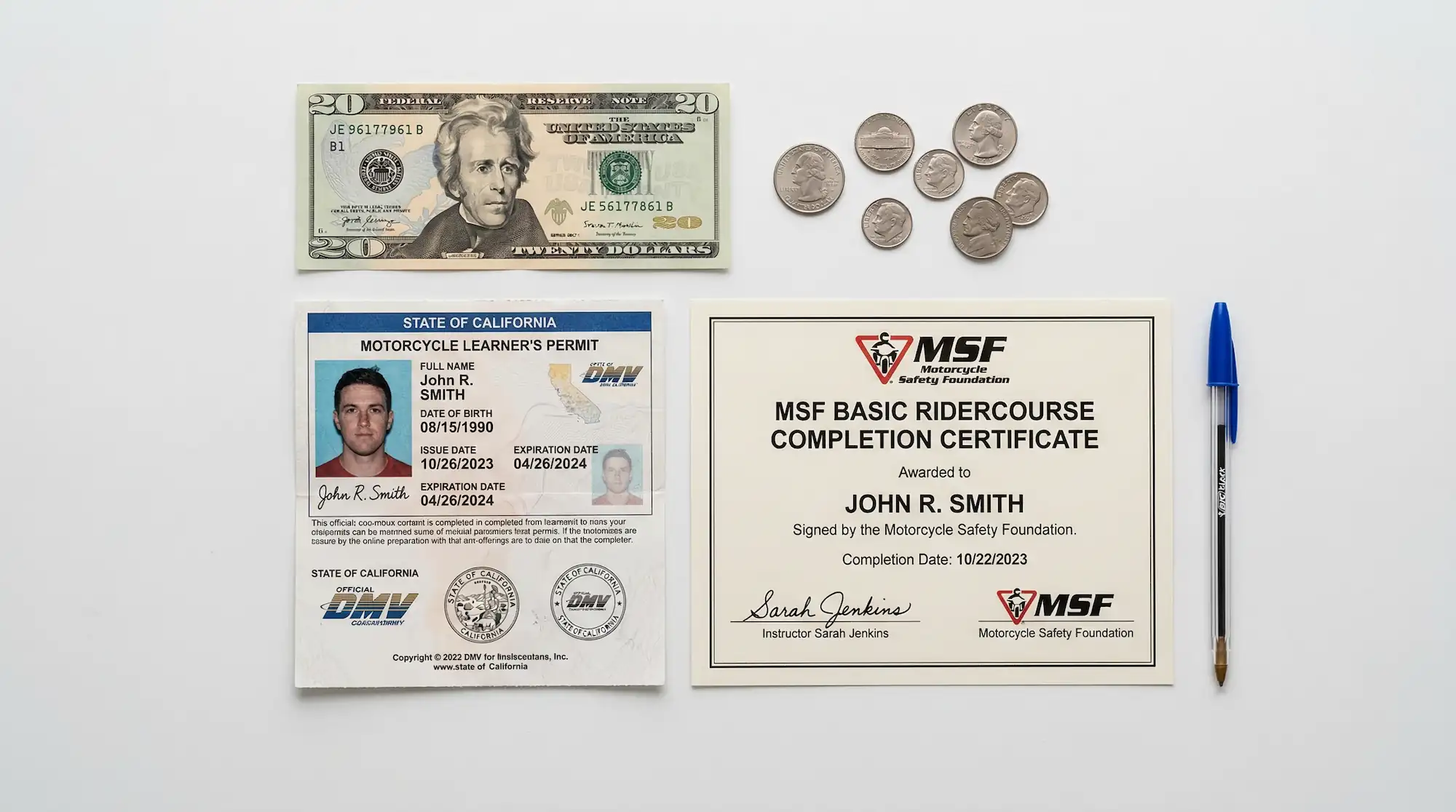
The training facility provides the motorcycles — usually lightweight 250cc or 300cc bikes that are forgiving to learn on. Upon passing the final riding evaluation, you receive a completion certificate. In approximately 40–42 states, presenting this certificate to the DMV fully substitutes the state’s physical road skills test. You pay your motorcycle endorsement cost and walk out fully licensed. Note that some states — including New York and Maryland — may require an additional DMV written test even after MSF completion. Always verify your specific state’s requirements directly with your DMV before assuming the waiver is automatic.
- Cost: $100–$350 for the course + $15–$50 for the final endorsement fee.
- Time: One full weekend for the course (15–20 hours total), plus 1–7 days for the DMV administrative visit.
- Insurance advantage: Most major insurers offer a 5–15% premium discount to riders holding an MSF completion certificate. For new riders facing high insurance rates, this discount frequently recovers a significant portion of the course cost within the first policy year.
Path 2 — Direct DMV Testing (No Course)
In states that permit it, an adult rider can bypass formal training. This path involves studying the state’s motorcycle operator manual independently, passing the written test for a learner’s permit, practicing under the permit’s restrictions, and scheduling a physical road skills test with a DMV examiner.
While this appears cheapest on paper, it comes with significant logistical hurdles. You must provide your own registered and insured motorcycle for the DMV test. Many states also require a licensed rider to accompany you to the testing site. The DMV skills test — which typically involves tight low-speed maneuvers including a U-turn box — has a notably high first-attempt failure rate among self-taught riders.
- Cost: Approximately $50–$140 total (permit fee + skills test fee + endorsement fee).
- Key limitation: This path is unavailable for riders under 21 in California, and Texas, New York, and Florida place strict limitations or effectively require a course through their licensing structure. Always verify current requirements with your specific state DMV.
Path 3 — Under 18 (Mandatory Course + Graduated Licensing)
For minor riders, prior riding experience is irrelevant to state licensing law. Virtually every state mandates the completion of an approved motorcycle safety course for riders under 18. There is no opt-out provision.
Beyond mandatory training, minors are subject to graduated licensing laws. This typically requires holding a learner’s permit for a minimum of 6–12 months before accessing a full unrestricted endorsement. During the permit phase, restrictions usually include daylight riding only, no passengers, and requirements to be accompanied by a fully licensed adult motorcyclist.
- Cost: Generally equivalent to Path 1 ($150–$400). Note that some minor-focused courses in certain regions carry higher registration fees due to increased liability insurance requirements for the training provider.
- Time: Measured in months, not weeks. The mandatory permit holding period is the controlling restriction in the process.
Motorcycle License Cost by State — 10 Largest States
State DMV fees are one fixed variable — the MSF course cost also varies significantly by region and provider. This table reflects current fee schedules from state DMVs for the credential itself, combined with typical MSF course price ranges in each state. Always verify exact figures on your state’s official DMV website before submitting payments, as government fees are updated periodically.
| State | Permit Fee | MSF Course (typical) | Endorsement Fee | Estimated Total |
|---|---|---|---|---|
| California | $41 | $295–$350 | $36 | $372–$427 |
| Texas | $16 | $200–$250 | $25 | $241–$291 |
| Florida | $10 | $250–$275 | $10–$15 | $270–$300 |
| New York | $10–$21 | $300–$500 | $10–$12 | $320–$533 |
| Illinois | $10 | $200–$250 | $10 | $220–$270 |
| Pennsylvania | $10 | $200–$250 | $32 | $242–$292 |
| Ohio | $11 | $150–$200 | $25 | $186–$236 |
| Georgia | $10 | $150–$200 | $25–$32 | $185–$242 |
| North Carolina | $15 | $150–$200 | $19 | $184–$234 |
| Arizona | $7 | $150–$200 | $25 | $182–$232 |
Note: New York features the widest cost range of any major state. The core DMV fee varies by county, and MSF-equivalent courses in the NYC metro area are significantly more expensive than upstate options. If you are in New York, compare multiple providers before booking. California’s permit fee reflects the current M1 instruction permit issuance cost as of 2026. Florida’s endorsement fee reflects the current $10–$15 range depending on transaction type. Always verify at your state’s official DMV website before paying.
Hidden Costs Most New Riders Do Not Budget For
The license is just the starting line. Many riders scrape together $300 for their course and DMV fees, then realize they are completely unequipped to legally or safely ride. These are the real-world expenses that must be budgeted alongside the licensing process.
- Riding gear: Helmet laws vary significantly by state. As of 2026, 19 states plus Washington D.C. have universal helmet laws requiring all riders to wear a helmet. An additional 28 states have partial laws covering only riders under 18 or 21. Iowa, Illinois, and New Hampshire have no mandatory helmet law at all. Regardless of what your state legally requires, a quality helmet is the single most effective piece of protective equipment you can wear. Budget at minimum $350–$600 for a complete starter kit: DOT-certified helmet ($80–$500), armored riding jacket ($150–$400), motorcycle gloves ($30–$100), and over-the-ankle riding boots ($80–$300).
- Motorcycle insurance: Liability coverage is legally mandatory in virtually every state before your tires touch a public road. For new riders without a history of motorcycle coverage, annual premiums average $200–$600 depending on bike displacement, your age, and your zip code. MSF completion typically shaves 5–15% off this figure.
- Course retake fee: If you drop the bike or accumulate excessive penalty points during the BRC final evaluation, you fail the course. Retaking it usually costs $50–$100. Take the weekend seriously.
- Permit violation fines: Riding at night, carrying a passenger, or accessing interstate highways while on a learner’s permit can result in fines of $100–$500 depending on the state, and can delay your path to a full endorsement. Respect every permit restriction.
Does the MSF Course Waive the DMV Road Test?
In approximately 40–42 states, yes. When you complete the MSF Basic Rider Course, you receive a certificate of completion. You present this document at the DMV along with your written permit, pay your final endorsement fee, and receive your Class M designation without needing to schedule or take the physical road skills test administered by a DMV examiner.
However, the waiver is not universal and is not automatic in every jurisdiction. States including New York, Connecticut, and Maryland have additional DMV requirements beyond certificate presentation — such as a separate DMV written test — even after MSF completion. Always verify the exact process with your state DMV before assuming the waiver covers everything.
The practical advantage of the MSF path extends beyond avoiding test anxiety. Getting a physical road skills test appointment at busy DMV locations in California, New York, or Texas can take several weeks or months during peak summer riding season. The MSF certificate bypasses that bureaucratic bottleneck entirely in the states where the full waiver applies.
Frequently Asked Questions
How much does it cost to get a motorcycle license in total?
For the vast majority of adult riders in the US, the total realistic cost is $150–$400. This includes the learner’s permit ($10–$50), the MSF Basic Rider Course ($100–$350), and the final endorsement fee ($15–$50). If your state permits direct DMV testing without a mandatory training course, the minimum total drops to approximately $50–$140. However, that direct option is becoming less accessible across the country and requires considerable self-directed practice to pass the DMV’s strict slow-speed skills evaluation.
Is the MSF course required or optional?
It depends on your state and your age. For riders under 18, completing an approved motorcycle safety course is mandatory in virtually every state. For adult riders 18 and over, the course is technically optional in states that still allow direct DMV testing — but it is strongly recommended everywhere. It waives the road test in most states, reduces insurance premiums, and builds the physical skills that a written test cannot evaluate. In California specifically, riders under 21 must complete an approved course regardless of skill level.
How much is a motorcycle endorsement versus a motorcycle license?
In most states, you add a motorcycle endorsement (Class M) to your existing driver’s license rather than obtaining a completely separate credential. The fee to add the endorsement is typically $10–$50. If you do not hold a regular car driver’s license, you can apply for a standalone motorcycle-only license at a similar cost, though you may need to pass additional general road rules testing. The riding privileges are identical in both cases.
Can I get a motorcycle license cheaper without taking the MSF course?
Yes, in states that still permit direct DMV testing for adults. Paying only the permit fee, skills test fee, and endorsement fee brings your total to approximately $50–$140. The trade-offs are significant: no insurance discount, no course-provided motorcycle, and you must provide your own registered and insured bike for the DMV test. States like California and New York restrict or effectively eliminate this option for younger riders and in practice for most urban applicants.
How long does it take to get a motorcycle license?
For most adults using the MSF path, the entire process takes 2–4 weeks: 1–7 days to file for the permit and pass the written test, one full weekend for the BRC, and 1–7 days for the final DMV endorsement visit. For minors, the timeline is measured in months — most states require holding a learner’s permit for 6–12 months before a full endorsement is accessible.
The base DMV fee for a motorcycle license is genuinely cheap — $15–$50 across most states. What turns this into a $200–$400 investment is the MSF training course, and that course is worth every dollar. It waives the high-pressure DMV road test in most states, actively reduces your insurance premiums, and teaches the emergency braking and hazard response skills that keep new riders alive in traffic.
Budget $250–$350 for the complete licensing process, and reserve another $350–$600 for basic safety gear before your first solo ride. For exact written test content, permit restrictions, and state-specific requirements in your location, our complete guide on how to get a motorcycle permit covers every US state in full detail.