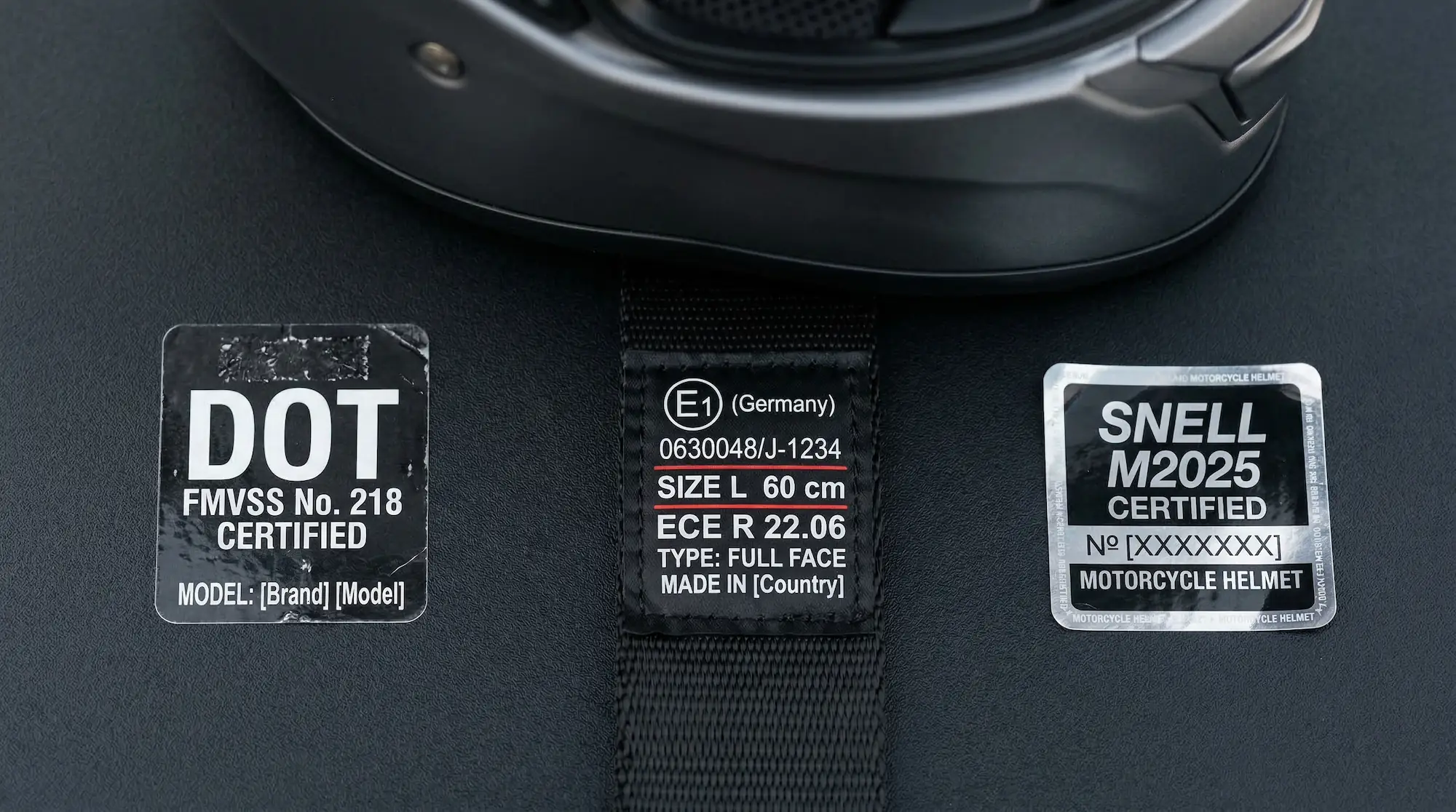
You buy a new lid, look at the back, and see a cluster of acronyms. You peel back the interior liner and find even more tags. Seeing “DOT” on one sticker and “ECE” on a sewn-in label can leave you wondering what either of them actually guarantees. The reality is that not all motorcycle helmet ratings work the same way. The problem for the average rider is distinguishing between standards that a manufacturer simply claims to meet, and standards verified by independent laboratories before the helmet ever hits a store shelf.
To make an informed decision, you need to know how these systems operate. DOT is self-certified by the manufacturer, ECE is independently tested prior to sale, and Snell is a rigorous voluntary standard often required for the track. Researched and verified against official NHTSA, UNECE, and Snell Memorial Foundation documentation, this guide breaks down exactly what these certifications test, with a comprehensive comparison table and a guide to choosing the right combination for your riding style.
Table of Contents
- What Helmet Ratings Actually Mean
- DOT — The US Legal Minimum
- ECE 22.06 — The Independent Standard
- Snell M2025 — The Voluntary Gold Standard
- SHARP and FIM — What Street Riders Need to Know
- Which Certification Should You Choose?
- How to Read Your Helmet’s Certification Labels
- Frequently Asked Questions
What Helmet Ratings Actually Mean
At their core, all helmet testing standards operate on the same basic physics principle: technicians strap the helmet to a weighted, instrumented metal headform and drop it onto various steel anvils (flat, hemispherical, or edge-shaped). Sensors inside the headform measure how much gravitational force is transferred through the helmet to the “head.”
However, the standards differ significantly in who conducts the tests, the speed and energy of the impacts, how many points on the shell are struck, and what additional components (like the chin bar or face shield) are evaluated. These discrepancies dictate the true protective value of your helmet.
| Feature | DOT (FMVSS 218) | ECE 22.06 | Snell M2025 |
|---|---|---|---|
| Governing Body | NHTSA (US Government) | UNECE (United Nations) | Snell Foundation (Private Non-profit) |
| Mandatory In | United States | 50+ Countries (Not US) | None (Required by many track days) |
| Certification Method | Manufacturer Self-Certification | Independent Laboratory | Snell Lab + Random Market Re-test |
| Current Version | FMVSS 218 (No major update since 1988) | ECE 22.06 (Active since Jan 2022) | M2025 (Active since Oct 2024) |
| Rotational Impact Test | No | Yes (Added in 22.06) | Partial (M2025R variant) |
| Chin Bar Tested | No | Yes | Yes |
| Visor Tested | No | Yes | Yes (Penetration) |
| Rigor Level | US Legal Minimum | High (Independent) | Highest (Voluntary) |
| Impact Velocity | ~6.0 m/s (flat anvil) | Up to 7.5 m/s (varies by anvil) | High (exceeds DOT energy thresholds) |
| Identification | Rear exterior sticker & interior label | Interior tag on chin strap | Interior sticker under liner + smf.org |
Note on impact velocity: ECE 22.06 tests at up to 7.5 m/s on certain anvil configurations — higher than DOT’s flat-anvil drop speed. The two standards use different test geometries and methodologies, so direct single-number comparisons are misleading. The key difference remains certification method: ECE is independently verified before sale; DOT is self-certified.
DOT — The US Legal Minimum
The DOT motorcycle helmet standard, officially known as FMVSS 218 (Federal Motor Vehicle Safety Standard No. 218), is governed by the National Highway Traffic Safety Administration (NHTSA). If a helmet is sold for street use in the United States, it legally must carry this certification. It tests for impact energy absorption, penetration resistance, and retention system (chin strap) strength.
However, the methodology is where the DOT standard faces legitimate criticism. It operates on a self-certification system: the manufacturer tests their own helmets internally and applies the DOT sticker. NHTSA then conducts random spot-checks on helmets already on the market, retrospectively. Because FMVSS 218 has not seen a major structural update since 1988 (aside from a minor labeling update in 2013), the test does not evaluate the chin bar on full-face helmets, the face shield, or rotational and oblique impacts that represent a significant portion of real-world crash mechanics.
The takeaway: DOT-only helmets are legal for street riding in the US. However, the self-certification method means quality is verified after-the-fact, not before the helmet reaches store shelves. A helmet carrying both DOT and ECE 22.06 has been independently tested before sale. Be alert to “novelty helmets” sold online for very low prices — they frequently carry fake DOT stickers to circumvent the law. Always purchase from a reputable motorcycle gear retailer. Helmet laws vary significantly by state — our guide on whether you need a motorcycle license covers which states enforce universal helmet laws and which have partial or no requirement. If you are still working through the licensing process, our motorcycle permit guide for every US state covers the exact legal requirements state by state, including helmet use during the permit period.
ECE 22.06 — The Independent Standard
The Economic Commission for Europe (UNECE) standard is recognized in over 50 countries. Unlike DOT, ECE requires third-party independent laboratory certification. A manufacturer cannot sell an ECE-labeled helmet until a certified lab tests a batch of production samples and officially approves the model.
In January 2022, the standard was comprehensively updated from 22.05 to ECE 22.06. As of March 2024, the older 22.05 versions can no longer be sold as new inventory. ECE 22.06 tests the chin bar, evaluates the optical clarity and shatter resistance of the visor, checks positional stability (ensuring the helmet does not roll off the head during an impact), and includes rigorous shell abrasion tests. Critically, 22.06 introduced strict rotational and oblique impact testing — simulating real-world crashes where a rider’s head strikes the pavement at an angle, generating rotational forces transmitted to the brain.
The takeaway for US riders: An ECE-only helmet is not legal for street use in the United States. However, a helmet certified with both DOT and ECE 22.06 is the sweet spot for American street riders. It satisfies the US legal requirement while providing the assurance that an independent laboratory verified the shell, visor, and chin bar before it was sold.
Snell M2025 — The Voluntary Gold Standard
The Snell Memorial Foundation is a private, non-profit organization established in 1957 following the fatal racing crash of Pete Snell. Because it is a private entity, Snell certification is entirely voluntary. No country legally requires a Snell rating for street riding, but many track day organizers and racing schools mandate it for on-track participation.
Snell is considered the most rigorous of the three major standards. Like ECE, it requires independent laboratory testing before the helmet reaches market. But Snell adds a further layer of quality control: they randomly purchase their certified helmets from retail shelves and re-test them to confirm manufacturers are not cutting corners on production units after approval. Their impact tests use higher energy thresholds and varied anvil shapes compared to both DOT and ECE.
The standard updates approximately every five years. The current standard — Snell M2025 — went into effect in October 2024, replacing the older M2020 rating. There are two variants: M2025D (aligned with DOT requirements) and M2025R (aligned with ECE 22.06 and incorporating Head Injury Criterion testing). There is a persistent internet myth that Snell helmets are “dangerously stiff” for street crashes. The Snell Foundation explicitly addresses this: M2025D helmets must remain compatible with DOT regulations, which sets a ceiling on shell rigidity as well as a floor.
How to Verify a Snell-Certified Helmet
Because Snell certification is frequently counterfeited on cheap helmets, never rely on the sticker alone. Verify any claimed Snell helmet by visiting the public database at smf.org and searching by manufacturer and model name. If the model does not appear in the database, it is not Snell certified, regardless of what the sticker says.
SHARP and FIM — What Street Riders Need to Know
SHARP
The Safety Helmet Assessment and Rating Programme (SHARP) is an initiative of the UK Department for Transport. It is not a certification. It is a 1-to-5 star rating system applied to helmets that have already passed ECE. SHARP’s value lies in comparative granularity: rather than a simple pass/fail, SHARP tests multiple impact points across the helmet surface and publishes the full dataset, showing exactly where each helmet performs strongly and where it is marginal. While primarily a European resource, the SHARP database is a useful secondary research tool for riders evaluating specific models.
FIM
The Fédération Internationale de Motocyclisme (FIM) standard is exclusively for professional racing circuits such as MotoGP and WorldSBK. For a helmet to be considered for FIM homologation, it must already possess an ECE, Snell, or JIS rating. Unless you are competing on a professional racing grid, FIM certification is not relevant to your purchasing decision.
Which Certification Should You Choose?
| Rider Profile | Recommended Certification |
|---|---|
| US Street Rider / Daily Commuter | DOT + ECE 22.06 — optimal blend of US legality and independent pre-sale testing |
| Track Day Enthusiast | Check your organizer’s rulebook. Most require Snell M2025. |
| International Rider / Traveling to Europe | ECE 22.06 is legally mandatory in EU countries. DOT alone is invalid. |
| Professional Circuit Racer | FIM FRHPhe (requires a base ECE or Snell certification first) |
For the vast majority of American street riders, a helmet with both DOT and ECE 22.06 is the smartest available choice. It satisfies the US legal requirement while ensuring a third-party laboratory verified your chin bar and rotational impact protection before you spent your money on it.
How to Read Your Helmet’s Certification Labels
- The DOT exterior sticker: Located on the bottom rear of the helmet. A legitimate DOT sticker will boldly state the manufacturer name, model name, “DOT,” “FMVSS No. 218,” and the word “CERTIFIED.”
- The DOT interior label: NHTSA requires a second interior label sewn into the liner or strap, detailing the manufacturer, model, size, date of manufacture, materials used, and safety instructions. A helmet with a DOT sticker on the outside but no interior label is a major red flag for a counterfeit — walk away.
- The ECE label: Never a sticker on the outside shell. It is a fabric tag sewn securely to the chin strap. It features a circle with a capital “E” followed by a number (the country that approved it) and a long approval number string. For ECE 22.06, this string begins with “06.”
- The Snell sticker: Placed inside the helmet. You typically need to peel back the EPS comfort liner near the crown or near the ear pocket to find it. Verify the model on smf.org before trusting the sticker.
Frequently Asked Questions
Is DOT certification enough for street riding?
Yes, it is the legal requirement for riding on public roads in the US. However, DOT is the only major helmet standard based entirely on manufacturer self-certification, with no independent laboratory required to verify the helmet before it reaches store shelves. A helmet carrying both DOT and ECE 22.06 has passed independent pre-sale testing covering the chin bar, face shield, and rotational impacts — areas DOT does not evaluate.
What is the difference between DOT and ECE 22.06?
Both establish minimum safety requirements, but the testing process differs fundamentally. DOT relies on manufacturer self-certification with after-the-fact market spot-checks by NHTSA. ECE 22.06 requires a helmet to pass independent laboratory testing before it can be sold anywhere. ECE 22.06 also tests components and scenarios that DOT ignores entirely: the chin bar on full-face helmets, face shield optical quality and shatter resistance, oblique and rotational impacts, and shell abrasion resistance.
What does Snell M2025 mean on a helmet?
Snell M2025 is the current certification (effective October 2024) from the Snell Memorial Foundation, a private non-profit. It is a voluntary standard — no country requires it for street riding — but it applies higher-energy impact tests than either DOT or ECE and includes random post-market re-testing of certified production helmets. Many track day organizers and racing schools require Snell certification for on-track participation. Verify any claimed Snell helmet at smf.org before purchasing.
Can I use an ECE-only helmet in the US?
Not legally on public roads. US federal and state law requires helmets to carry DOT certification. An ECE helmet without a DOT sticker does not satisfy this requirement. Helmets certified with both DOT and ECE 22.06 are fully legal in the US and carry the additional assurance of European independent pre-sale testing.
How often do helmet safety standards get updated?
FMVSS 218 (DOT) has not received a major structural update since 1988. ECE updated from 22.05 to 22.06 in January 2022, with all new helmet sales required to meet 22.06 from March 2024. The Snell Memorial Foundation updates its standard approximately every five years — the current M2025 replaced M2020 in October 2024.
Helmet certifications are not marketing buzzwords — they are the baseline of verified protection. For the American street rider, prioritizing a helmet with dual DOT + ECE 22.06 certification is the most practical choice: legally compliant in the US, independently tested in a lab before sale, and covering impact scenarios that DOT alone leaves unexamined. If you plan to ride on a closed circuit, verify your organizer’s requirements — a Snell M2025 rating will almost certainly be mandatory. The helmet you wear does not change until you replace it; it is worth knowing exactly what those stickers guarantee. If you are looking for specific helmet recommendations with fit and sizing guidance, see our roundup of the best motorcycle helmets for women, which covers DOT and ECE-certified options across multiple shell shapes and price points.