
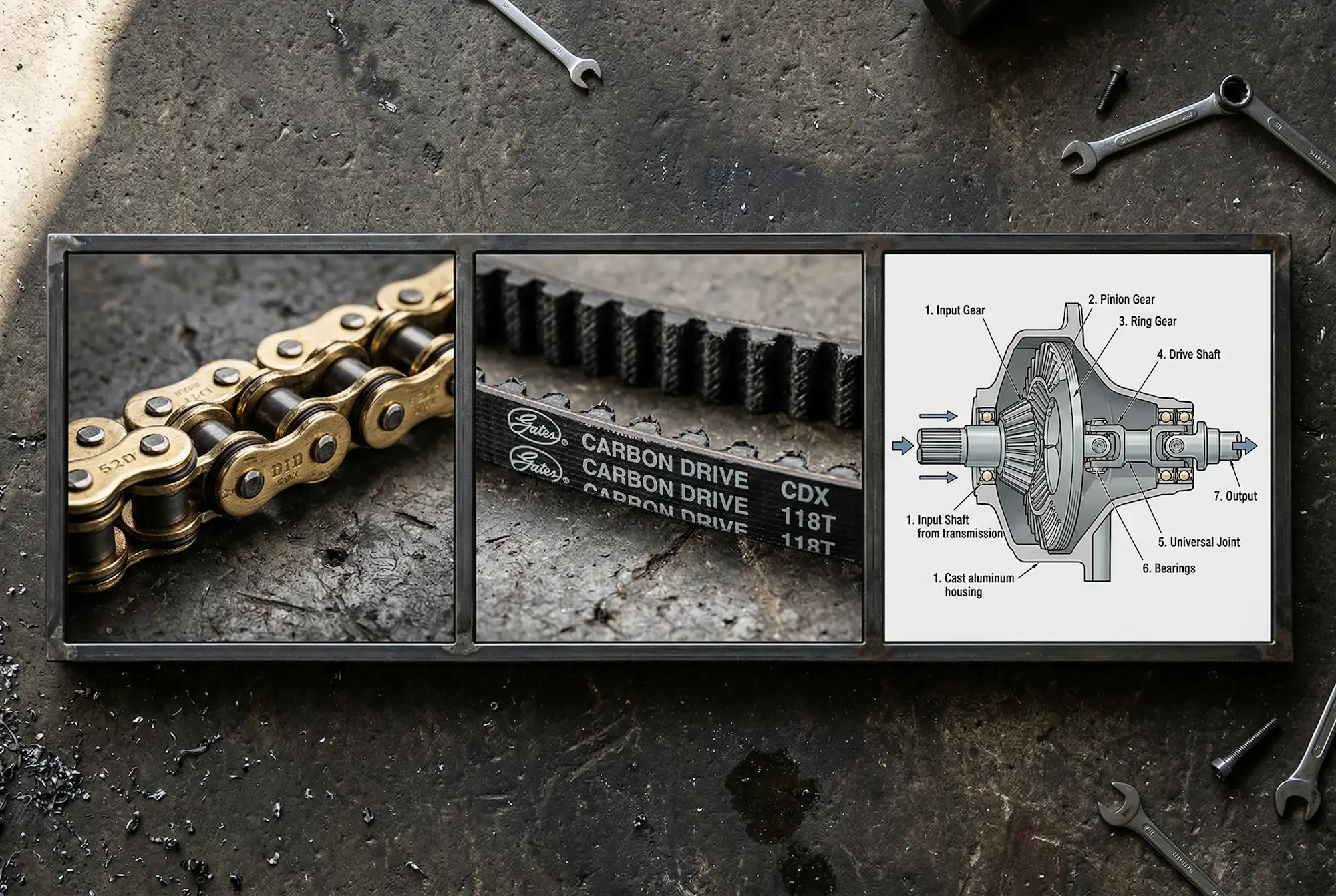
Your motorcycle’s final drive system — chain, belt, or shaft — affects maintenance costs, riding feel, reliability, and even resale value. Yet most riders never think about it until they’re comparing bikes at a dealership and wondering why one needs chain lube every weekend while the other just… doesn’t.
The chain vs belt vs shaft drive motorcycle debate has been running for decades, and it won’t end any time soon — because each system has genuine strengths depending on how you ride. There’s no “best.” There’s only “best for your situation.”
This guide covers how each motorcycle drive system works mechanically, the real-world cost of ownership over 50,000 km, which current bikes use which system, and a clear breakdown of which matters most for your riding style. Let’s settle this properly.
How Each Drive System Works (Quick Breakdown)
Before we compare, you need to understand the basic mechanics of each system. Here’s a no-BS explanation of what’s happening between your gearbox and rear wheel.
Chain Drive
The most common system on motorcycles by a wide margin. A roller chain — typically 520, 525, or 530 pitch (the number refers to chain dimensions in 8ths of an inch) — connects the front sprocket on the gearbox output shaft to the rear sprocket on the rear wheel. What those numbers actually encode — and the one size that breaks the rule — is set out in the motorcycle chain size chart.
Modern chains use O-ring or X-ring seals between the inner and outer plates, trapping factory lubricant inside each roller to reduce wear and extend lifespan. These sealed chains are a massive improvement over older non-sealed designs and are standard on virtually all street bikes today.
Power transfer efficiency sits around 97–99%, making chain the most efficient mechanical final drive option. It’s essentially the same technology as a bicycle chain, just massively beefed up — a 530 chain can handle over 1,000 Nm of tensile force. This is why the chain driven motorcycle dominates everything from 125cc learner bikes to MotoGP prototypes.

Belt Drive
A reinforced toothed rubber belt — usually Kevlar or carbon-fiber reinforced — runs between toothed pulleys on the gearbox and rear wheel. No external lubrication needed.
Belt tension still requires periodic inspection — typically every 5,000–10,000 km. While belts don’t stretch the way chains do (through pin and bushing wear), they do require a specific static tension measured with a dedicated tool (like a Krikit gauge on Harleys). Running a belt too loose causes “ratcheting” — the belt skips teeth under load, which can shred the belt instantly. Running it too tight overloads the output shaft bearing, leading to an expensive repair. “Zero adjustment” is a common myth — it’s more accurate to say “infrequent adjustment.”
Originally associated with Harley-Davidson (which has used belt drive since 1980 on select models), belt drive is now found on bikes like the Indian Scout and Chief range, Kawasaki Vulcan 900, Zero electric motorcycles, and Harley-Davidson’s LiveWire. Power transfer efficiency: approximately 96–98% — slightly lower than a well-maintained chain due to rubber hysteresis (energy lost as the belt flexes around the pulleys).
Belt drive has become the standard on most electric motorcycles because of its silent operation and low-maintenance requirements — two characteristics that pair perfectly with the quiet, smooth nature of electric powertrains. However, not all electric motorcycles use belts: Energica (Ego, Eva, EsseEsse9, Experia) uses chain drive (520 O-ring chain) because the massive instantaneous torque of their motors would require an impractically wide belt for reliable power transfer. Any belt drive motorcycle owner will tell you: the reduced cleaning routine alone is worth the trade-offs.

Shaft Drive
A driveshaft connects the gearbox to a bevel gear at the rear wheel via universal joints — similar in principle to a car’s driveshaft. It’s a sealed, enclosed system that lives entirely out of sight and out of mind.
Found on touring bikes (BMW R-series, BMW R18, Honda Gold Wing), adventure bikes (BMW R1300GS), sport tourers, and some cruisers (Moto Guzzi V85 TT, Yamaha V-Star 1300). Power transfer efficiency: approximately 90–95% — the lowest of the three due to friction losses in the bevel gear.
This efficiency penalty is why shaft drive motorcycles are rarely found on high-performance sportbikes where every horsepower counts. But for touring and ADV applications where longevity and low-maintenance trumps peak efficiency, it’s the gold standard. A well-maintained shaft drive system can easily exceed 200,000 km, though it’s not entirely “zero maintenance forever” — the cush drive rubbers (damper rubbers in the rear hub) dry out over time and develop play, creating a noticeable backlash or “clunk” when transitioning between acceleration and deceleration. These are a wear item that should be inspected periodically and replaced when worn.

Chain vs Belt vs Shaft Drive — The Complete Comparison Table
Here’s every specification that matters, side by side. This motorcycle drive system comparison is the centerpiece of this article — bookmark it for reference when you’re bike shopping.
| Feature | Chain Drive | Belt Drive | Shaft Drive |
|---|---|---|---|
| Power Efficiency | 97–99% | 96–98% | 90–95% |
| Maintenance Required | High (clean & lube every 500–1,000 km, adjust every 1,000–2,000 km) | Low (inspect tension every 5,000–10,000 km, no lube needed) | Very low (oil change every 20,000–40,000 km, inspect cush drive rubbers periodically) |
| Lifespan | 20,000–40,000 km (O/X-ring chain) | 50,000–100,000+ km | Typically lifetime (200,000+ km) |
| Replacement Cost | $100–$300 (chain + sprockets) | $150–$400 (belt only; pulleys rarely need replacing) | $1,500–$3,500+ (final drive unit + labor — rare) |
| Weight | Lightest (1–3 kg total) | Light (1.5–3 kg) | Heaviest (5–10 kg additional) |
| Noise | Moderate (audible chain whir) | Very quiet (nearly silent) | Quiet (slight gear whine at low speed) |
| Gear Ratio Changes | Easy — swap sprockets ($20–$80) | Difficult — limited pulley options, expensive | Impossible without major engineering |
| Off-Road Suitability | Excellent — handles dirt, mud, impact | Poor — a single stone trapped between belt and pulley will sever the reinforcing fibers instantly (catastrophic, non-repairable in the field) | Good — sealed system, handles mud |
| Performance Feel | Direct, immediate throttle response | Smooth, slight dampening | Smooth, slight throttle delay (“shaft jacking”) |
| Common Bike Types | Sport, naked, ADV, MX, most bikes | Cruisers, most electrics (Zero, LiveWire), some classics | Touring, heavy ADV, some cruisers |
Key takeaways: Chain drive wins on versatility and performance — it’s the lightest, most efficient, and the only system that lets you easily change gear ratios. Belt drive wins on low maintenance and silence — minimal lube, infrequent adjustment, near-zero noise. Shaft drive wins on longevity and pure set-it-and-forget-it reliability — change the gear oil once or twice a year and you’re done for decades. No system is universally “best” when it comes to chain vs belt motorcycle pros cons — it always depends on how you ride.
The Real Cost of Ownership — 50,000 km Breakdown
Theory is one thing. Real money over a realistic ownership period tells a clearer story. Here’s what each system actually costs you over 50,000 km (~31,000 miles) — the kind of distance a daily commuter or weekend warrior covers in 3–5 years.
Chain Drive Cost Over 50,000 km
Chains need replacing approximately 1.5–2 times over 50,000 km (assuming 25,000–35,000 km per chain with good maintenance). Sprocket sets typically get replaced with the chain — running a new chain on worn sprockets chews through both faster.
- Chain + sprocket kits: 2 × $150 = $300
- Chain lube (every 500 km, roughly 100 applications): ~$60 (2–3 cans)
- Chain cleaner: ~$30
- Time investment: approximately 30 hours total (adjustments + cleaning sessions)
- Total: ~$390 + 30 hours of your time
Belt Drive Cost Over 50,000 km
A quality carbon-fiber reinforced belt (like Gates Carbon Drive) typically lasts the full 50,000 km or more. You may not need a replacement at all within this period.
- Belt replacement (may not be needed): $0–$200
- No lubrication costs
- Periodic tension inspections (minimal time, but not truly “zero”)
- Time investment: approximately 2–3 hours total (visual and tension inspections)
- Total: $0–$200 + minimal time
Shaft Drive Cost Over 50,000 km
Shaft drive is the cheapest to maintain over this distance. Gear oil changes every 20,000–40,000 km and that’s literally it.
- Gear oil changes: 1–2 × $30 = $30–$60
- No adjustments or external maintenance
- Time investment: approximately 1–2 hours total
- Total: $30–$60 + minimal time
Worth noting: if the shaft or bevel gear does fail (rare), it’s a $1,500–$3,500+ repair on modern BMW or Honda machines (OEM parts alone for a BMW R1200/R1250 driveshaft run $1,000+, before labor). But this almost never happens before 100,000+ km, and many shaft drive systems outlast the rest of the motorcycle entirely. BMW has issued service bulletins requiring driveshaft replacement every 60,000 km on certain R1200/R1250 models — a warranty-covered item, but worth knowing about if you’re buying used.
One important caveat: while shaft and belt are dramatically cheaper to maintain, the bike purchase price often reflects this. Shaft-drive bikes tend to sit in higher price brackets — touring machines and premium ADVs. Belt-drive Harleys and Indians aren’t budget machines either. Chain-drive bikes cover every price range from $3,000 beginner bikes to $30,000+ superbikes, so the up-front savings can easily offset the higher running costs.
Which Drive System Is Best for Your Riding Style?
Here’s where the rubber meets the road — or the chain meets the sprocket, the belt meets the pulley, and the shaft meets the bevel gear. Matching drive system to riding style matters more than any spec sheet comparison.

Best for Commuters and Daily Riders
Belt drive is ideal for commuting. Low maintenance means fewer excuses — you just ride. No chain lube flinging onto your pants or rear wheel. Tension checks are infrequent (every 5,000–10,000 km) rather than weekly adjustments. The near-silent operation is also a huge plus for early-morning departures from residential streets.
If your bike options are chain-only, don’t stress — it’s still perfectly fine. Just commit to a regular lube schedule every 500–1,000 km and you’ll be golden. A shaft drive motorcycle is also excellent for daily commuters covering longer distances.
Best for Sport and Track Riders
Chain drive, no contest. The lightweight design, high efficiency, and easy gearing changes make chains the only serious option for performance riding. You can swap a rear sprocket in 30 minutes to change your final drive ratio for different tracks or riding conditions — try doing that with a belt or shaft.
This is exactly why every MotoGP bike, every WSBK bike, and every race bike at every level of competition uses chain drive. When lap times matter, the 3–8% efficiency advantage and multi-kilogram weight savings are non-negotiable.
Best for Touring and Long-Distance Riders
Shaft drive is the traditional choice for continent-crossing mileage — and for good reason. Brands like BMW and Honda have used it on touring bikes for decades specifically because it requires almost zero roadside maintenance. When you’re 500 km from the nearest dealer in rural Patagonia, that matters.
Belt drive is also excellent here — Harley touring models prove this over hundreds of thousands of km. Chain drive works for touring but means more frequent maintenance stops on multi-day trips and carrying lube in your panniers.
Best for Off-Road and Adventure Riders
Chain drive dominates off-road. Belts are extremely vulnerable to rocks and debris — and this isn’t gradual wear. A single sharp stone that gets trapped between the belt and pulley will sever the reinforcing carbon-fiber or Kevlar strands instantly, destroying the belt completely with zero warning. There is no field repair for a broken belt — you’re calling a tow truck. Chains can take a beating from mud, water, and impacts. Even if a chain breaks on a remote trail, it can be repaired with a chain breaker tool and a spare master link (about $5 and the size of a AA battery in your toolkit).
Shaft drive works off-road too — the BMW R1300GS proves this daily — but adds 5–10 kg of unsprung weight and rotating mass. For serious enduro or technical trail riding, that extra weight low in the bike is a real disadvantage. For fire roads and gravel touring, it’s perfectly fine.
Best for Beginners
Either chain or belt, depending on what bike you buy. Don’t choose a motorcycle based on drive system alone — it’s one factor among many (ergonomics, seat height, engine character, and price matter far more for a new rider). But if it’s a chain-driven bike, budget for maintenance supplies from day one and learn to adjust your chain early. It’s a fundamental motorcycle skill that’ll save you money for as long as you ride.
The “Shaft Jacking” Effect Explained
If you’ve spent any time in shaft-drive forums or reading bike reviews, you’ve seen “shaft jacking” mentioned — sometimes called “shaft effect.” Here’s what it actually is and why it matters (or doesn’t).
The shaft drive’s bevel gear creates a rotational force that pushes the rear of the bike up or down depending on whether you’re accelerating or decelerating. Under acceleration, the rear suspension extends slightly (the bike “lifts”). Under deceleration, it compresses. This creates a slight delay in throttle response feel and can make the ride feel less “connected” compared to chain drive.
BMW’s Paralever system and Moto Guzzi’s CARC (Compact Reactive Shaft Drive) system specifically address this by decoupling the shaft forces from the suspension geometry. The 2024–2026 BMW R1300GS uses an updated EVO Paralever design with larger universal joints and reduced deflection angles, which has further minimized the effect compared to older designs.
Modern shaft-drive bikes have largely tamed shaft jacking. Pre-2005 BMW R-series and older Yamaha FJR1300 models (the FJR1300 is now discontinued in the US but still available in Canada) are more noticeably affected. For the average rider, shaft jacking is barely perceptible and shouldn’t be a deciding factor. For enthusiast riders who obsess over throttle response precision and cornering feedback, it’s a real — if minor — consideration.
Notable Motorcycles by Drive System (2025–2026)
Quick reference table of popular current models so you know what you’re getting when you walk into a dealership.
| Drive Type | Current Models |
|---|---|
| Chain | Honda CB650R, Yamaha MT-07, Kawasaki Z900, Ducati Monster, KTM 890 Duke, Suzuki GSX-8S, Triumph Street Triple, Aprilia Tuono 660, Royal Enfield Himalayan, Triumph Bonneville T120, Honda NT1100, Energica Experia (electric), Energica Ego (electric) |
| Belt | Harley-Davidson Sportster S, Harley-Davidson Road Glide, Indian Scout, Indian Chief, Kawasaki Vulcan 900, Zero SR/F (electric), Zero SR/S (electric), Harley-Davidson LiveWire (electric) |
| Shaft | BMW R18, BMW R1300GS, Honda Gold Wing, Moto Guzzi V85 TT, BMW K1600, Kawasaki Concours 14, Yamaha V-Star 1300, Triumph Tiger 1200 |
Note: Some manufacturers have changed drive systems across model generations, and some models have been discontinued in certain markets. The Honda NT1100, despite being a sport tourer (a category traditionally associated with shaft drive), uses chain drive because it shares its engine and platform with the chain-driven Africa Twin. Its predecessor, the Honda NT700V Deauville, was shaft-driven — so don’t assume a model line keeps the same drive system across generations. The Yamaha FJR1300 — a legendary shaft-drive sport tourer — was dropped from the US lineup for 2025, though it remains available in Canada. Always check the spec sheet of the specific model year you’re considering.

Final drive is a running-cost decision as much as a riding one: chains need the attention set out in cleaning and lubing a motorcycle chain and motorcycle chain adjustment, and the yearly arithmetic of all of it is in how much a motorcycle costs to own. If you are comparing two used machines with different drives, what counts as a lot of miles is the other variable.
Frequently Asked Questions
Can you convert a chain drive motorcycle to belt drive?
Technically possible but expensive and rarely practical. A conversion requires machining new pulleys, modifying the swingarm, and ensuring precise alignment. Aftermarket conversion kits exist for a handful of models — like the Free Spirits kit for the Triumph Bonneville range (~$750+) — but expect to spend $500–$1,500+ for parts alone, plus professional installation. For most riders, it’s simpler and cheaper to buy a bike that already has the drive system you want.
Do belt drive motorcycles break down more often?
No — modern belts are extremely reliable. Carbon-fiber reinforced belts (like Gates Carbon Drive) can last 50,000–100,000+ km. The main risk is puncture or cuts from sharp road debris (rocks, metal), but this is uncommon on paved roads. Belt failure, when it happens, is typically catastrophic and instant — unlike a chain, which gives warning signs (noise, tight spots, visible wear) before failing. On-road, a belt is one of the most dependable components on your entire motorcycle.
Why don’t sportbikes use shaft drive?
Two reasons: weight and efficiency. A shaft drive system adds 5–10 kg versus a chain setup, and its power efficiency is 90–95% compared to a chain’s 97–99%. On a sportbike where every kilogram and every horsepower directly affects lap times, those are significant penalties. The shaft jacking effect also reduces the precision of throttle response that sport riders demand for corner entry and exit control.
How long does a motorcycle chain last?
With proper maintenance — cleaning and lubing every 500–1,000 km and keeping correct tension — a quality O-ring or X-ring chain on a middleweight bike typically lasts 20,000–40,000 km. Neglected chains can wear out in as little as 8,000–15,000 km. Aggressive riding, poor lubrication, incorrect tension, and contamination (dirt, sand) are the main killers. Always replace chain and sprockets together as a complete set — a new chain on worn sprockets (or vice versa) accelerates wear on both.
Is shaft drive maintenance-free?
Nearly, but not quite. Shaft drive requires periodic gear oil changes every 20,000–40,000 km depending on the manufacturer — check your service manual. The oil change itself is simple: drain, refill with the specified gear oil (typically 80W-90 or a manufacturer-specific fluid), and you’re done in 15 minutes. The cush drive rubbers (damper rubbers in the rear hub assembly) are a wear item that should be inspected when you notice a “clunk” during on/off throttle transitions — replacement is straightforward and costs $50–$150 in parts. Beyond that, shaft drive has no routine maintenance. The only “big” service event is bevel gear inspection at very high mileage (100,000+ km), and even that is rare. For all practical purposes, it’s the closest thing to maintenance-free that any mechanical drive system offers.
Why do some electric motorcycles use chain instead of belt?
Torque. Electric motors produce massive instant torque from zero RPM, and high-performance electric bikes like the Energica range generate so much force that a belt would need to be impractically wide to handle it reliably. Energica chose a 520 O-ring chain specifically because it offers a compact, high-strength solution for their motor’s enormous output. Zero and LiveWire, which produce less peak torque, use belt drive successfully. The choice comes down to the specific motor’s torque characteristics and the packaging constraints of the frame.
Wrapping Up
The chain vs belt vs shaft drive motorcycle debate isn’t about which system is “best” — it’s about which fits your riding style, bike choice, and maintenance tolerance. Chain gives you versatility and performance. Belt gives you peace of mind and silence. Shaft gives you near-zero maintenance and extreme longevity.
Most riders will be perfectly happy with whatever drive system comes on the bike they love. Just know the trade-offs so you can maintain it properly and set realistic expectations for the road ahead.