
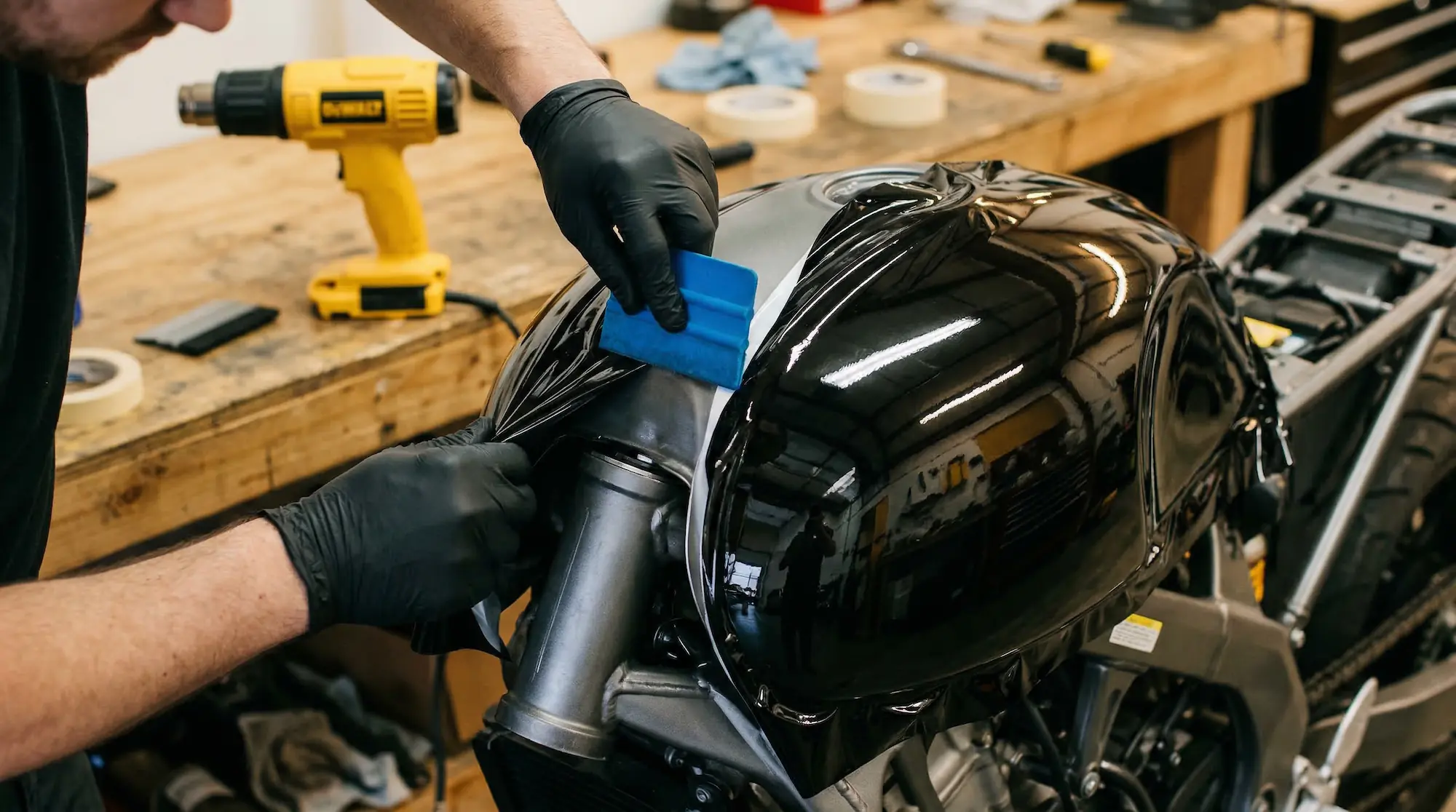
If you are looking to completely transform the look of your bike without committing to a permanent, expensive paint job, you are likely asking: exactly how much does it cost to wrap a motorcycle? The direct answer is that having a motorcycle wrapped professionally costs between $1,500 and $3,500 in most cases. A smaller commuter bike can come in significantly lower, while a massive touring rig with full fairings and hard bags can push past $4,000. Tackling the project yourself brings the cost down to just $200–$600 for the raw vinyl material.
This price range comes down to three main factors: the size and structural complexity of your motorcycle, the specific type of vinyl finish you choose, and whether you pay for professional labor or do it yourself. This guide breaks down the true motorcycle wrap cost with detailed pricing tables by bike type and finish, and compares vinyl wrap against custom paint so you can make the best decision for your ride.
Table of Contents
- Quick Answer: Wrap Cost at a Glance
- Motorcycle Wrap Cost by Bike Type
- Motorcycle Wrap Cost by Finish Type
- Professional vs. DIY — Real Cost Comparison
- Motorcycle Wrap vs. Custom Paint
- How Long Does a Motorcycle Wrap Last?
- How Much Vinyl Do You Need?
- Frequently Asked Questions
How Much Does It Cost to Wrap a Motorcycle? Quick Answer
| Type of Wrap | Cost (Professional) | Cost (DIY, Vinyl Only) |
|---|---|---|
| Full motorcycle wrap | $1,500–$3,500 | $200–$600 |
| Tank wrap only | $100–$300 | $30–$80 |
| Fairings only | $200–$600 | $80–$200 |
| Partial (tank + fairings) | $300–$1,000 | $100–$300 |
Professional pricing includes premium vinyl (3M 2080 or Avery Dennison SW900) and expert installation. DIY cost reflects vinyl material only — a heat gun and quality squeegee will add $40–$80 if you do not already own them.
Motorcycle Wrap Cost by Bike Type
Why does bike type matter so much? Surface area and geometry. Wrapping a car is relatively straightforward because the panels are large and gently curved. Motorcycles are the opposite. A naked bike has limited surface area but extreme tank curves. A sport bike is covered in complex fairings with aggressive aerodynamic cuts, vents, and sharp angles that require meticulous stretching and heat manipulation. A full-size touring bike has roughly the surface area of a compact car when you factor in the batwing fairing, tank, side covers, and saddlebags.
| Bike Type | Vinyl Needed | Full Wrap Pro Cost | Notes |
|---|---|---|---|
| Scooter / Small Commuter | ~10 ft | $500–$1,200 | Less surface area, generally simpler panels. |
| Naked / Street (MT-07, CB650R) | ~10–12 ft | $800–$1,800 | No complex fairings, mostly tank and tail sections. |
| Sport Bike with Fairings (R6, Ninja 650) | ~12–14 ft | $1,500–$2,500 | Complex curves, vents, and high installation time. |
| Cruiser (Softail, Sportster) | ~12–15 ft | $1,500–$2,500 | Detailed work required around chrome pieces and classic lines. |
| Large Touring (Street Glide, Gold Wing) | ~15 ft+ | $2,500–$3,500 | Saddlebags, trunks, and large fairings multiply surface area and time. |
Sport bikes carry a premium labor charge over naked bikes because the installer must disassemble, prep, wrap, and reassemble multiple plastic fairing pieces. For touring bikes, the sheer volume of material and the intensive work required to wrap hard saddlebags flawlessly drives the price to the top tier.
Motorcycle Wrap Cost by Finish Type
The material itself plays a major role in your final bill. Standard gloss colors are highly pliable, easier to manufacture, and forgiving to stretch over complex curves. Specialty finishes change the equation. Chrome wraps are notoriously stiff and prone to whitening or distorting if overstretched — installers must work slower and more carefully, which drives up labor time and cost.
| Finish Type | Additional Cost vs. Base | Expected Durability |
|---|---|---|
| Gloss | Base price (cheapest) | 5–7 years with good care |
| Matte | +10–15% vs. gloss | 5–7 years (requires specific cleaning products) |
| Satin | +10–20% vs. gloss | 5–7 years |
| Metallic | +15–25% vs. gloss | 5–7 years |
| Carbon Fiber Look | +20–30% vs. gloss | 4–6 years (more prone to surface scratching) |
| Chrome | +50–100% vs. gloss | 3–5 years (very delicate, scratches easily) |
| Custom Graphics / Design | +$100–$500 design fee | Variable based on base material |
Practical recommendation: If you are on a strict budget or tackling your first DIY wrap, stick to standard gloss or matte. They are the most forgiving during installation, the easiest to maintain long-term, and the most widely available from premium brands. Chrome looks incredible but is expensive, fragile, and genuinely difficult for amateur installers to apply without distortion.
Professional Installation vs. DIY — Real Cost Comparison
The motorcycle wrap DIY cost is undeniably attractive, but it comes with a steep learning curve.
Professional Installation: You are guaranteed a showroom-quality finish with no bubbling, peeling edges, or visible seams. Professionals also manage the severe, complex geometries of motorcycle fairings and tanks that defeat most first-time installers. Most reputable shops offer an installation warranty. The trade-off is the upfront cost: $1,500–$3,500 is a serious investment for purely aesthetic work.
Who it is for: Riders who demand absolute perfection, anyone with a heavily faired sport bike or full touring rig, or anyone without days of free time to dedicate to the project.
DIY Installation: The savings are massive — $1,000–$2,500 in labor costs eliminated. There is also genuine satisfaction in customizing your own machine. The honest trade-offs: wrapping a motorcycle tank is significantly harder than wrapping a car hood due to multi-directional curves. Mistakes are inevitable for beginners, and overtretching or tearing a panel means buying more vinyl.
Required tools: A proper heat gun ($25–$50), soft plastic squeegees with felt edges, knifeless tape, and precision cutting blades. A hairdryer is not a substitute for a heat gun — it cannot generate the sustained, focused heat required to properly stretch vinyl around deep curves.
Who it is for: Riders with high patience, experience in precise manual work, or those with simple bikes like a naked or cruiser with minimal fairing panels.
💡 DIY Pro Tip: Do not start with the gas tank. Order 15–20% extra vinyl and practice on a small, relatively flat piece like a side cover or front fender first. Understand how the material reacts to heat and stretching before tackling the main visual focal points.
Motorcycle Wrap vs. Custom Paint — Which Is Better Value?
| Factor | Vinyl Wrap | Custom Paint |
|---|---|---|
| Cost | $1,500–$3,500 (Pro) | $3,000–$8,000+ |
| Time | 1–3 days | 1–3 weeks |
| Reversible | Yes — safely removable | No — permanent |
| Protects Original Paint | Yes, acts as a protective layer | Replaces the original paint entirely |
| Durability | 5–7 years | 10–15+ years |
| Customization | Very high — any color or graphic | Very high |
| Resale Value Impact | Neutral/Positive (preserves factory paint) | Variable — custom designs can limit buyer appeal |
Vinyl wrap wins on raw cost, speed of application, and reversibility. Custom paint is the undisputed leader in long-term durability — hardened automotive clear coat resists direct impacts that would gouge a vinyl panel. If you are building a permanent show bike, custom paint is the correct investment. If you ride regularly, want to protect your OEM paint from rock chips, and want the flexibility to change your bike’s appearance every few years, wrapping is the superior practical choice. For a full picture of what ongoing ownership costs look like beyond cosmetics, our motorcycle tune-up cost guide covers the maintenance expenses that come with any bike you customize.
How Long Does a Motorcycle Wrap Last?
Premium vinyl brands — 3M 2080 and Avery Dennison SW900 — installed correctly and maintained properly will last 5–7 years. Unbranded vinyl sourced from unknown suppliers typically begins to bubble, peel, or fade from UV exposure within 1–3 years, regardless of how well it is installed.
What shortens wrap lifespan: Leaving the bike parked outdoors in direct sunlight daily without a cover (UV radiation is vinyl’s primary enemy), using high-pressure power washers directly on seams and edges, and applying harsh abrasive or solvent-based cleaners.
What extends wrap lifespan: Storing the bike in a garage or under a quality motorcycle cover, washing exclusively by hand with low-pressure water and pH-neutral soap, and applying a dedicated UV-protectant spray formulated for vinyl wraps every six months. Winter storage is particularly important — our motorcycle winterization guide covers the correct storage procedure including protecting exterior surfaces from the temperature cycling and moisture that degrades vinyl over a storage season.
How Much Vinyl Do You Need to Wrap a Motorcycle?
For a DIY project, most bikes require a roll approximately 5 feet wide by 10–15 feet long:
- Naked bikes / scooters: ~10 linear feet.
- Sport bikes with full fairings: ~12–14 linear feet.
- Touring bikes with saddlebags and trunks: ~15 linear feet or more.
Never order the exact minimum. Always buy 15–20% extra. Deep stretching around the gas tank consumes more material than flat calculations suggest, and you will need the backup footage if you have to redo a panel during the learning process.
Frequently Asked Questions
How much does it cost to wrap a motorcycle professionally?
A complete professional motorcycle wrap costs $1,500–$3,500 in most scenarios. Smaller motorcycles like scooters or naked street bikes typically come in at $800–$1,200. Massive touring motorcycles with hard saddlebags and full front fairings (Honda Gold Wing, Harley Street Glide) can exceed $3,500 due to the labor time involved. This price should always include premium materials like 3M 2080 or Avery Dennison SW900. Always request a detailed quote that explicitly states the vinyl brand and model being used — a shop unwilling to specify the material is a red flag.
How much does it cost to wrap a motorcycle yourself?
Raw material cost runs $200–$600 for enough high-quality vinyl to complete a full wrap. Add $40–$80 for a heat gun, squeegees, and a precision cutting knife if you do not already own them. Factor in your time: a full bike wrap takes 2–4 days for a beginner, and ruining a panel means reordering material. The total DIY expenditure can creep up toward $700–$800 if multiple panels need to be redone.
Is it cheaper to wrap or paint a motorcycle?
Wrapping is significantly cheaper. A professional wrap runs $1,500–$3,500 versus $3,000–$8,000+ for a professional custom paint job. Wrapping is also reversible and protects the original paint underneath. Paint wins on longevity (10–15+ years versus 5–7 for vinyl) and resistance to direct mechanical impacts like dropped tools.
How long does a motorcycle vinyl wrap last?
With premium vinyl (Avery Dennison SW900 or 3M 2080) installed correctly and maintained properly, 5–7 years. Cheap unbranded vinyl typically degrades, bubbles, or fades within 1–3 years. The key variables are UV exposure management (garage storage or quality cover) and cleaning method (hand wash with pH-neutral soap only, no high-pressure washing near seams).
Does wrapping a motorcycle affect its resale value?
In most cases positively or neutrally. The vinyl acts as a protective shield against rock chips and UV fading — removing it before selling typically reveals factory-condition paint underneath, which is a genuine selling point. A beautifully installed wrap can also improve visual appeal. A poorly installed, peeling, or bubbling wrap will deter buyers. The reversibility of a wrap is one of its strongest advantages over custom paint from a resale perspective.
A well-installed wrap is one of the most versatile modifications you can make to a motorcycle. It shields your factory paint, is entirely reversible, and lets you completely transform the look of the bike for a fraction of the cost of high-end custom paint. The golden rule regardless of path: do not cheap out on the vinyl. The few dollars saved on unbranded material will cost you years of durability. If you go DIY, practice on a small piece first. If you take it to a pro, make sure the invoice specifies the vinyl brand. Thinking about picking up a used bike to customize? Our guide on how long motorcycles last covers exactly what to look for in a used bike before committing to a cosmetic investment.