
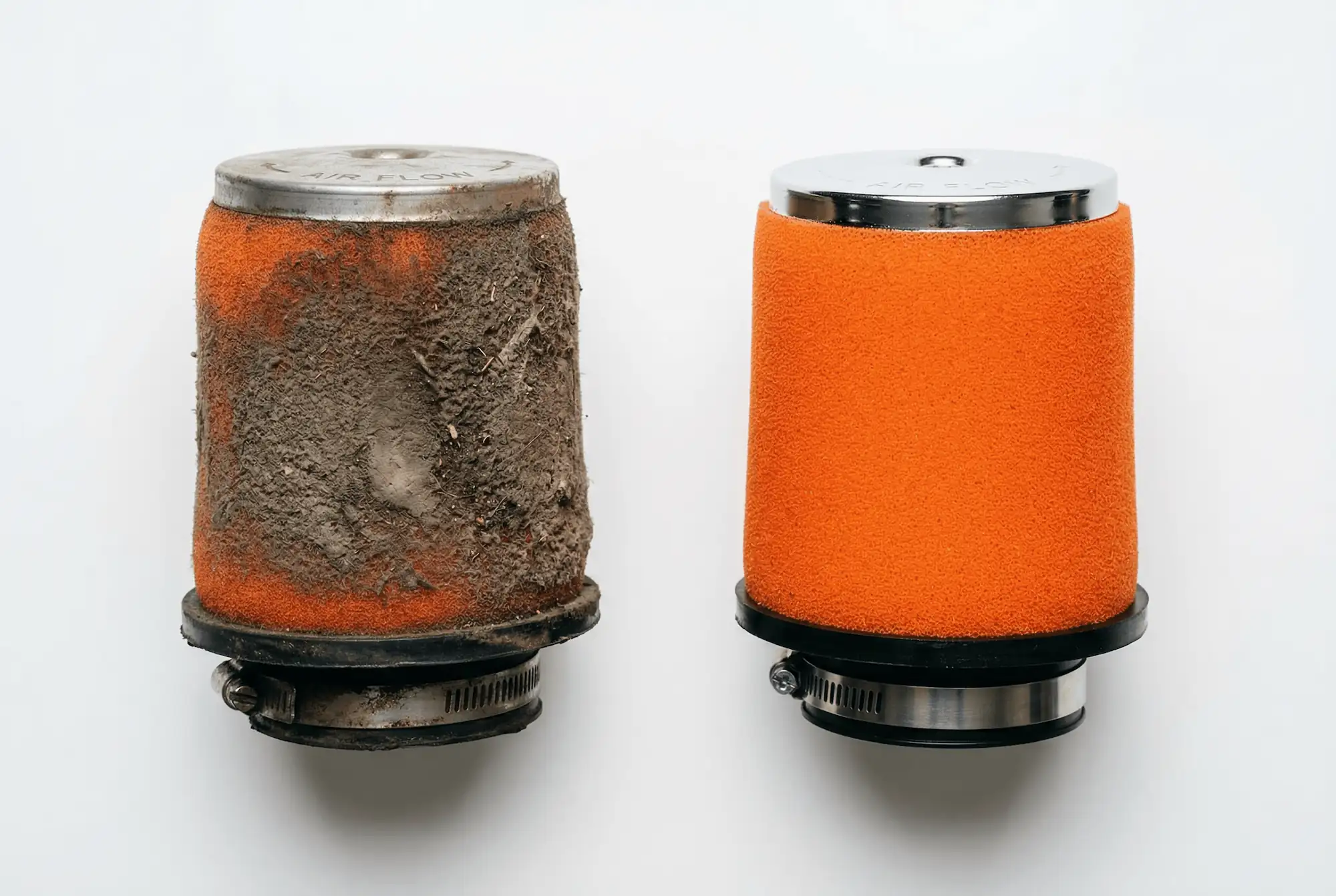
Your motorcycle’s air filter is the only barrier between the outside world and your engine’s internals. Every grain of dust, every bug, every particle of road grit that gets past a dirty or damaged filter ends up grinding against pistons, rings, and valve seats. A clogged filter chokes airflow, killing power and increasing fuel consumption. A damaged filter lets contaminants straight through. Either way, your engine loses.
Cleaning your motorcycle air filter is one of the easiest maintenance tasks on any bike — but the method depends entirely on which type of filter you have. This guide covers all three: foam, paper, and cotton/oiled gauze (K&N-style), with step-by-step instructions for each. Whether you ride street, dirt, or adventure, you’ll know exactly how to clean a motorcycle air filter the right way.
Why a Clean Air Filter Matters — What Happens If You Skip It
A dirty air filter isn’t just an inconvenience — it actively damages your engine over time. Here’s what happens when you neglect motorcycle air filter maintenance:
- Reduced power output — a clogged filter restricts airflow, starving the engine of oxygen. A heavily restricted filter can cost you 5–10% of your usable power. On a 50hp commuter bike, that’s 3–5 horsepower you’re leaving on the table.
- Increased fuel consumption — the engine compensates for less air by running rich (more fuel per combustion cycle), wasting gas and leaving unburned fuel in the exhaust.
- Engine wear — a damaged or poorly maintained filter lets fine abrasive particles through. Dust wears piston rings, cylinder walls, and valve seats. This damage is cumulative and irreversible without a rebuild. Desert and off-road riders are especially vulnerable — fine sand is essentially liquid sandpaper for engine internals.
- Carbon buildup — running rich from restricted airflow deposits carbon on spark plugs, valves, and combustion chambers, degrading performance further.
- Fouled spark plugs — rich running produces black, sooty deposits on plugs, causing misfires, rough idle, and hard starting.
⚠️ A brand-new air filter costs $10–$40. An engine rebuild costs $1,000–$5,000+. Clean your filter.
The 3 Types of Motorcycle Air Filters
1. Foam Filters
Made of open-cell polyurethane foam, coated in sticky filter oil that traps fine particles the foam structure alone would miss. Without oil, fine dust passes right through — the oil is not optional.
Used on: most dirt bikes, motocross, enduro, some ADV bikes, and some older street bikes. Pros: excellent filtration when properly oiled, washable and reusable, cheap to replace ($10–$20). Cons: requires re-oiling after every wash, messy to work with, needs frequent attention in dusty conditions.
2. Paper Filters
Made of pleated cellulose or synthetic paper media. This is the OEM standard on most modern street motorcycles and scooters.
Used on: the majority of street bikes, sport-touring bikes, and scooters as factory equipment. Pros: high filtration efficiency, no oiling required, cheap ($10–$25), easy to install. Cons: NOT washable — paper degrades when wet. Must be replaced when dirty, not cleaned. Some synthetic paper filters can be gently blown clean with low-pressure compressed air from the inside out, which extends life slightly but doesn’t fully restore filtration.
3. Cotton/Oiled Gauze Filters (K&N Style)
Made of oiled cotton gauze sandwiched between layers of aluminum mesh. These are aftermarket performance filters — K&N, BMC, Sprint Filter, and DNA are the major brands — designed as drop-in replacements for paper OEM filters.
Used on: any bike where the rider has upgraded from the stock paper filter. Pros: washable and reusable (50,000+ mile lifespan with proper care), slightly better airflow than paper, one filter replaces a lifetime of paper replacements. Cons: more expensive upfront ($40–$80), requires a specific cleaning kit and re-oiling process, and over-oiling can contaminate the intake tract on fuel-injected bikes.
How to Clean a Motorcycle Foam Air Filter (Dirt Bikes & Off-Road)
This is the most involved process but one every dirt rider needs to master. Here’s the complete how to clean motorcycle air filter procedure for foam filters:
- Prep the area — clean around the airbox BEFORE removing the filter. Wipe away any mud or dust from the seat area and airbox cover so nothing falls into the intake when you open it.
- Remove the filter — take off the seat or side panel (model-dependent), then remove the filter from its cage.⚠️ Stuff a clean rag into the airbox intake opening while the filter is out — this prevents any debris from entering the engine.
- Shake off loose dirt — gently tap and shake the filter. Do NOT twist or wring the foam — it tears easily along the seam lines.
- Soak in filter cleaner — submerge in a purpose-made air filter cleaner (Maxima, Twin Air, or Muc-Off are popular options for petroleum-based oil systems; No-Toil makes its own cleaner for its biodegradable oil system). Let soak 1–5 minutes, then gently massage to release trapped dirt and old oil. ⚠️ Warning — Do NOT mix chemical ecosystems. Biodegradable systems like No-Toil use enzyme-based cleaners formulated exclusively for their own oil. Using No-Toil cleaner on a filter treated with standard petroleum-based oil (such as Maxima, Bel-Ray, or Twin Air oil) will create a sticky, un-washable residue that ruins the filter. Likewise, petroleum-based solvents will not properly remove No-Toil oil. Always use the cleaner designed for the oil you applied. ⚠️ NEVER use gasoline, brake cleaner, or aggressive solvents — they degrade the polyurethane foam and dissolve the adhesive on seams.
- Rinse thoroughly — rinse with warm water and a small amount of dish soap. Rinse from the inside out to push contaminants away from the filtration surface. Repeat until the water runs clear.
- Dry completely — squeeze gently (no wringing), then air dry in a clean, dust-free area. Do NOT use a heat gun, hair dryer, or clothes dryer — heat degrades the foam glue. The filter must be 100% dry before oiling — moisture trapped under oil eventually causes problems inside the engine.
- Re-oil the filter — apply motorcycle foam air filter oil (spray or liquid). The best method: place the filter in a plastic bag with oil, massage until the entire filter is uniformly colored throughout with no dry spots. Squeeze out excess — you want even, complete coverage without heavy pools or dripping. After oiling, let the filter sit in a well-ventilated area for 15–30 minutes before installing. This allows the carrier solvent (alcohol, propellant, or water depending on the brand) to evaporate, leaving only the tacky oil behind. If you install and start the engine immediately, the motor will aspirate the carrier solvent, causing erratic idle, backfiring, or an overly rich mixture that can stall the engine. Water-based oils like No-Toil Evolution may need up to several hours of drying time — check the product label.
- Grease the seal — apply a thin bead of waterproof grease to the filter’s rim/lip where it contacts the airbox housing. This prevents fine dust from sneaking past the seal — a detail that separates careful maintenance from sloppy work. Exception: if your filter has a thick neoprene sealing ring (such as modern Twin Air or Moose Racing filters, which are specifically marketed as “greaseless”), skip the grease. These neoprene rings are designed to seal without it. Applying grease to a neoprene seal can attract dust and create an abrasive paste that degrades the ring over time. Only use grease on traditional foam filter bases without a dedicated neoprene ring.
- Reinstall — remove the rag from the intake opening. Seat the filter on its cage, install in the airbox, and replace the seat or panel.
💡 Pro tip: serious dirt riders keep a spare pre-oiled filter ready to go. Pull the dirty filter, immediately install the clean spare, and wash the dirty one at home later. This minimizes downtime between rides and ensures you never ride with a dirty filter because you “didn’t have time” to clean it.
Inspect Before Reinstalling
Every time you clean a foam filter, check for tears or holes in the foam, degraded glue on seams, and foam that’s become brittle or crumbly. Any damage means replace the filter immediately. A torn filter is worse than no filter because it gives false confidence — you think you’re protected, but dust is pouring through the tear straight into the engine.
How to Clean a K&N Motorcycle Filter (Cotton/Oiled Gauze)
The process for cleaning a cotton/oiled gauze filter is different from foam — the pleated structure requires gentler handling and brand-specific products:
- Remove the filter — take it out of the airbox. Note the orientation for correct reinstallation.
- Apply dedicated filter cleaner — use the brand-specific cleaning solution (K&N Power Kleen, BMC Detergent, or equivalent). Spray generously on both sides of the filter. Let it sit for 10 minutes to dissolve the old oil and loosen embedded dirt.
- Rinse with low-pressure water — rinse from the clean side (inside) outward. Use a gentle stream — no high-pressure water, which can damage the delicate cotton pleats. Continue rinsing until the water runs clear.
- Air dry completely — set the filter upright in a clean area. Allow it to air dry fully — typically 1–4 hours depending on humidity and airflow. Do NOT use compressed air or heat to speed drying, as both can damage the cotton gauze structure.
- Re-oil — apply filter oil evenly along each pleat. Let the oil wick into the cotton for about 20 minutes, then check for any dry (uncolored) spots and add a touch more oil there. The filter should be uniformly pink/red (K&N) or the brand’s indicator color with no white patches visible.
⚠️ Do NOT over-oil. Excess oil can be pulled into the throttle body and contaminate the intake tract. On fuel-injected bikes, excess oil can coat the MAP (Manifold Absolute Pressure) or MAF (Mass Air Flow) sensor and the throttle body butterflies. An oil-coated sensor misreads air density, causing fuel injection errors — erratic idle, poor throttle response, and diagnostic trouble codes that are expensive to chase down. The fix is a dedicated MAF sensor cleaner spray, but prevention is far easier: apply sparingly. This is the most common mistake when cleaning a K&N motorcycle filter. Apply sparingly — even, complete coverage matters more than heavy coverage. If the filter is dripping oil, you’ve used too much — blot the excess with a paper towel before installing.
Paper Filters — Clean or Replace?
Short answer: replace, don’t clean.
Paper filters are designed as disposable items. The cellulose fibers degrade when wet, and the fine pleated structure can’t be effectively restored by washing. Your limited cleaning options include gently tapping the filter to shake off loose debris (extends life slightly) and using low-pressure compressed air from the inside out only — never from outside, which pushes dirt deeper into the fibers.
If using compressed air, keep the pressure at or below 30 PSI and hold the nozzle at least 2 inches from the filter media. Standard shop compressors run at 90–120 PSI, which will invisibly tear the cellulose microfibers — the filter will look clean but will pass fine dust straight through. Use a regulator to dial the pressure down, or use a low-pressure blowgun attachment.
For a quick inspection, hold the filter up to a light source. If light passes through relatively evenly, the filter still has usable life. If sections are dark and opaque with no light penetration, it’s time to replace.
⚠️ Paper filters are cheap at $10–$25. When in doubt, just replace it. The peace of mind is worth more than the cost of a new filter.
Motorcycle Air Filter Cleaning Schedule
| Riding Type | Filter Type | Cleaning / Replacement Frequency |
|---|---|---|
| MX / enduro racing | Foam | After EVERY ride (or every 2–3 hours of riding) |
| Trail / casual off-road | Foam | Every 2–5 rides (sooner in dusty conditions) |
| ADV touring (mixed) | Foam or cotton | Every 3,000–5,000 miles or after any dusty off-road ride |
| Street commuting | Paper | Replace every 8,000–15,000 miles (check at each service) |
| Street commuting | Cotton (K&N) | Clean every 10,000–15,000 miles |
| Sport / track | Cotton (K&N) | Clean every 5,000–10,000 miles |
These are guidelines, not hard rules. If you ride in dusty, sandy, or heavily polluted environments, increase your frequency. If you notice power loss, hesitation, poor fuel economy, or black smoke from the exhaust, check the filter immediately regardless of mileage.
Don’t Forget the Airbox
Every time the filter is out, take two minutes to clean the inside of the airbox. A clean filter sitting in a dirty airbox is only half the job. This step is often skipped even by experienced riders, but accumulated dirt inside the airbox can migrate onto a freshly cleaned filter the moment you reinstall it.
- Wipe the interior walls with a clean rag dampened with contact cleaner or mild solvent.
- Remove any accumulated dust, debris, mud, or old oil residue.
- Inspect the airbox seal and gasket for cracks, warping, or deterioration.
- Check that the intake boot (connecting the airbox to the carburetor or throttle body) is tight, properly clamped, and not cracked.
⚠️ Do NOT blow compressed air inside an open airbox unless you have first blocked the intake tract (the opening that leads to the carburetor or throttle body) with a perfectly clean rag or mechanical plug. Compressed air lifts settled dust and blasts it directly into the intake — straight toward the engine’s valves. A dampened rag wiped by hand is the safest and most effective method for cleaning the airbox interior.
Any gap or crack in the airbox system allows unfiltered air to bypass the filter entirely — defeating the purpose of motorcycle air filter cleaning in the first place.
A filter service is one of the cheapest jobs on the machine, which makes it a useful yardstick for the rest: the full running-cost picture is in how much a motorcycle costs to own and the shop equivalent in how much a motorcycle tune-up costs. If the filter came out of a bike you are considering buying, read it alongside what counts as a lot of miles.
Frequently Asked Questions
Can I use gasoline to clean a foam air filter?
No. Gasoline degrades the polyurethane foam and dissolves the adhesive holding the seams together. It also evaporates leaving harmful residues. Use a purpose-made air filter cleaner — products from Maxima, Twin Air, and Muc-Off are formulated to degrease without damaging the foam material. If you use No-Toil oil, use only the No-Toil cleaner — their biodegradable system is chemically incompatible with petroleum-based cleaners.
What happens if I ride with no air filter?
Unfiltered air carries abrasive particles directly into the engine, causing accelerated wear on piston rings, cylinder walls, and valve seats. This damage is irreversible without an engine rebuild. Even a single dusty ride without a filter can cause measurable wear. Never ride without one installed.
Can I wash a paper air filter?
No. Paper filters are designed as disposable items. Water degrades the cellulose fibers and reduces filtration efficiency permanently, even after drying. Replace paper filters when they’re dirty — they’re cheap at $10–$25 and widely available for virtually every motorcycle model.
How much filter oil should I use?
Enough to evenly color the entire filter with no dry spots visible, but not so much that it drips. An over-oiled filter restricts airflow and can contaminate the intake tract. For foam filters, the typical amount is roughly 1.5–2 oz. Apply oil, massage it in thoroughly, squeeze out excess, and check for uniform coverage before installing. Remember to let the filter sit for 15–30 minutes after oiling so the carrier solvent evaporates before you install and start the bike.
Is a K&N filter better than a stock paper filter?
It depends on your priorities. K&N-style cotton gauze filters allow slightly more airflow (1–3% in most independent tests — often within the margin of error for real-world riding). Their main advantage is reusability: one K&N filter at $50–$80 replaces a lifetime of paper filters at $15 each. Over 50,000 miles, a paper filter at $15 replaced every 12,000 miles costs about $60 total, while a single K&N costs $50–$80 plus ~$15 for a cleaning kit. The economics are roughly comparable, but the K&N generates less waste. For most street riders, the stock paper filter provides excellent filtration and the airflow difference is not perceptible during normal riding. If you want the convenience of cleaning instead of replacing, a K&N is a solid choice for street and track use. However, independent ISO 5011 laboratory testing consistently shows that cotton gauze filters allow significantly more fine micron-sized dust through than OEM paper filters — in one controlled test, a paper filter passed 0.4 grams of dust while a cotton gauze filter passed 7.0 grams under identical conditions. If you ride an adventure bike in dusty or sandy environments, stick with the OEM paper filter for superior engine protection against fine silica particles.
Wrapping Up
Motorcycle air filter cleaning takes 15–30 minutes and costs almost nothing in materials. Skipping it costs you power today and engine life down the road. Match the method to your filter type — foam gets washed and re-oiled, cotton gauze gets cleaned and re-oiled with brand-specific products, and paper gets replaced. Check your filter on schedule, always inspect for damage before reinstalling, and don’t forget to clean the airbox while you’re in there.