
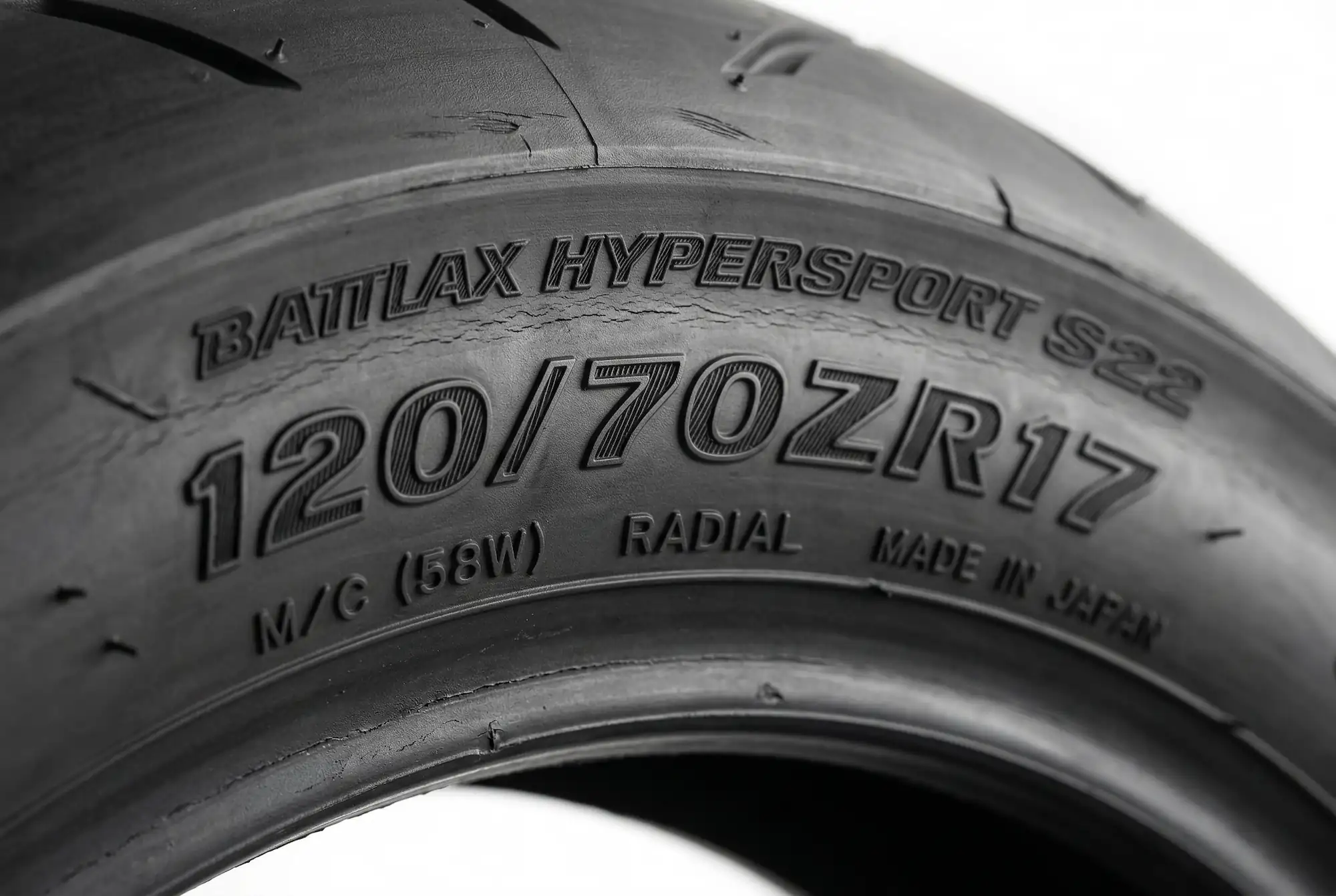
The string of numbers and letters on your motorcycle tire sidewall — something like 180/55ZR17 73W — looks like a secret code, but every character has a specific meaning. Understanding motorcycle tire size isn’t just trivia — it directly affects your bike’s handling, safety, speedometer accuracy, and whether the tire even fits your rim. Get the size wrong and you could end up with a tire that rubs the swingarm, throws off your ground clearance, or doesn’t seat properly on the wheel.
This guide decodes every number and letter using a real tire as the example, so you can confidently buy the right rubber for your bike. We’ll also cover all four tire sizing systems (because older bikes use different formats), speed ratings, load index, and the motorcycle tire numbers meaning that most guides skip over. Whether you’re shopping for your first set of tires or trying to figure out if you can upsize your rear, this is the reference you’ll want to bookmark.
Let’s Decode a Real Tire — 180/55ZR17 73W
This is the most common format you’ll see on modern motorcycles (metric system). Let’s break down each element left to right, so you know exactly how to read motorcycle tire size on any bike.
180 — Tire Width (in Millimeters)
The first number is the section width — the tread width measured in a straight line across the widest point of the tire when mounted and inflated. 180mm equals approximately 7.1 inches. Wider tires mean a larger contact patch with the road, which translates to more grip but heavier steering input. Front tires on most bikes range from 110–130mm, while rears are typically 150–200mm+ on sportbikes and touring machines.
Bike type dictates typical widths. A Ninja 400 runs a 110mm front and 150mm rear. A Hayabusa or liter-class superbike uses a 120mm front and 190–200mm rear. Touring bikes like the Gold Wing run 130mm front and 200mm rear. The width needs to match your rim — a tire that’s too wide for the rim won’t seat properly, and one that’s too narrow will have an excessively rounded profile that hurts stability.
55 — Aspect Ratio (Sidewall Height as % of Width)
The second number is the aspect ratio — the sidewall height expressed as a percentage of the tire width. In our example: 180mm × 0.55 = 99mm sidewall height. A lower aspect ratio means a shorter sidewall, which gives quicker steering response but a harsher ride. A higher number means a taller, more cushioned sidewall but less precise handling.
Typical aspect ratio ranges by bike type: sportbikes use 50–60 (short, stiff sidewalls for fast turn-in), touring bikes favor 70–80 (more cushion for long rides and bumpy roads), and cruisers sit at 70–90 (tall sidewalls complement the relaxed geometry). The aspect ratio directly affects your bike’s overall ride height and ground clearance, so changing it — even by 5% — alters how the bike handles and how far you can lean before scraping hard parts.
Z — Speed Rating (Embedded in Size String)
The letter between the aspect ratio and the construction type is the speed rating — the maximum sustained speed the tire is designed to handle. Z means 149+ mph (240+ km/h). This is safety-critical: never mount a tire with a lower speed rating than your bike’s manufacturer specifies. A full speed rating table is below.
R — Construction Type
R = Radial. The cords in the tire’s plies run radially (perpendicular to the direction of travel). B = Bias-belted. No letter or “–” = Bias-ply (diagonal cords). Radial tires are standard on modern sportbikes and touring bikes — they offer better high-speed stability, heat dissipation, and tread life. Bias-ply tires are still common on cruisers, vintage bikes, and off-road motorcycles.
The practical difference matters more than you’d think. Radial tires flex in the sidewall while keeping the tread flat on the road, which means better grip in corners and more consistent handling as the tire heats up during aggressive riding. Bias-ply tires flex across the entire carcass, which makes them more load-bearing (good for heavy cruisers) but less stable at sustained highway speeds. The construction type is one of the most important motorcycle tire numbers meaning — it tells you how the tire was built from the inside out.
⚠️ Do not mix radial and bias-ply tires on the same motorcycle UNLESS your motorcycle’s manufacturer specifies a mixed fitment. Several manufacturers — including Harley-Davidson, Yamaha, Honda, and Triumph — produce models that come factory-equipped with a bias-ply front tire and a radial rear tire. Examples include the Harley-Davidson Softail Breakout (130/60B-19 bias front, 240/40R-18 radial rear), Yamaha Raider S (120/70-21 bias front, 210/40R-18 radial rear), Honda Fury, and some Triumph Thruxton/Bonneville models. These chassis were specifically engineered and tested for that mixed combination. However, if your motorcycle came with matched construction types (both radial or both bias-ply), do NOT mix them on your own — radial and bias-ply tires have fundamentally different flex characteristics, and unauthorized mixing creates unpredictable handling in corners. When mixed fitment is specified by the OEM, the bias-ply tire is always on the front — never the other way around. Dunlop and Michelin’s official position: “do not mix bias ply and radial tires on the same motorcycle unless it is with the approval of the motorcycle or tire manufacturer.”
17 — Rim Diameter (in Inches)
The number after the construction letter is the wheel diameter the tire fits. Common motorcycle rim sizes include 16″ (cruisers), 17″ (sportbikes, naked bikes, standards), 18″ (some cruisers, older bikes), and 19″–21″ (adventure and dual-sport front wheels). This number must match your wheel exactly — a 17″ tire will not fit on a 16″ rim under any circumstances.
73 — Load Index
The two-digit number after the size designation is the load index — the maximum weight the tire can safely carry at its maximum inflation pressure. 73 = 365 kg (805 lbs). This is especially critical for touring riders carrying luggage and a passenger, where the rear tire’s load capacity can become the limiting factor. Always match or exceed your OEM load index. A complete load index table is below.
W — Speed Symbol (Service Description)
The final letter is the speed symbol in the service description. Sometimes the speed rating appears here instead of (or in addition to) being embedded in the size string. W = 270 km/h (168 mph). When both Z and W appear (as in our example), Z indicates the tire is rated above 240 km/h, and W provides the more specific maximum: 270 km/h. If you see (W) in parentheses, it means the tire is rated above 270 km/h. The same parentheses rule applies to Y and (Y) — see the speed rating table below for the full distinction.
Motorcycle Tire Speed Rating Chart
| Symbol | Max Speed | Common Use |
|---|---|---|
| J | 100 km/h (62 mph) | Off-road, utility |
| L | 120 km/h (75 mph) | Off-road |
| M | 130 km/h (81 mph) | Spare / temporary tires |
| N | 140 km/h (87 mph) | Small displacement |
| P | 150 km/h (93 mph) | Small displacement |
| S | 180 km/h (112 mph) | Touring, commuter |
| H | 210 km/h (130 mph) | Sport-touring |
| V | 240 km/h (149 mph) | Sport bikes |
| (Z) | 240+ km/h (149+ mph) | High-performance sport |
| W | 270 km/h (168 mph) | Superbikes |
| (W) | Above 270 km/h (168+ mph) | High-performance superbikes |
| Y | 300 km/h (186 mph) | Hyperbikes |
| (Y) | Above 300 km/h (186+ mph) | Top-tier hyperbikes (actual max set by manufacturer) |
⚠️ The parentheses matter. A “Y” rated tire is tested to exactly 300 km/h. A “(Y)” rated tire has been tested and certified beyond 300 km/h — the actual maximum is determined and published by the tire manufacturer. The same applies to W vs. (W). When both Z and a secondary rating appear in the size string (e.g., 180/55ZR17 73W), the Z confirms the tire exceeds 240 km/h, and the final letter (W) provides the specific maximum.
⚠️ Always match or exceed your OEM speed rating. Downgrading to a lower-rated tire is unsafe and may void your insurance coverage in the event of an accident.
Motorcycle Tire Load Index Table
| Index | Max Load (kg) | Max Load (lbs) |
|---|---|---|
| 50 | 190 | 419 |
| 52 | 200 | 441 |
| 54 | 212 | 467 |
| 56 | 224 | 494 |
| 58 | 236 | 520 |
| 60 | 250 | 551 |
| 62 | 265 | 584 |
| 65 | 290 | 639 |
| 67 | 307 | 677 |
| 69 | 325 | 717 |
| 71 | 345 | 761 |
| 73 | 365 | 805 |
| 75 | 387 | 853 |
| 77 | 412 | 908 |
| 79 | 437 | 963 |
Load capacity is especially important for touring bikes carrying a passenger plus luggage. Your owner’s manual lists the minimum required load index for both front and rear tires — always match or exceed it.
The 4 Motorcycle Tire Sizing Systems
The metric system above is the modern standard, but if you ride an older or vintage motorcycle, you may encounter three other formats. Here’s a motorcycle tire size chart covering all four systems.
1. Metric System (Modern Standard)
Format: 180/55ZR17. Used on virtually all modern motorcycles manufactured since the 1980s. This is the system we decoded above — width in mm, aspect ratio as percentage, speed rating, construction type, and rim diameter in inches.
2. Alpha System
Format: MT90B16. The “M” stands for Motorcycle. The letter after M is a width code (T = ~130mm). The number is the aspect ratio (90%). B = Bias-belted construction. 16 = Rim diameter in inches. This system is most commonly found on Harley-Davidson touring bikes and some older American cruisers.
Alpha width codes (verified from Dunlop and industry-standard conversion charts):
- MH = ~80mm
- MJ = ~90mm
- ML = ~100mm
- MM = ~110mm
- MN = ~120mm
- MP = ~130mm
- MR = ~140mm
- MT = ~130mm (used as front/rear depending on aspect ratio — e.g., MT90 = 130/90)
- MU = ~140mm (e.g., MU90 = 140/90)
- MV = ~150mm (e.g., MV85 = 150/80 or 150/90)
⚠️ Important: The Alpha system does NOT extend beyond 150mm. Modern tires wider than 150mm (160, 170, 180, 190, 200mm+) use metric sizing only. If you encounter an Alpha-sized tire on your Harley or older cruiser, do NOT assume the letter codes scale linearly to 180mm — they don’t. An MT90 is a 130mm-wide tire, not 160mm. Buying the wrong width based on incorrect conversion will result in a tire that either won’t fit your rim or creates dangerous handling.
Note on the overlapping codes: You’ll notice MP, MR, and MT/MU appear to overlap in width range with each other. This is because the Alpha system uses different letter designations for front vs. rear tires of similar widths, and the aspect ratio (85 vs 90) further differentiates them. For example, MT90 (front) ≈ 130/90 and MR90 (rear) ≈ 120/90. Always cross-reference with the conversion chart below rather than assuming based on the letter alone.
3. Standard Inch System (Legacy)
Format: 4.00-18. Width in inches (4.00), rim diameter in inches (18). The aspect ratio is typically assumed to be 100% (tire height equals tire width), though some manufacturers produced profiles at approximately 90% with additional designations. Found only on vintage motorcycles from the 1970s and earlier — think classic British twins, early Honda CBs, and older Harley-Davidsons. This system is being phased out, but you’ll still encounter it when shopping for replacement tires on classic machines. If you own a vintage bike, the cross-reference chart below will help you find the modern metric equivalent.
4. Series System (Uncommon)
Format: 130S17. Width in mm (130), speed rating (S), rim diameter (17). No aspect ratio is designated — it’s assumed to be approximately 82%. This system is mostly obsolete and rarely encountered on bikes made after the 1980s. You might see it on some older European motorcycles or in reference literature. For practical purposes, if you encounter a series-sized tire, convert to metric using the manufacturer’s fitment data.
Motorcycle Tire Size Cross-Reference Chart
If you’re converting between sizing systems — common when shopping for vintage or legacy bike tires — use this approximate equivalency table:
Front Tires
| Metric | Alpha | Inch (Approx.) |
|---|---|---|
| 80/90 | MH90 | 2.50–2.75 |
| 90/90 | MJ90 | 2.75–3.00 |
| 100/90 | MM90 | 3.25–3.50 |
| 110/90 | MN90 | 3.75–4.00 |
| 120/80 | — | 4.25–4.50 |
| 120/90 | MR90 | 4.25–4.50 |
| 130/90 | MT90 | 5.00–5.10 |
Rear Tires
| Metric | Alpha | Inch (Approx.) |
|---|---|---|
| 110/90 | MP85 | 4.00–4.25 |
| 120/90 | MR90 | 4.50–4.75 |
| 130/80 | — | 5.00–5.10 |
| 130/90 | MT90 | 5.00–5.10 |
| 140/80 | — | 5.50–6.00 |
| 140/90 | MU90 | 5.50–6.00 |
| 150/80 | MV85 | 6.00–6.25 |
| 150/90 | MV85 | 6.00–6.25 |
⚠️ These are approximate equivalents based on Dunlop and industry-standard conversion charts. Actual dimensions vary between manufacturers and specific models. Always verify fitment with the tire manufacturer’s specifications or a dealer’s fitment chart before purchasing. Tires wider than 150mm (160, 170, 180, 190, 200mm+) exist only in metric sizing — there is no Alpha or Inch equivalent.
How to Find Your Motorcycle Tire Size
Three reliable methods, in order of convenience:
- Read the sidewall of your current tire — the size is printed on every tire. Look for the number sequence described above (e.g., 120/70ZR17 on the front, 180/55ZR17 on the rear).
- Check your owner’s manual — it lists OEM front and rear tire sizes, speed ratings, load indices, and recommended inflation pressures. This is the most reliable source since it reflects what the manufacturer designed the bike around.
- Look at the VIN plate or chassis label — some manufacturers print tire specifications on the frame or swingarm decal, particularly European and Japanese brands.
Can you change your motorcycle tire size? Yes, within limits. Going slightly wider (one size up, e.g., 170 → 180 rear) can work if the swingarm and fender have adequate clearance. But wider tires change handling geometry — the bike may feel slower to turn in and require more effort at low speeds. Speedometer accuracy changes too, because the rolling circumference is different. And you may lose lean angle if the wider tire fills the available space in the swingarm. Always verify that your rim width falls within the tire manufacturer’s specified range for that tire size.
⚠️ Critical warning for modern motorcycles (2015+): Changing tire width or aspect ratio alters the tire’s rolling circumference, which changes the rotational speed of each wheel. On bikes equipped with ABS, traction control, and/or an Inertial Measurement Unit (IMU — standard on most sportbikes and adventure bikes since ~2015), the electronics continuously compare front and rear wheel speeds to detect wheelspin or lockup. A mismatch in rolling circumference of more than ~3% can cause these systems to read a phantom “slip” condition, resulting in erratic ABS intervention, premature traction control activation, or unexpected power cuts — particularly dangerous mid-corner. Before changing from OEM tire sizes on any bike with electronic rider aids, verify with the tire manufacturer and your dealer that the new size produces a rolling circumference within the bike’s ECU tolerance. Some manufacturers publish acceptable size alternatives; others do not recommend any deviation.
Going narrower than OEM is generally a worse idea than going wider — it reduces your contact patch and can make the bike feel unstable, especially under braking. When in doubt, consult a fitment chart from a tire manufacturer like Michelin, Dunlop, or Pirelli, or ask your dealer.
Other Important Markings on Your Motorcycle Tire
Beyond the motorcycle tire size itself, several other sidewall markings are worth understanding:
- DOT code (manufacturing date) — the last 4 digits of the DOT number indicate the production date: week + year. For example, 2524 = week 25 of 2024. Tires older than 5 years should be carefully inspected for cracking and hardening; tires older than 10 years should be replaced regardless of remaining tread depth. This is especially important when buying tires online or from discount sellers — a “new” tire that sat in a warehouse for 6 years is not really new. A note on heat cycles vs. calendar age: Tire rubber hardens and loses grip not just with age but also with repeated heat cycles — heating under hard use followed by cooling. A tire that has endured many track days or aggressive canyon riding over 2 years may be more “used up” in terms of grip than a tire that saw 4 years of gentle touring, even if both have similar tread depth remaining. Track day riders should inspect tire surface condition (shiny, hard-glazed appearance = heat-cycled compound) in addition to checking the DOT date and tread depth.
- TWI (Tread Wear Indicator) — small triangle markers on the sidewall show where the wear bars are located in the tread grooves. When the tread surface is flush with these bars, the tire has reached its minimum safe depth (typically 0.8–1mm) and must be replaced. You can also use a tread depth gauge — most riders replace at 2mm remaining for a safety margin, particularly if they ride in wet conditions.
- Rotation arrow — indicates the correct direction of spin when mounted. Critical for directional tread patterns — mounting a tire backwards can compromise wet traction and, in extreme cases, cause the tread splice to separate under acceleration or braking forces.
- Front / Rear designation — some tires are specifically designed for front or rear use only. The tread pattern, compound, and internal structure differ between front and rear tires to match their different roles (steering vs. drive). Using a rear tire on the front, or vice versa, changes the tire’s behavior in ways the manufacturer didn’t design for.
- TT vs. TL — TT = Tube Type (requires an inner tube). TL = Tubeless (seals directly to the rim). Most modern cast or alloy wheels use tubeless tires. Spoked wheels on adventure and dual-sport bikes typically require tube-type tires unless they have sealed rims specifically designed for tubeless operation.
⚠️ If you mount a tube inside a tubeless (TL) tire — common when fitting TL tires to spoked wheels — be aware that the added friction between the tube and the radial carcass generates extra heat at sustained high speeds. According to Continental, up to 130 mph (H speed index), the addition of a tube has no effect on the speed rating. Above 130 mph, the tire should be derated by one speed letter (e.g., treat a W-rated tire as V, a V as H). Continental also notes that their inner tubes are developed for speeds up to 210 km/h (130 mph) maximum. This is especially important for adventure bike owners who fit tubeless sport-touring tires with tubes on their spoked wheels and then ride at sustained highway speeds.
Frequently Asked Questions
What does 180/55ZR17 mean on a motorcycle tire?
It means the tire is 180mm wide, has a sidewall height that’s 55% of its width (99mm), carries a Z speed rating (149+ mph), uses radial (R) construction, and fits a 17-inch rim. If followed by “73W,” the load index is 73 (365 kg max) and the W further specifies the speed rating at 270 km/h (168 mph).
Can I put a wider tire on my motorcycle?
Within limits, yes. Going one size up (e.g., 170 → 180 rear) can work if there’s clearance in the swingarm and fender and your rim width is within the tire’s specified range. But it will change handling feel, speedometer accuracy, and available lean angle. On bikes with ABS, traction control, or IMU, a change in rolling circumference can cause the electronics to intervene incorrectly — verify compatibility before changing sizes. Never exceed the rim width range printed on the tire sidewall. Consult a fitment chart before changing sizes.
What happens if I use the wrong motorcycle tire size?
The tire may not seat properly on the rim (causing a slow bead leak), rub against the swingarm or fender under load, alter the bike’s handling geometry, or produce incorrect speedometer readings. On modern bikes, mismatched rolling circumference can also cause ABS and traction control to malfunction. In worst cases, an improperly fitted tire can unseat from the rim at speed — which is catastrophic. Always match your OEM specifications.
How often should motorcycle tires be replaced?
Replace when tread depth reaches 1–2mm (check the TWI indicators or use a tread depth gauge). Also replace if tires are over 5 years old regardless of tread (check the DOT date code), sidewalls show cracking or dry rot, or you see uneven or abnormal wear patterns. Tires that have been through many heat cycles (track days, aggressive riding) may lose grip before reaching these thresholds — inspect the tread surface for a hard, glossy appearance that indicates heat-cycled compound. Sport-touring tires typically last 6,000–12,000 miles; cruiser tires can reach 10,000–20,000 miles.
Can I mix radial and bias-ply tires on a motorcycle?
Only if your motorcycle’s manufacturer specifies a mixed fitment. Several production motorcycles (Harley-Davidson Breakout, Yamaha Raider, Honda Fury, and others) come factory-equipped with a bias-ply front tire and a radial rear — these chassis were specifically designed and tested for that combination. If your bike was NOT designed for mixed construction, do not mix types on your own — they have fundamentally different flex characteristics, carcass stiffness, and heat behavior, creating unpredictable handling in corners. The official position from both Dunlop and Michelin: “do not mix bias ply and radial tires on the same motorcycle unless it is with the approval of the motorcycle or tire manufacturer.” When OEM-specified, the bias-ply is always on the front, never the rear.
Wrapping Up
Every number on your motorcycle tire exists for a reason — and now you know what each one means. When buying new rubber, match the OEM size, speed rating, load index, and construction type from your owner’s manual. If you want to experiment with different sizes, do your homework on rim width compatibility and swingarm clearance first. On modern bikes with electronic rider aids (ABS, traction control, IMU), verify that any size change produces a rolling circumference within the ECU’s tolerance before mounting. Your tires are the only thing connecting your bike to the road — getting the motorcycle tire size right isn’t optional.