
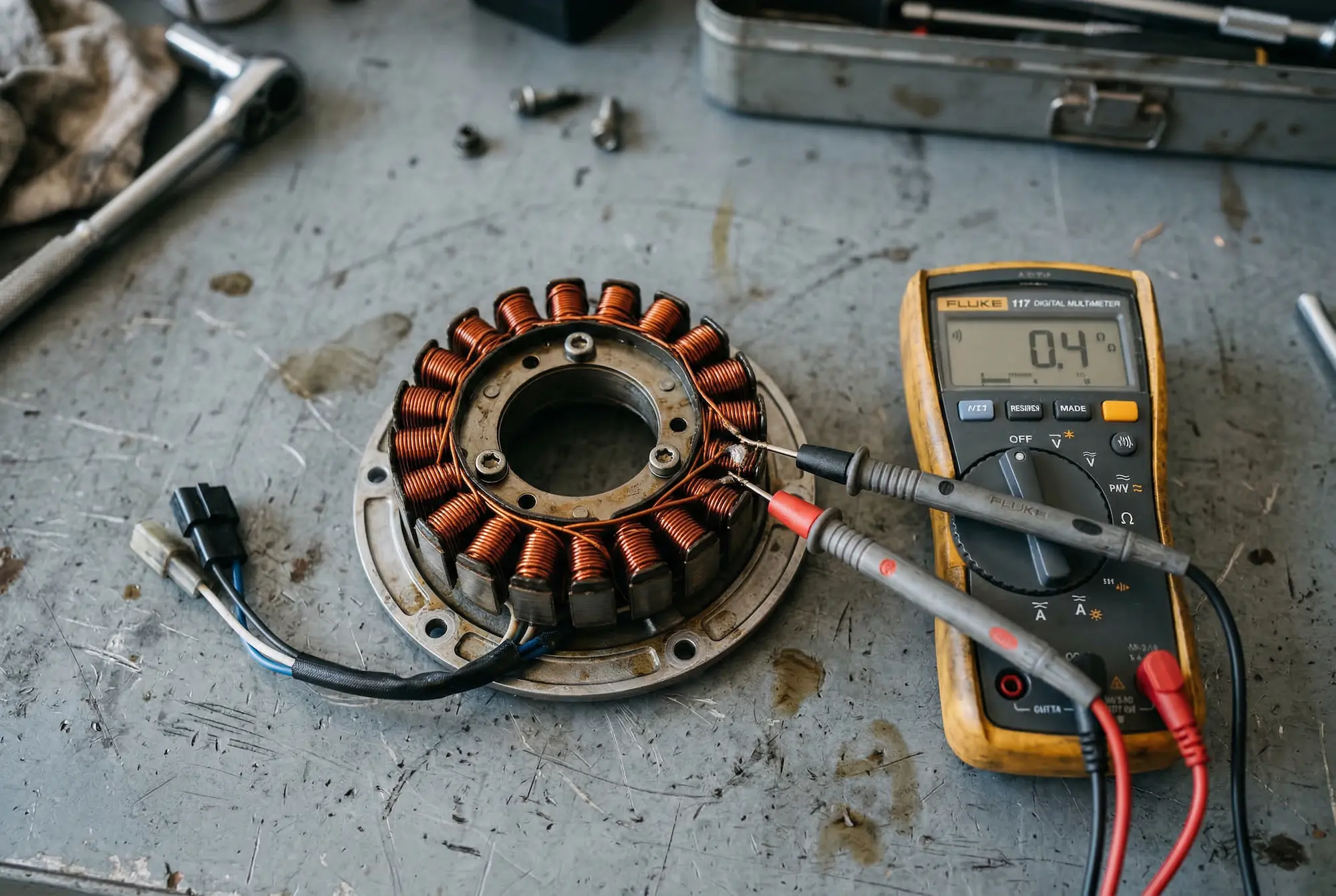
Your motorcycle’s stator is the component responsible for generating the electricity that charges your battery and powers every electrical system on the bike — lights, ignition, fuel injection, instruments, heated grips, everything. When riders say their “stator is fried,” they mean their bike has stopped generating electricity. The battery drains, the lights dim, and eventually the bike dies.
Understanding what a motorcycle stator is, how it works within the charging system, and what happens when it fails can save you from being stranded — and help you avoid a $500+ repair bill by catching problems early. This guide covers the motorcycle stator explained in practical terms: what it does, how to spot failure, how to test it, and what it costs to fix.
The 30-Second Explanation
Your motorcycle engine spins a set of magnets (the rotor) around a set of copper wire coils (the stator). This generates alternating current (AC) electricity — the same principle as a power plant, just much smaller. That AC electricity flows to a regulator/rectifier (reg/rec), which does two things: converts AC to DC (direct current, which your battery needs) and caps the voltage at approximately 14.4V so it doesn’t overcharge the battery. The charged battery then powers everything electrical on the bike.
That’s the entire motorcycle charging system in one paragraph. Magnets spin → electricity generated → converted to DC → battery charged → bike runs.
[IMAGE: Simple diagram showing the flow: Engine crankshaft → Rotor (magnets) → Stator (coils) → AC electricity → Regulator/Rectifier → DC electricity → Battery → Lights, ignition, fuel injection, etc. · alt: “motorcycle charging system diagram showing stator rotor regulator rectifier and battery”]
How the Motorcycle Charging System Works — In Detail

The Stator
The stator is a circular plate with multiple wire coils wound around iron cores (called “poles”). It’s bolted to the engine case and does not move — that’s literally what “stator” means: stationary. On most motorcycles, it’s located behind a cover on the left side of the engine, commonly called the stator cover or magneto cover.
Most modern motorcycles use a three-phase stator with three output wires because three-phase systems are more efficient and produce smoother power output. The voltage the stator produces increases with engine RPM — at idle it might output around 20V AC, while at 5,000 RPM it can produce 60–80V AC.
The Rotor (Flywheel)
The rotor is a cylindrical component with permanent magnets embedded inside it. It’s bolted to the end of the crankshaft and spins with the engine. The rotor fits around the stator like a cup over a plate. As the magnets spin past the stator coils, the changing magnetic field induces electrical current in the copper windings — this is electromagnetic induction, the fundamental principle behind all electrical generators.
Key concept: because the magnets are permanent (not electromagnets that can be turned up or down), the stator always generates the maximum power it can at any given RPM. The stator cannot increase or decrease its output based on electrical demand — its output is dictated entirely by engine speed and the fixed physical properties of the magnets and coils. This is fundamentally different from car alternators, which use electromagnetic rotors that can be varied to adjust output. Understanding this distinction is essential to understanding why motorcycle stators fail.
The Regulator/Rectifier (Reg/Rec)
The reg/rec is the middleman between the stator and the battery. It performs two critical jobs. The rectifier function converts the stator’s AC output to DC — batteries can only store direct current. The regulator function limits output voltage to approximately 14.4V. Without regulation, the stator’s output would climb with RPM and eventually fry the battery and every electrical component on the bike.
On most motorcycles, the regulator is a “shunt” type. When the battery and electrical system don’t need all the power the stator is producing, the shunt regulator diverts the excess current to ground — essentially dumping it as heat. This means the stator is always running at full output, and the regulator’s job is to bleed off whatever isn’t being used. The more accessories you run, the less the regulator has to dump — and the cooler it runs. Fewer accessories mean more excess power for the regulator to dissipate, making it run hotter.
The reg/rec is usually a finned aluminum box mounted somewhere on the frame with good airflow, because heat is its primary enemy. It connects to the stator via a 3-pin connector carrying the three AC phases.
The Battery
The battery stores the DC electricity the charging system produces. It provides the initial burst of power to crank the starter motor (the stator doesn’t generate electricity until the engine is already spinning), and it powers accessories when the engine is off or at very low RPM. A typical motorcycle battery is 12V, ranging from 8–20 Ah depending on the size and electrical demands of the bike.
Stator vs Alternator Motorcycle — What’s the Difference?
This is the number-one confusion point among riders — and the exact question that comes up constantly on forums.
Short answer: A stator is one component of an alternator system. A stator (coils) + rotor (magnets) together function as an alternator. The term “alternator” typically refers to an all-in-one unit with the stator, rotor, and reg/rec integrated into a single housing — which is standard on cars but relatively uncommon on motorcycles.
There’s a more important distinction: most motorcycles use a Permanent Magnet Alternator (PMA), where the rotor contains fixed permanent magnets. Cars use field-coil alternators, where the rotor is an electromagnet whose strength can be varied by the engine computer. This means a car’s alternator adjusts its output to match electrical demand. A motorcycle’s PMA cannot — it always generates maximum output for the given RPM. This fundamental difference is why motorcycle and car charging systems fail in completely different ways.
On most motorcycles: the stator and rotor sit inside the engine case, and the reg/rec is a separate box mounted elsewhere on the frame. Riders and mechanics call this entire setup “the stator” even though it’s technically a multi-component alternator system. When someone says “my stator went bad,” they mean the stationary coil assembly inside the engine failed.
On some motorcycles — notably certain BMW models, Honda Gold Wings, and other large touring bikes — an external, self-contained alternator similar to a car’s unit is belt-driven or gear-driven. These produce higher output for bikes with heavy electrical demands (heated seats, stereos, GPS, intercom systems) but are less common across the broader motorcycle market.
Bottom line: when your mechanic says “your stator is fried,” they’re talking about the stationary coil assembly. When they say “your alternator is bad,” it usually means the same thing unless you ride one of the few bikes with a self-contained alternator.
Bad Stator Symptoms Motorcycle Riders Should Know

This is what most riders are actually searching for. Recognizing the symptoms of a failing stator early can be the difference between riding home and calling a tow truck.
Electrical Symptoms
- Dim or flickering headlight — especially noticeable at idle or low RPM. The headlight may brighten when you rev the engine (more RPM = more stator output) and dim when you return to idle.
- Battery keeps dying — you charge it overnight, ride for a day or two, and it’s dead again. The battery itself is fine — it’s just not being recharged while riding because the stator isn’t delivering power.
- Dashboard warning lights flickering — voltage dropping below threshold triggers random warnings, especially the battery light or check engine light.
- Gauge instruments behaving erratically — speedometer or tachometer needles jumping, trip computer resetting, or displays flickering.
Performance Symptoms
- Bike dies at idle — at low RPM, the stator can’t produce enough power to keep the ignition system running and charge the battery simultaneously. The ignition draws from the battery, the battery drops too low, and the engine stalls.
- Hard starting or no-start — if the battery has been deeply discharged from days of non-charging, the starter motor won’t have enough power to crank the engine.
- Loss of power at higher RPMs — on fuel-injected bikes, the fuel pump and injectors need steady voltage. A failing stator can cause inconsistent fueling, resulting in hesitation or surging.
Physical Signs
- Burnt smell from the stator cover area — fried coil insulation produces a distinctive acrid, electrical burning smell. If you notice it near the left side of the engine, the stator is a prime suspect.
- Oil discoloration — melted stator coil insulation can contaminate the engine oil with dark particles. Check for unusual dark flecks during an oil change.
- Visible burn marks — if you remove the stator cover, melted or charred coil windings are unmistakable. Healthy coils are clean copper or uniformly coated; fried coils are blackened and melted. However, don’t judge by color alone — many functional stators look dark brown or amber from years of heat-cured epoxy varnish and hot engine oil exposure. A dark stator is not necessarily a dead stator. The multimeter tests described below are the only reliable way to confirm or rule out a stator failure.
What Causes Stator Failure?
To understand stator failure, you first need to understand how a motorcycle’s Permanent Magnet Alternator (PMA) differs from a car’s alternator. In a PMA system, the stator always generates maximum power for the given engine RPM — it cannot adjust output based on demand. The regulator/rectifier manages the difference between what the stator produces and what the bike’s electrical system needs, typically by shunting (short-circuiting) excess energy to ground as heat. This means the stator runs at full load whenever the engine is spinning, regardless of how many accessories are turned on.
Faulty regulator/rectifier — the #1 cause of stator death. Most motorcycle regulators are shunt-type devices. When a shunt regulator fails, it typically fails in a shorted (closed) state, creating a permanent dead short across the stator phases. This causes massive current to flow through the stator windings continuously, generating extreme heat that melts the coil insulation in minutes. A failed regulator doesn’t “push voltage back” — it short-circuits the stator’s output, and the resulting current surge burns the copper windings. This is why replacing only the stator without checking the reg/rec is a recipe for repeat failure: the new stator will fry the same way.
Heat damage from shunt regulation. Even when working normally, a shunt-type regulator subjects the stator to thermal cycling. At high RPM with low electrical load (for example, riding with LED lights that draw minimal power), the regulator must dump large amounts of excess energy. This continuous shunting heats the stator windings over thousands of miles, gradually degrading the coil insulation. This is normal wear, but it’s accelerated by older thyristor (SCR) type regulators that generate more switching heat than modern MOSFET designs.
Electrical overloading — but not for the reason you’d think. Adding heated grips, extra lights, phone chargers, and audio systems does NOT make the stator work harder — it always runs at 100% for the given RPM regardless. However, if the total accessory draw exceeds the stator’s maximum rated output, the battery begins to discharge while riding because the stator can’t keep up. A chronically undercharged battery stresses the regulator/rectifier, which must manage erratic current patterns, leading to premature reg/rec failure — which then kills the stator via the short-circuit mechanism described above.
Weak or old battery. A degraded battery with high internal resistance creates erratic charging conditions that stress the regulator/rectifier. The stator itself is unaffected — its output is dictated entirely by RPM — but the reg/rec working overtime to manage a failing battery will degrade faster, and when the reg/rec fails, the stator follows.
Water intrusion — water in the stator connector or inside the engine case (from riding through deep water or pressure washing) can short coil windings.
Age and mileage — coil insulation degrades naturally over decades. Bikes with 50,000+ miles may eventually need a stator replacement regardless of how well they’ve been maintained. Vintage and older bikes are especially susceptible as the original insulation materials break down with heat cycles and age.
💡 Modern upgrade: Series Regulators. If your bike has a history of stator failures, or you want to extend stator life as preventive maintenance, consider upgrading to a series-type regulator/rectifier such as the Shindengen SH847. Unlike shunt regulators that short-circuit excess energy to ground (keeping the stator at 100% load always), series regulators open the circuit when power isn’t needed — effectively “turning off” the stator’s output. Bench testing has shown stator temperatures roughly halved (100°F vs 200°F) with a series regulator compared to a shunt type under the same conditions. The SH847 is widely used as an upgrade on Ducati, Buell, Aprilia, BMW, and Japanese bikes known for eating stators. Genuine units are available from specialist suppliers — beware of counterfeit copies that are shunt regulators in SH847 casings.
How to Test a Stator (Quick Diagnostic)

Two basic tests with a multimeter can confirm or rule out a stator problem. You’ll need access to the stator connector — a 3-pin plug usually located near the left engine cover.
Static Test (Engine Off)
- Locate the stator connector (3-pin) and unplug it.
- Set your multimeter to resistance (Ω).
- Measure resistance between each pair of stator wires: pin 1↔2, pin 1↔3, pin 2↔3.
- All three readings should be similar and within the spec listed in your service manual (typically 0.1–1.0 Ω for most bikes).
- Then measure from each pin to engine ground (bare metal on the engine case). Should read infinite — open circuit, no continuity to ground. If any pin shows continuity to ground, the stator has a shorted winding and needs replacement.
Dynamic Test (Engine Running)
- With the stator connector still unplugged, start the bike (battery must be fully charged first — the stator won’t be charging during this test, so you’re running on battery alone).
- Set your multimeter to AC Volts.
- Measure AC voltage between each pair of stator wires at idle and at approximately 5,000 RPM.
- At idle: expect roughly 20V AC. At 5,000 RPM: expect 50–80V AC (check your service manual for exact specs).
- All three readings should be within 10% of each other. A significant imbalance between phases indicates a failed winding.
⚠️ If you’re not comfortable with electrical testing around a running engine, take the bike to a shop. These are straightforward tests, but safety around hot engines and spinning parts is non-negotiable.
Motorcycle Stator Replacement Cost
| Component | Part Cost | Labor Cost | Total |
|---|---|---|---|
| Stator | $80–$300 (OEM $150–$300, aftermarket $60–$150) | $100–$400 | $180–$700 |
| Regulator/rectifier | $50–$150 | $50–$100 | $100–$250 |
| Both (recommended if one fails) | $130–$450 | $150–$500 | $280–$950 |
Labor cost varies dramatically by motorcycle model. On many Japanese sportbikes and standards, the stator is accessible behind a bolt-on side cover — remove cover, unplug old stator, bolt in new one, replace gasket, refill oil. On some BMWs, Ducatis, and certain Harley-Davidsons, the job requires significant disassembly, driving up labor hours. Always get a quote before authorizing the work.
DIY or Mechanic?
If the stator is behind a bolt-on side cover (most Japanese bikes, many Harleys), it’s a moderate DIY job. Remove the cover, unplug the old stator, bolt in the new one, reconnect, replace the cover gasket, apply high-temperature RTV silicone sealant (such as Hondabond HT, ThreeBond TB1207B, or Permatex Ultra Black) around the rubber wiring grommet where the stator cables exit the cover — this is the single most common oil leak point on a stator job, and skipping it virtually guarantees hot engine oil weeping down the left side of the engine onto the rear tire, and refill the oil to the correct level. Total time: 1–2 hours. If access requires pulling the engine or splitting the cases — that’s professional shop territory.
⚠️ Magnet warning: The rotor contains powerful permanent magnets that will forcefully attract the stator cover as you position it near the engine. When reinstalling the cover, grip it firmly with both hands and control its approach — the magnets will try to slam it into place, and fingers caught between the cover and engine case can be seriously injured. When removing the cover, be prepared for strong resistance as you pull against the magnetic attraction.
A failing stator is one of the repairs that decides whether an older machine is worth keeping, so it is worth reading next to what counts as a lot of miles and what is my motorcycle worth. The charging system is also what the battery reading in the motorcycle battery voltage chart is actually telling you about.
Frequently Asked Questions
What does a motorcycle stator do?
The stator generates AC electricity as the engine runs. This electricity is converted to DC by the regulator/rectifier and used to charge the battery and power all electrical systems — lights, ignition, fuel injection, instruments, and accessories.
Is a stator the same as an alternator?
Not exactly. A stator is one component of the alternator system. The stator (coils) + rotor (magnets) together function as an alternator. On most motorcycles, these are separate internal components with an external reg/rec. On cars and some large touring bikes, the alternator is a self-contained external unit with everything in one housing. The critical difference: most motorcycle alternators use permanent magnets (PMA), meaning output is fixed for a given RPM. Car alternators use electromagnetic rotors that can vary output based on demand.
How do I know if my stator is bad?
Common bad stator symptoms on a motorcycle include a dim or flickering headlight, a battery that won’t hold a charge despite being in good condition, the bike dying at idle, and erratic instrument behavior. A burnt electrical smell from the left engine cover is a strong indicator. Confirm with a multimeter test — check resistance between stator leads and test for shorts to ground.
Can I ride with a bad stator?
Briefly. The battery will power the bike until it’s fully drained, which could be anywhere from 30 minutes to a few hours depending on the battery’s state of charge and the bike’s electrical load. Once the battery dies, the bike dies. It’s not immediately dangerous, but you risk being stranded.
How long does a motorcycle stator last?
Typically 50,000–100,000+ miles. Many stators outlast the motorcycle itself. The most common cause of premature failure is a faulty regulator/rectifier that fails in a shorted state, creating a dead short across the stator phases and melting the coil insulation. Keep your battery healthy, ensure your reg/rec has adequate airflow for cooling, and the stator should last the life of the bike. If your bike model is known for stator failures, upgrading to a series-type regulator (such as the Shindengen SH847) can significantly extend stator life by reducing its thermal load.
Wrapping Up
The stator is the heart of your motorcycle’s electrical system — it generates every watt of electricity your bike uses while riding. On most motorcycles, it’s a permanent magnet system that runs at full output whenever the engine is spinning — the regulator/rectifier manages the difference between what’s generated and what’s needed. When the stator fails, the battery drains and the bike dies. Know the symptoms (dim lights, dead battery, stalling at idle), test with a multimeter if you’re comfortable, and if you do need a replacement, swap the stator and the reg/rec together to prevent repeat failures. For bikes with chronic stator problems, upgrading to a series-type regulator is the most effective long-term solution.