
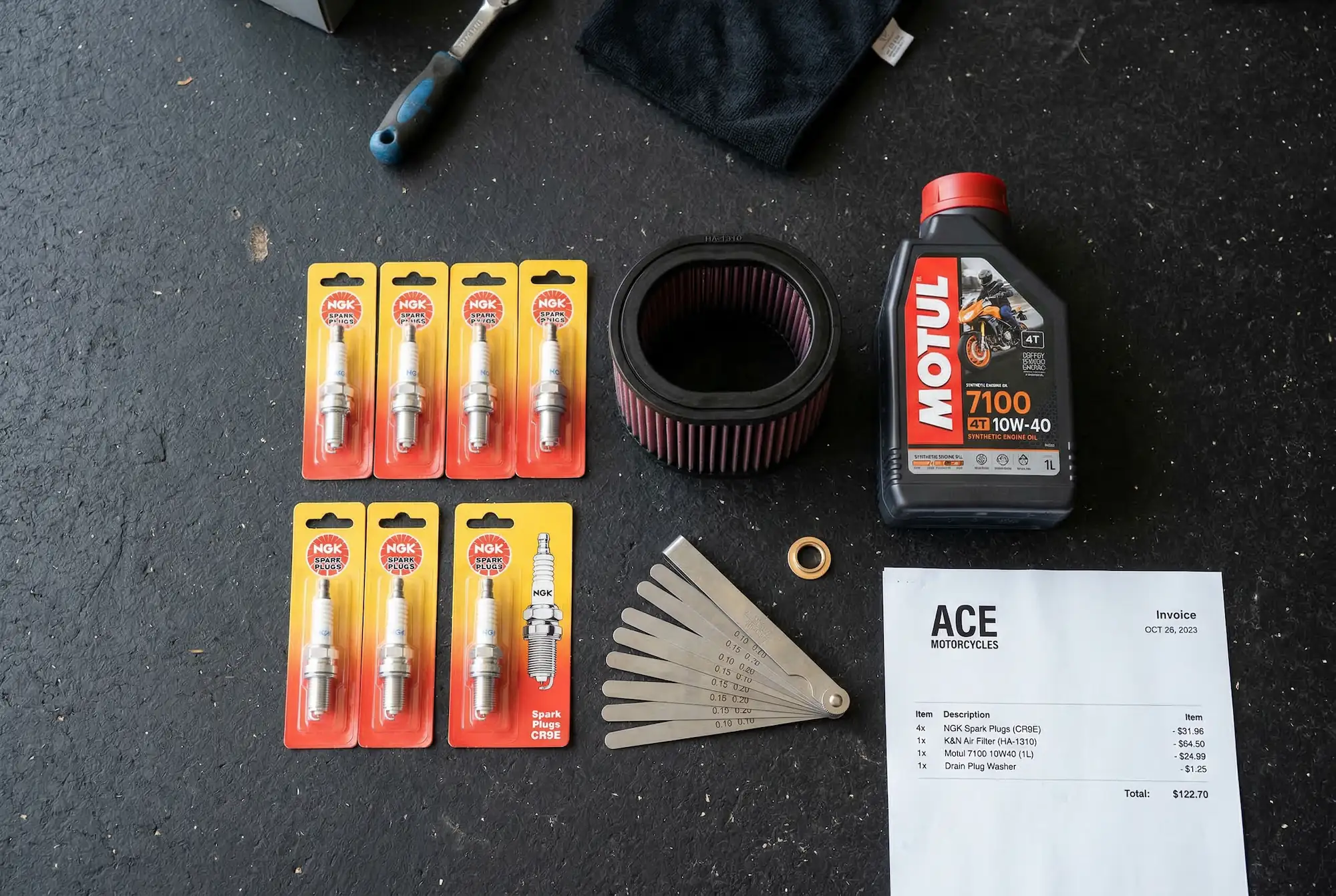
Picture this: you walk out of a dealership holding a $600 bill for a “tune-up” you genuinely thought would cost $150. Or you pay an independent shop $80 and spend the rest of the week wondering if safety corners were cut. The direct answer is that a basic motorcycle tune-up cost typically ranges from $100 to $300 at most reputable shops.
A full major service that includes a valve clearance check and all fresh consumables can easily reach $400 to $600. This range exists because the word “tune-up” has no universal definition in the powersports industry — one shop might change your oil and kick the tires, while another performs a comprehensive mechanical teardown. The type of bike you ride also matters enormously when labor hours are tallied.
This guide breaks down exactly what you are paying for: actual 2026 prices by service type, a honest comparison of dealer versus independent shop versus DIY costs, and the real story behind the valve adjustment bill that surprises riders most.
Table of Contents
- What Is Actually Included in a Motorcycle Tune-Up?
- Motorcycle Tune-Up Cost by Service Type
- Motorcycle Tune-Up Cost by Bike Type
- Dealer vs. Independent Shop vs. DIY
- The Valve Adjustment — The Cost That Surprises Riders Most
- Signs Your Motorcycle Needs a Tune-Up
- How to Avoid Overpaying
- Frequently Asked Questions
What Is Actually Included in a Motorcycle Tune-Up?
The biggest trap in the powersports industry is that “tune-up” has no universal definition. You need to know exactly what you are buying before handing over your keys.
Basic Tune-Up ($100–$200)
Your standard seasonal maintenance package. A reputable shop should include:
- Oil and oil filter change: Draining the old oil, replacing the filter, and filling with fresh motorcycle-specific oil in the manufacturer-specified viscosity and type.
- Air filter inspection and replacement: Checking the paper, foam, or cotton gauze element. Replacement cost is typically extra if a new filter is needed.
- Spark plug inspection and replacement: Pulling the plugs to read combustion condition and replacing if electrodes are worn or fouled.
- Chain inspection and lubrication: Checking tension, looking for tight spots or kinks, and applying fresh lube. Our complete motorcycle chain cleaning and lubing guide covers this process in full if you want to handle it yourself, and our chain tension adjustment guide covers the spec-setting procedure.
- Tire pressure and tread check: Verifying PSI against the owner’s manual spec and inspecting for dry rot, cracking, or wear bars.
- Visual safety inspection: Brake pad thickness, all lights, throttle and clutch cable operation, and lever feel.

Full Service / Major Tune-Up ($250–$500+)
The heavy-duty maintenance interval. Valve check intervals vary dramatically by engine design — from as early as 6,000 miles on some BMW boxer engines to 26,600 miles on the Yamaha MT-07. Always verify your specific model’s service manual for the exact interval. Full service includes everything above, plus:
- Valve clearance check and adjustment: Measuring the gap between the cam lobe and valve lifter (bucket and shim on most modern engines). This is the single biggest cost driver in any major service.
- Brake fluid flush: Bleeding out moisture-contaminated fluid and replacing with fresh fluid per your manufacturer’s specification. Important: DOT 4 is not universal — many ABS-equipped bikes (BMW, KTM, Yamaha ABS models) require DOT 4 LV (Low Viscosity). Using standard DOT 4 in a system that requires LV can damage ABS hydraulic components. Always verify your spec before authorizing this service. Our complete motorcycle brake bleeding guide explains fluid types and the full flush process.
- Coolant check and flush: On liquid-cooled bikes, draining and refilling with fresh antifreeze to restore thermal capacity and pH neutrality.
- Fuel filter replacement: Swapping the inline or in-tank fuel filter to protect injectors from debris contamination.
- Throttle body sync or carburetor sync: Using vacuum gauges to balance all cylinders to identical air draw at idle. On carbureted bikes, this often pairs with a full carb clean — our carburetor cleaning guide covers when cleaning is sufficient versus when a full rebuild is needed.
- Cable lubrication and adjustment: Injecting Teflon-based lube down clutch and throttle cables and setting correct freeplay.
- Battery load test: Checking cold cranking amps (CCA) against the battery’s rated output to confirm it will survive the season.
⚠️ Mechanic’s Tip: If your shop quotes “a tune-up” without specifying what is included, stop them immediately. Demand an itemized list of exact tasks before handing over your keys or authorizing any work.
Motorcycle Tune-Up Cost by Service Type
Here are the verified 2026 price ranges across the United States, broken down by individual task. Labor rates drive these numbers — independent shops typically charge $75–$120 per hour, while dealerships charge $100–$150 per hour due to higher overhead. A basic tune-up takes a professional mechanic 1–2 hours.
| Service | DIY Cost | Indie Shop | Dealer |
|---|---|---|---|
| Oil + filter change | $15–$35 | $50–$90 | $70–$120 |
| Spark plugs (per cylinder) | $3–$8/plug | $15–$30/plug | $20–$40/plug |
| Air filter replacement | $8–$25 | $25–$60 | $35–$80 |
| Chain clean + lube | $5–$12 | $20–$40 | $30–$60 |
| Valve adjustment | $50–$80 (parts only) | $150–$350 | $200–$500 |
| Brake fluid flush | $8–$15 | $50–$100 | $70–$130 |
| Carburetor sync | $10–$20 | $60–$120 | $80–$150 |
| Full basic tune-up | $30–$60 | $100–$200 | $150–$300 |
| Full major service | $80–$150 | $250–$500 | $350–$700 |
Motorcycle Tune-Up Cost by Bike Type
The second biggest cost driver after labor rate is the motorcycle itself. Changing spark plugs on a naked standard takes 10 minutes. The identical job on a fully-faired inline-4 sportbike takes over an hour of fairing removal before a wrench ever touches the engine.
| Bike Type | Basic Tune-Up | Full Service with Valve Check | Why the Difference |
|---|---|---|---|
| Single-cylinder commuter (Honda CB, Kawasaki Z) | $100–$180 | $200–$350 | Simple layout, easy access, 1–2 spark plugs, minimal disassembly required. |
| Parallel-twin / inline-4 sportbike (Yamaha R6, Ninja 400) | $150–$250 | $280–$500 | More plugs, tight valve access under plastic fairings, delicate bodywork removal adds significant labor time. |
| V-twin cruiser (Harley-Davidson, Indian, Kawasaki Vulcan) | $150–$280 | $300–$550 | Air-cooled engines are accessible, but heavy components and Harley’s mandatory triple-fluid primary/gearbox/engine service adds cost. |
| Adventure bike (BMW GS, KTM 1290) | $200–$350 | $400–$700 | Complex electronics, ABS systems requiring DOT 4 LV fluid, expensive OEM parts, heavy crash bars to remove for access. |
| Ducati / premium Italian | $250–$450 | $500–$1,200 | Desmodromic valve system requires highly specialized labor regardless of mileage. Premium OEM parts and European dealer overhead compound the cost. |
Always verify current prices at your local shops. Urban coastal markets consistently charge 20–40% more than rural midwestern shops for identical work, purely based on real estate and operating costs.
Dealer vs. Independent Shop vs. DIY — What Is the Real Difference?
Choosing who works on your bike affects far more than just the invoice total. It affects parts quality, warranty coverage, and the depth of knowledge applied to your specific engine.
| Factor | Dealer | Independent Shop | DIY |
|---|---|---|---|
| Labor rate | $100–$150/hr | $75–$120/hr | Your time only |
| Parts | Usually OEM at retail markup | Mix of OEM and quality aftermarket | Your choice entirely |
| Warranty on work | Typically 90 days–1 year | Varies — ask before booking | None |
| Specialized tools | Yes, including factory diagnostic computers | Usually yes | Must acquire yourself |
| Model knowledge | High — factory trained | Varies widely by mechanic | Depends entirely on your research |
| Basic tune-up total | $150–$300 | $100–$200 | $30–$60 |
The critical takeaway: independent shops are not a compromise. Many experienced indie mechanics specialize exclusively in specific brands or engine families and know them more deeply than junior dealer technicians rotating through multiple models per week. Always ask an indie mechanic how long they have worked on your specific engine family before committing to major service.
The Valve Adjustment — The Cost That Surprises Riders Most
When riders receive a massive, unexpected service bill, the valve adjustment is almost always the reason. Understanding what it involves makes the cost immediately understandable.
Valves control the airflow into and out of your combustion chamber. On most modern motorcycle engines, the system uses a bucket-and-shim design — the cam lobe presses directly down onto a metal bucket (tappet) sitting over the valve stem, with a precision shim underneath controlling the clearance gap. Over thousands of miles, the metal surfaces wear together and the clearances shift out of specification.
Too tight: The valve is held fractionally open at rest and never fully seats against the head. Hot combustion gases torch the exposed valve edge, destroying the sealing surface and requiring a full top-end rebuild. This is the failure mode that kills engines silently over time — there is often no warning symptom until compression is already gone.
Too loose: The cam strikes the bucket with excessive force rather than a controlled ramp, producing the characteristic metallic ticking at idle. Valve lift duration is also slightly reduced, affecting power delivery at high RPM and accelerating wear on the bucket faces and cam lobes.
The check itself is mechanically straightforward with feeler gauges. The cost comes entirely from access. On a fully-faired inline-4, the mechanic must remove fairings, the fuel tank, the airbox, the throttle bodies, and the valve cover just to insert the gauges. That teardown and reassembly is where the labor bill accumulates.
Real-world valve service labor costs in 2026:
- Simple parallel twin: $150–$250 in labor.
- Inline-4 engine: $200–$400 in labor.
- Ducati Desmodromic system: $400–$800 in labor. The Desmo system closes valves mechanically via a closing cam rather than return springs, requiring separate clearance measurements for both the opening and closing rockers. Never let a shop without specific Ducati Desmo experience touch this system.
⚠️ A massive green flag: If a shop quotes you for a valve adjustment, calls you an hour later, and says “All clearances were in spec — no adjustment needed,” keep that mechanic forever. It means they actually measured the clearances rather than automatically billing you for the tedious shim-swapping time that adjustment requires.

Signs Your Motorcycle Needs a Tune-Up
Your bike communicates mechanical problems before they become catastrophic failures. These are the specific symptoms that indicate overdue service.
- Hard starts or won’t idle smoothly: Classic symptom of a dirty carburetor, fouled spark plugs, or a lean air/fuel mixture. If your bike cranks extensively before catching, suspect fuel delivery or ignition first.
- Sluggish throttle response: When the bike bogs on throttle opening, suspect a clogged air filter, worn spark plugs, or a deteriorating fuel pump. The air filter is the fastest and cheapest check — our motorcycle air filter cleaning guide covers foam, paper, and cotton gauze types and when to clean versus replace.
- Excessive chain noise: Loud slapping or grinding from the chain means lubrication is depleted or the chain has stretched beyond its safe operational limit. Both conditions accelerate sprocket wear and risk chain failure.
- Spongy or soft brake lever: Brake fluid absorbs atmospheric moisture over time, lowering its boiling point and reducing hydraulic pressure. A lever that travels too far before engaging the caliper needs an immediate fluid inspection and likely a full flush.
- Engine running hot on a liquid-cooled bike: Points to coolant that has lost its thermal capacity through age and acidification, or a severely blocked air filter forcing the engine to work harder than designed.
- Noticeably increased fuel consumption: A sudden drop in tank range of 15–20+ miles indicates the engine is running rich to compensate for fouled spark plugs or restricted air intake.
- Metallic ticking at idle that fades when warm: The classic, specific sound of valve clearances that have drifted out of specification. The ticking fades as the metal expands with heat and partially closes the excess gap. Get them inspected at the next service interval.
How to Avoid Overpaying for a Motorcycle Tune-Up
- Always demand an itemized quote. Never accept “a tune-up for $300.” Get a line-by-line list of every fluid being changed, every component being inspected, and the labor rate being applied.
- Know your service interval before calling. Read your owner’s manual and know exactly what interval you are at (e.g., the 16,000-mile service). Do not let a shop upsell a valve check at 3,000 miles when your manual specifies 16,000.
- Get two quotes for any job over $200. Call one independent shop and one local dealership. Use both quotes as leverage and as a sanity check on labor estimates.
- DIY the consumables, pay for the skilled work. Do your own oil changes, air filter swaps, chain cleaning and lubrication, and chain tension adjustments. Pay a professional shop to handle valve adjustments, brake fluid flushes, and throttle body synchronization.
- Skip the dealer for basic maintenance on Japanese bikes. A standard oil and plug change on a common Honda, Yamaha, Kawasaki, or Suzuki commuter does not benefit from a dealer’s 30–40% labor premium over a competent indie shop.
- Ask indie shops about bringing your own parts. Some independent shops allow customers to supply their own oil and OEM filters, saving the shop’s standard 20–40% parts markup. Ask politely before showing up with parts in hand.
The air filter is the easiest place to start cutting costs — it is a task most riders can handle in 15 minutes at home. Our complete motorcycle air filter cleaning guide covers every filter type so you can do it correctly the first time instead of paying a shop $40–$60 for a five-minute job.
Frequently Asked Questions
How much does a motorcycle tune-up cost at a dealer?
At a dealership, expect $150–$300 for a basic tune-up covering oil, spark plugs, air filter, and a visual safety inspection. A full service with valve adjustment runs $350–$700 or more depending on bike complexity. Dealers charge $100–$150 per hour and use OEM parts at retail markup. Factory-trained technicians make this worth it for complex European bikes, but the premium is rarely justified for standard Japanese commuters.
How often should I get a motorcycle tune-up?
A basic service (oil, plugs, air filter) should happen every 3,000–6,000 miles for most bikes, or annually if you ride less. Full major service intervals vary dramatically by engine: BMW R-series boxer engines require valve checks every 6,000 miles, while the Yamaha MT-07 specifies 26,600 miles. High-performance 4-cylinder sportbikes (Honda CBR600RR, Yamaha R6) require valve inspection as early as every 8,000 miles. Always check your specific owner’s manual — never rely on a generic interval. Brand-new bikes also require a very early first service (600–1,000 miles) to flush metallic break-in particles, which dealers typically charge $200–$500 to complete.
Can I do a motorcycle tune-up myself?
Yes — and the easy tasks are well within reach of most riders with a basic socket set. Oil changes, air filter swaps, spark plug replacement, chain cleaning and lubing, and chain tension adjustment all cost $30–$60 in parts versus $100–$200 at a shop. Valve adjustments require feeler gauges, torque wrenches, and solid mechanical confidence. If you are new to wrenching, have a shop perform the valve check the first time and observe — then consider handling it yourself on future intervals.
Why is a motorcycle tune-up at a Ducati dealer so expensive?
Ducati’s Desmodromic valve system closes valves mechanically via a dedicated closing cam and rocker rather than conventional return springs. This means both the opening and closing rocker clearances must be measured and set independently — a process that typically takes 4–6 hours of skilled labor versus 1–2 hours on a standard shim-and-bucket engine. Combined with premium OEM parts pricing and European dealer overhead, a full Ducati major service routinely costs $500–$1,200. Many Ducati owners seek trusted independent Italian motorcycle specialists to reduce this cost without sacrificing quality.
What is the difference between a tune-up and a full service?
A basic tune-up covers consumable items only: oil and filter, spark plugs, air filter inspection, and a chain check. This typically costs $100–$200 at a shop. A full major service adds a valve clearance check and adjustment, brake fluid flush (using the correct fluid type for your specific ABS or non-ABS system), coolant inspection and flush, throttle body or carb synchronization, cable lubrication, and a comprehensive safety inspection. Full service typically runs $300–$600. Many shops use both terms interchangeably — always request an itemized breakdown before authorizing any work.
The typical motorcycle tune-up cost runs $100–$300 for a basic seasonal service, and $300–$600 for a full major service that includes a valve check. Your two biggest cost variables are the shop’s hourly labor rate and the mechanical complexity of your specific bike. Cut your maintenance overhead by handling consumables yourself — oil, chain, air filter — and paying professionals for the high-stakes valve and brake work that requires specialized tools and experience. Always read the owner’s manual before booking a service; knowing your exact interval is the single most effective way to avoid being sold work your bike does not yet need.
Suspecting an electrical issue before your next service? Our guide on what a motorcycle stator does explains how to identify charging system problems and rule out a failing stator or regulator before paying a shop to diagnose it.
Ready to handle chain maintenance yourself between services? Our complete motorcycle chain cleaning and lubing guide and chain tension adjustment guide cover both tasks in full detail.
{ “@context”: “https://schema.org”, “@graph”: [ { “@type”: “Article”, “@id”: “https://gearriderhub.com/motorcycle-tune-up-cost/#article”, “headline”: “How Much Does a Motorcycle Tune-Up Cost? (2026 Price Guide)”, “description”: “How much does a motorcycle tune-up cost in 2026? Basic service runs 00-00, full service with valve adjustment 00-00. Complete price breakdown by service type, bike type, dealer vs. indie shop vs. DIY.”, “datePublished”: “2025-11-01”, “dateModified”: “2026-03-01”, “author”: { “@type”: “Organization”, “name”: “GearRiderHub”, “url”: “https://gearriderhub.com” }, “publisher”: { “@type”: “Organization”, “name”: “GearRiderHub”, “url”: “https://gearriderhub.com” }, “mainEntityOfPage”: { “@type”: “WebPage”, “@id”: “https://gearriderhub.com/motorcycle-tune-up-cost/” } }, { “@type”: “FAQPage”, “@id”: “https://gearriderhub.com/motorcycle-tune-up-cost/#faq”, “mainEntity”: [ { “@type”: “Question”, “name”: “How much does a motorcycle tune-up cost at a dealer?”, “acceptedAnswer”: { “@type”: “Answer”, “text”: “At a dealership, expect 50-00 for a basic tune-up covering oil, spark plugs, air filter, and a visual safety inspection. A full service with valve adjustment runs 50-00 or more depending on bike complexity. Dealers charge 00-50 per hour and use OEM parts at retail markup. Factory-trained technicians make this worth it for complex European bikes, but the premium is rarely justified for standard Japanese commuters.” } }, { “@type”: “Question”, “name”: “How often should I get a motorcycle tune-up?”, “acceptedAnswer”: { “@type”: “Answer”, “text”: “A basic service covering oil, plugs, and air filter should happen every 3,000-6,000 miles for most bikes, or annually if you ride less. Full major service valve check intervals vary dramatically by engine design: BMW R-series boxer engines require valve checks every 6,000 miles, the Yamaha MT-07 specifies 26,600 miles, and high-performance 4-cylinder sportbikes like the Honda CBR600RR require inspection every 8,000 miles. Always verify your specific owner manual – never rely on a generic interval. Brand-new bikes require an early first service at 600-1,000 miles to flush metallic break-in particles, which dealers typically charge 00-00 to complete.” } }, { “@type”: “Question”, “name”: “Can I do a motorcycle tune-up myself?”, “acceptedAnswer”: { “@type”: “Answer”, “text”: “Yes – and the easy tasks are well within reach of most riders with a basic socket set. Oil changes, air filter swaps, spark plug replacement, chain cleaning and lubing, and chain tension adjustment all cost 0-0 in parts versus 00-00 at a shop. Valve adjustments require feeler gauges, torque wrenches, and solid mechanical confidence. If you are new to wrenching, have a shop perform the valve check the first time and observe, then consider handling it yourself on future intervals.” } }, { “@type”: “Question”, “name”: “Why is a motorcycle tune-up at a Ducati dealer so expensive?”, “acceptedAnswer”: { “@type”: “Answer”, “text”: “Ducati’s Desmodromic valve system closes valves mechanically via a dedicated closing cam and rocker rather than conventional return springs. Both the opening and closing rocker clearances must be measured and set independently – a process that takes 4-6 hours of skilled labor versus 1-2 hours on a standard shim-and-bucket engine. Combined with premium OEM parts pricing and European dealer overhead, a full Ducati major service routinely costs 00-,200.” } }, { “@type”: “Question”, “name”: “What is the difference between a tune-up and a full service?”, “acceptedAnswer”: { “@type”: “Answer”, “text”: “A basic tune-up covers consumable items only: oil and filter, spark plugs, air filter inspection, and a chain check. This typically costs 00-00 at a shop. A full major service adds a valve clearance check and adjustment, brake fluid flush using the correct fluid type for your ABS or non-ABS system, coolant inspection and flush, throttle body or carburetor synchronization, cable lubrication, and a comprehensive safety inspection. Full service typically runs 00-00. Always request an itemized breakdown before authorizing any work.” } } ] }, { “@type”: “ItemList”, “@id”: “https://gearriderhub.com/motorcycle-tune-up-cost/#symptoms-list”, “name”: “Signs Your Motorcycle Needs a Tune-Up”, “description”: “Specific mechanical symptoms that indicate your motorcycle is overdue for a tune-up or full service.”, “itemListElement”: [ { “@type”: “ListItem”, “position”: 1, “name”: “Hard starts or won’t idle smoothly”, “description”: “Classic symptom of a dirty carburetor, fouled spark plugs, or a lean air/fuel mixture preventing the engine from catching and idling consistently.” }, { “@type”: “ListItem”, “position”: 2, “name”: “Sluggish throttle response”, “description”: “A clogged air filter, worn spark plugs, or deteriorating fuel pump causing the engine to bog down before accelerating when the throttle is opened.” }, { “@type”: “ListItem”, “position”: 3, “name”: “Excessive chain noise”, “description”: “Loud chain slapping or grinding indicates lubrication is fully depleted or the chain has stretched beyond its safe operational limit, accelerating sprocket wear.” }, { “@type”: “ListItem”, “position”: 4, “name”: “Spongy or soft brake lever”, “description”: “Brake fluid has absorbed atmospheric moisture, lowering its boiling point and reducing hydraulic pressure. A lever that travels too far before engaging requires immediate fluid inspection and likely a full flush.” }, { “@type”: “ListItem”, “position”: 5, “name”: “Engine running hot on a liquid-cooled bike”, “description”: “Coolant has lost thermal capacity through age and acidification, or a severely blocked air filter is forcing the engine to work harder than designed.” }, { “@type”: “ListItem”, “position”: 6, “name”: “Noticeably increased fuel consumption”, “description”: “A sudden drop in tank range of 15-20+ miles indicates the engine is running rich to compensate for fouled spark plugs or a restricted air intake.” }, { “@type”: “ListItem”, “position”: 7, “name”: “Metallic ticking at idle that fades when warm”, “description”: “The classic, specific sound of valve clearances that have drifted out of specification. The ticking fades as metal expands with heat and partially closes the excess gap. Schedule a valve inspection at the next service interval.” } ] }, { “@type”: “ItemList”, “@id”: “https://gearriderhub.com/motorcycle-tune-up-cost/#cost-by-type-list”, “name”: “Motorcycle Tune-Up Cost by Bike Type (2026)”, “description”: “Average basic tune-up and full major service costs broken down by motorcycle category across the United States in 2026.”, “itemListElement”: [ { “@type”: “ListItem”, “position”: 1, “name”: “Single-cylinder commuter (Honda CB, Kawasaki Z)”, “description”: “Basic tune-up: 00-80. Full service with valve check: 00-50. Simple engine layout with easy access and minimal disassembly required.” }, { “@type”: “ListItem”, “position”: 2, “name”: “Parallel-twin and inline-4 sportbike (Yamaha R6, Ninja 400)”, “description”: “Basic tune-up: 50-50. Full service with valve check: 80-00. More spark plugs, tight valve access, and significant fairing removal adds labor time.” }, { “@type”: “ListItem”, “position”: 3, “name”: “V-twin cruiser (Harley-Davidson, Indian, Kawasaki Vulcan)”, “description”: “Basic tune-up: 50-80. Full service with valve check: 00-50. Air-cooled engines are accessible but Harley mandatory triple-fluid primary, gearbox, and engine service adds cost.” }, { “@type”: “ListItem”, “position”: 4, “name”: “Adventure bike (BMW GS, KTM 1290)”, “description”: “Basic tune-up: 00-50. Full service with valve check: 00-00. Complex electronics, ABS systems requiring DOT 4 LV fluid, expensive OEM parts, and crash bar removal required.” }, { “@type”: “ListItem”, “position”: 5, “name”: “Ducati and premium Italian bikes”, “description”: “Basic tune-up: 50-50. Full service with Desmodromic valve check: 00-,200. Desmo system requires measuring both opening and closing rocker clearances independently, adding 4-6 hours of specialized labor.” } ] } ] }Servicing is a recurring cost, not a one-off. It is one of several ongoing expenses covered in our guide to the real cost of owning a motorcycle.
Two jobs that fall outside a standard tune-up and catch owners out on cost: fork seal replacement and diagnosing a weak battery with our voltage chart.